Shrikant Rao
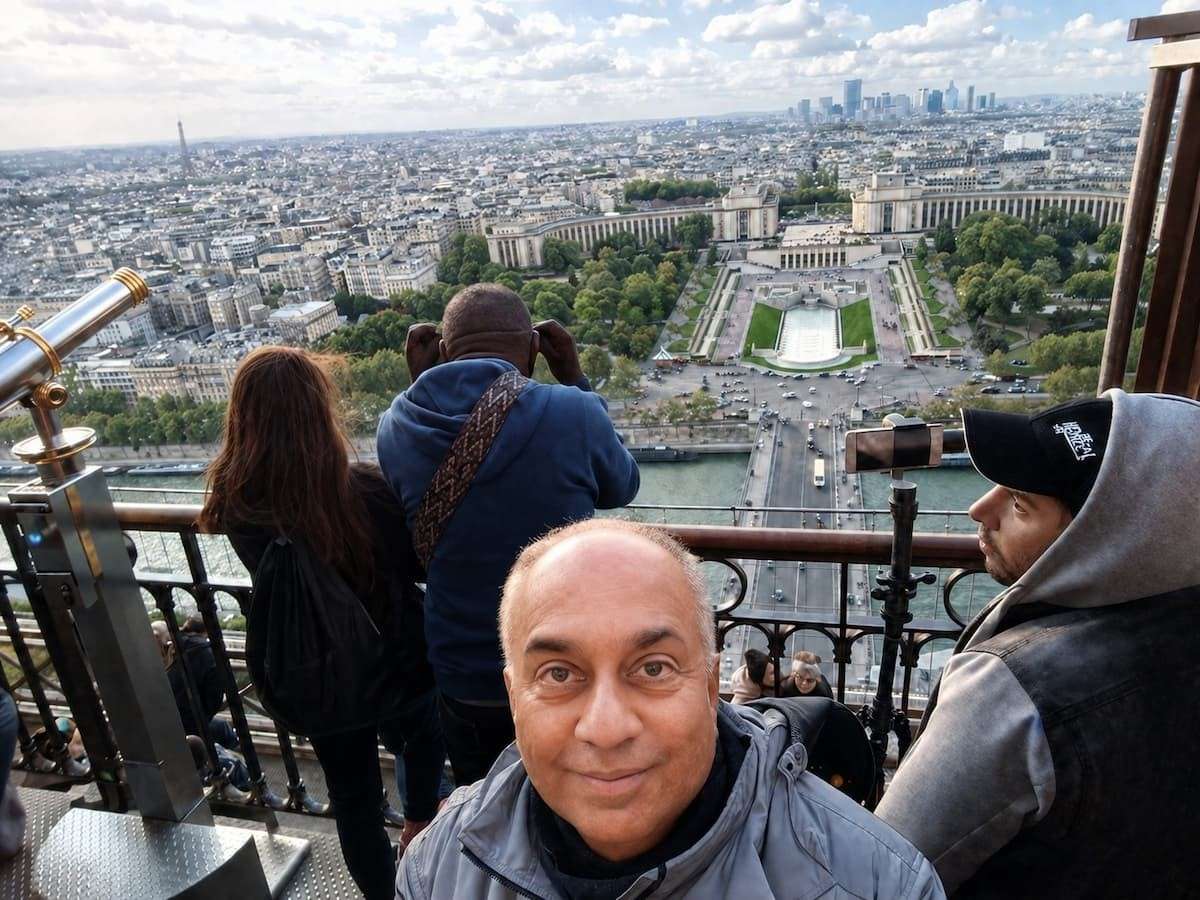
A few months ago, in April, standing on the observation deck of the Eiffel Tower for the ninth time in my journalistic career, looking out over the grey slate roofs of Paris and the rise of Montmartre in the distance, I felt a familiar tug of history.
But this time, the emotion wasn’t the usual colonial hangover of admiration. It was something sharper, more mischievous.
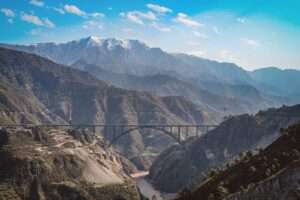
My mind drifted from Gustave Eiffel’s iron lattice to a remote gorge in Jammu & Kashmir, where the Chenab Rail Bridge now rises 359 metres above the riverbed — 35 metres higher than the Eiffel Tower. For the first time in my years as a journalist, the view from Paris’s most famous man-made landmark did not make an Indian traveller feel small.
It made me feel like I was finally looking across, not up.
At 68 now, more than four decades as a journalist have given me a ringside seat to the rewriting of the global order, beginning at one of modern history’s great hinge points — from the euphoric reunification of Germany and the fall of the Berlin Wall to the sudden, staggering collapse of the Soviet Union.
Since then, as a global traveller covering those tectonic shifts, passing through the historic metro networks of London, Paris, Berlin, Munich, Stockholm or Madrid was an exercise in deep civilisational humility. One treated Western infrastructure as a glimpse into a science-fiction future that our own homeland, locked in the slow gears of post-Independence recovery, could never quite replicate. We were the perpetual tourists of modernity.
That era is changing.
Today, as India celebrates its 80th Independence Day in 2026, walking through the ageing, damp platforms of the London Underground or navigating the weary corridors of the Paris Métro doesn’t automatically evoke envy. There is something else now — a quieter, almost rude realisation that the infrastructure back home has changed beyond recognition, and that India is increasingly building its own future rather than waiting for someone else to define it.
Accidental Sovereignty
The realisation of how deeply our roots are entangled with global history struck me with absolute force on a chilly afternoon in early 1994. I was in Paris, walking through the quiet stone pathways of Père-Lachaise Cemetery in the 20th arrondissement. I was originally hunting for famous graves — Oscar Wilde, Chopin and the other celebrated names that draw visitors into that vast city of the dead. Then I stopped in Division 89.
There, etched onto a simple grey marble vault, was a name that felt like a piece of Indian sovereign territory hidden inside France: J.R.D. Tata.
The great man had passed away in Geneva on November 29, 1993, and was interred at Père-Lachaise a few days later. Standing before that vault, a massive surge of emotion and national pride rushed through me. My mind immediately flashed back to a brief personal encounter I had with the man during his lifetime.
The Tatas did not merely build factories; they helped build an Indian industrial civilisation.
J.R.D. Tata championed progressive labour practices, employee welfare and institution-building long before many such ideas became standard corporate practice.
As India’s first licensed commercial pilot, he also gave the nation its wings.
Finding this industrial titan tucked away in a Parisian cemetery became a personal anchor for the decades of reporting that followed.
Industrial Crossings
The blueprint for much of India’s transformation was forged during those turbulent, anxious years, a period I had the privilege of chronicling firsthand.
In August 1992, just a year before I found J.R.D.’s vault, the Nagarjuna Fertilizers and Chemicals complex was commissioned at Kakinada. India was emerging from a devastating foreign-exchange crisis, having begun dismantling the restrictive License Raj even as the collapse of the Soviet Union threatened one of the country’s important trading relationships.
The massive, gas-based ammonia-urea plant was an extraordinary feat of heavy engineering for its time. More than a fertiliser project, it belonged to an India trying to strengthen its own industrial capabilities and reduce vulnerability to external supply shocks.
Yet the real genius of India’s journey lies in its contradictions. To understand the soul of this transformation, one had to travel from the heavy industrial world of Kakinada to the cooperative dairy networks of Anand, Gujarat.
Interviewing Dr Verghese Kurien — the legendary ‘Milkman of India’ — in 1994 revealed another side of the fiercely competitive Indian spirit. Even as the doors were opening to global corporate conglomerates, Kurien was turning millions of small rural farmers into a democratic economic powerhouse through Amul. His argument was compelling: Indian progress did not have to mean mimicking Western capitalism. It could also mean giving millions of small producers the scale and bargaining power that they had never possessed individually.
Space Shields
My journey across that transformative decade also took me to Bengaluru, where I interviewed ISRO Chairman U.R. Rao.
In the mid-1990s, the successes of the Polar Satellite Launch Vehicle and INSAT programme were beginning to establish themselves as tangible realities. Rao, one of the central figures in India’s space programme, was navigating immense geopolitical constraints at a time when access to advanced technologies was tightly controlled.
When Western sanctions and technology restrictions complicated India’s access to cryogenic technology, the response was not to abandon the ambition. India pursued indigenous capability, slowly building the technological base that would eventually allow the country to launch increasingly sophisticated missions on its own terms.
But the most intimate anchor of this national awakening occurred during a visit to a modest coastal home in Rameswaram.
There, in the early 1990s, I sat with Dr A.P.J. Abdul Kalam. Before he became the People’s President, he was one of India’s most prominent defence scientists, closely associated with the country’s indigenous missile programmes.
Yet when I met him in his simple ancestral house, the layers of military secrecy seemed to disappear. He was sitting quietly, absorbed in the intricate grace of playing Samaja Varagamana on the veena. The Carnatic composition by Saint Tyagaraja, set in Raga Hindolam, evokes the majestic gait of the divine elephant.
There was a sublime irony in watching a scientist associated with India’s missile ambitions spend his private hours immersed in a song of graceful, almost meditative movement.
Industrial Maps
This baseline of self-reliance eventually spilled over from state laboratories into heavy commercial manufacturing. In 2013, I was among a select group of global journalists invited to the legendary JCB headquarters at Rocester in the British Midlands. We had gathered around a genuine industrial milestone: the production of JCB’s millionth machine, a 22-tonne JS220 tracked excavator.
It was a triumph of Western industrial engineering.
Yet, as a Construction Equipment sector specialist, the real epiphany came when I looked back at India.
Over the subsequent decade, I watched a complete redrawing of India’s industrial map.
JCB’s Indian operations grew into a major manufacturing and export base, with machines produced in India reaching markets across the world. What had once been viewed primarily as a domestic market was increasingly becoming a platform from which global companies could manufacture for global customers.
And JCB was hardly alone.
Companies such as Caterpillar, Volvo Construction Equipment, Schwing Stetter, CNH, Ammann, Liebherr, Wirtgen, Hyundai Construction Equipment, Komatsu, Kobelco, XCMG, Putzmeister, Sany, LiuGong, Scania and Herrenknecht have expanded manufacturing, technology, sourcing or project capabilities in India, helping turn the country into an increasingly important node in global industrial supply chains.
But the more consequential story may be what happened simultaneously on the Indian side. Companies such as L&T, Mahindra & Mahindra, the Tata Group, BEML and ACE — alongside specialised engineering companies such as Bharat Forge, Escorts Kubota, Bull Machines and TIL — have steadily moved beyond the limitations of a protected domestic market. They have increased engineering complexity, developed products for demanding applications and, in different ways, begun competing for space in the global manufacturing order.
The psychological shift is as important as the industrial one. India is no longer merely asking multinational companies to manufacture here. Increasingly, it is asking whether Indian companies can design, engineer, manufacture and export products that the world wants to buy.
New Growth Centres
India’s industrial transformation has not been confined to steel, concrete and machines.
Some of its most consequential infrastructure cannot be seen from a highway or a railway window.
The software revolution changed the geography of Indian ambition. Bengaluru, Hyderabad, Pune, Chennai, Gurugram and Noida became laboratories of a new India, exporting code, digital services and intellectual capital to the world. What began as an outsourcing story gradually evolved into something much larger, with India becoming an indispensable technology partner to global business.
Then came the Global Capability Centre revolution. Multinationals that once came to India primarily for lower-cost technology services began moving entire functions here — engineering, finance, analytics, cybersecurity, product development, research and increasingly strategic decision-making. India was no longer merely the world’s back office. It was becoming one of the world’s principal centres for global corporate capability.
Automation added another layer to that transformation. Robotics, industrial software, sensors, digital twins and connected machines are changing the factory floor, even as software increasingly becomes part of the product itself.
And now artificial intelligence is opening another frontier. India’s technology talent pool, digital public infrastructure, entrepreneurial ecosystem and enormous domestic market give it a rare combination of scale and experimentation. The question is no longer whether India can participate in the AI economy. It is whether it can build enough of the technology, platforms and applications to shape it.
India’s new growth centres are therefore no longer defined only by what can be physically manufactured. They are also defined by what can be designed, coded, automated, analysed and imagined. The geography of Indian growth has expanded well beyond the factory gate.
Transit Metamorphosis
This surge in manufacturing power has been accompanied by a sweeping transformation of the physical landscape.
Travel across India’s expanding highway network and the sheer speed and scale of execution can be startling. From the Delhi-Mumbai Expressway to economic corridors and major urban connectors, roads are no longer simply stretches of asphalt linking one settlement to another. They are becoming high-capacity arteries designed to compress distance, reduce logistics time and knit together markets that once functioned in relative isolation.
The transformation is equally visible in the cities. Metro systems in Delhi, Mumbai, Bengaluru, Kolkata and a growing number of other urban centres have changed the daily experience of public transport. Air-conditioned coaches, modern stations, digital ticketing and increasingly integrated networks have brought a different standard of urban mobility to millions.
That does not make every foreign system obsolete, nor should it. London, Paris, Berlin, Munich and Madrid possess transit networks with histories stretching back generations.
But age has its own price. Maintenance backlogs, capacity constraints and ageing infrastructure can make parts of even the world’s most celebrated systems feel surprisingly ordinary beside newer Indian networks.
Even surface transport is changing, with electric buses beginning to replace older, more polluting fleets in cities across the country.
The remarkable thing is not that India has suddenly surpassed every Western system. It is that comparison no longer feels absurd.
High Horizons
On the rails, India is moving into another phase.
The Mumbai-Ahmedabad High Speed Rail corridor is taking the country towards its first high-speed rail service, while the present has already been transformed by the indigenously designed and manufactured Vande Bharat trains and the expanding network of Amrit Bharat train services.
These trains have altered expectations around ordinary long-distance rail travel for millions, demonstrating that India can design, engineer and manufacture increasingly sophisticated rolling stock within the country. But the ambition does not stop where the tracks end.
India is also rediscovering its waterways through the revival of inland navigation and national waterways. The Ganga National Waterway and the development of modern cargo, roll-on/roll-off and passenger services are gradually turning traditional river routes into contemporary transport corridors. It is an old idea being given new machinery.

National Confidence
All of this infrastructure does something that is rarely captured in project reports or government statistics. It creates something less tangible but increasingly visible: national confidence.
Consider Mumbai’s sweeping transport infrastructure. The Bandra-Worli Sea Link is not simply a piece of transport infrastructure; it is a visible demonstration of India’s ability to engineer across difficult terrain and water.
More importantly, the idea has history behind it. A Maharashtra government steering group chaired by J.R.D. Tata in 1981 recommended the Sewri-Nhava Sheva connection, an early attempt to address Mumbai’s crippling congestion and improve connectivity with the mainland. The connection between that earlier vision and today’s Mumbai Trans Harbour Link is a reminder that infrastructure often has a longer memory than politics.
That connection between the pioneers of an earlier India and the infrastructure of today’s India is worth pausing over.
When a country successfully lands a spacecraft near the Moon’s south polar region while simultaneously executing transport and infrastructure projects once regarded as beyond its capabilities, something changes in the collective psyche.
The old, resigned “Chalta Hai” mindset begins to sound less convincing. Exceptional quality is no longer automatically viewed as a foreign luxury. Increasingly, it is demanded as a domestic standard.
You feel it the moment you land at India’s newer airports. Bengaluru’s Terminal 2, for instance, has turned the airport experience into something closer to an architectural statement, combining extensive use of natural materials and greenery with digital-first passenger systems.
The point is not that every Indian airport, metro or highway is world-class. It is that Indians increasingly expect them to be.
Unfinished Business
However, a chronicler’s eye must remain brutally honest.
The provocative truth of India at 80 is that its hyper-modern infrastructure still coexists with deep and painful contradictions. Our digital public infrastructure can allow a street vendor in a remote village to accept an instant mobile payment, even as physical connectivity, public transport, healthcare and basic urban services remain inadequate across large parts of the country.
Magnificent airports, soaring sea links and expanding metro corridors are changing the face of India. But they do not yet touch every Indian equally.
That is where the next chapter becomes more difficult — and far more important.
As we look towards India at 100, the defining mission of the next twenty years cannot simply be the creation of more urban marvels. The challenge is to take the engineering confidence generated by those marvels and push it outward, into the districts, villages and communities that remain outside the main arc of India’s infrastructure revolution.
The true victory of Indian engineering will not ultimately be measured by how high our bridges rise or how fast our rockets travel into deep space.
It will be measured by how effectively those achievements become lifelines for the citizen who has never stood beneath a metro viaduct, crossed a sea link or walked through a gleaming new airport.
The ultimate task is to bridge the distance between India’s technological summits and its rural valleys.
Only then will the civilisational blueprint that began taking shape in the uncertain India of the 1990s be fully realised — and the country that once looked at the world’s infrastructure with awe finally become a country the world looks at with something closer to respect.
The author is a Mumbai-based Editor, Industrial Analyst, and Chronicler of India’s industrial growth story with over four decades of experience covering construction, infrastructure, manufacturing, mining, mobility, and equipment sectors. He is the Founder of Sri ViKaS Global, a strategic media and industrial intelligence initiative focused on manufacturing, infrastructure and cross-border industrial collaboration. Connect with him on his LinkedIn profile – https://www.linkedin.com/in/shrikant-rao-875b344/ or write to: shrikant.rao.professional@gmail.com