



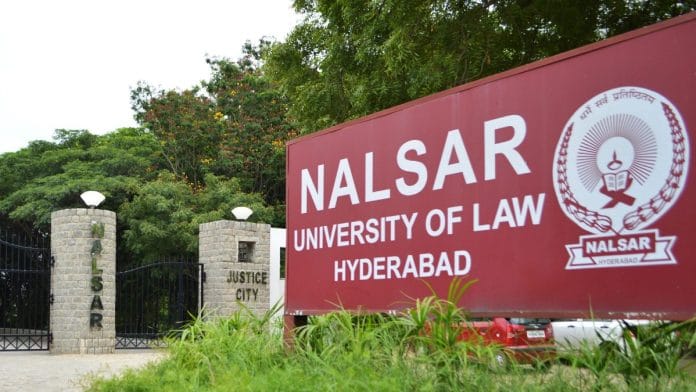
The reported refusal by students of Hyderabad’s NALSAR University of Law to have the Chief Justice of India as chief guest at their convocation is more than a campus controversy. It forces a disturbing question: has freedom of speech and expression, guaranteed by the Constitution, begun crossing the line from legitimate dissent into institutional defiance?
Let there be no ambiguity: students have every right to disagree, protest and express their displeasure. That is democracy. But democracy does not mean that every disagreement must become a confrontation, nor does freedom of expression confer a licence to insult, intimidate or delegitimise constitutional institutions. The distinction between dissent and disruption must not be allowed to disappear.
The response from the Bar Council of India, threatening to prevent NALSAR graduates from enrolment as advocates, was equally disproportionate and ill-advised. A professional regulator cannot respond to a campus disagreement with what effectively amounts to collective punishment. Fortunately, the Chief Justice himself appears to have shown the maturity that the controversy desperately needed, making it clear that the matter concerns him and the students and that nobody else has business entering it. The BCI should therefore withdraw its circular without delay.
The students’ opposition reportedly stems from remarks attributed to the Chief Justice during judicial proceedings concerning unemployed youth. Whether those remarks were appropriate is certainly debatable. Judges, particularly those occupying the highest constitutional offices, must understand that even an off-the-cuff observation can carry enormous consequences. Judicial authority is strengthened by restraint, not by rhetorical flourish.
But the larger issue is what this episode tells us about the culture being cultivated in some sections of student politics. If students of a premier law university believe that protest should extend to rejecting the presence of the Chief Justice at their own convocation, one is entitled to ask what conception of constitutionalism they will carry into the legal profession.
This is not an argument against protest. It is an argument for responsible protest.
Unfortunately, the problem is wider than NALSAR. Parliament has repeatedly been reduced to sloganeering and disruption. Constitutional authorities are routinely subjected to personal attacks. The Prime Minister, Home Minister, Election Commission and judiciary themselves are not spared. Political leaders sometimes appear to believe that the louder and more abusive the language, the stronger the argument.
That is precisely where the judiciary must also introspect.
If judges make controversial observations and political leaders respond with provocative rhetoric, each side risks lowering the institutional bar. The Constitution protects speech, but it also operates within a framework of law, dignity and public order. Freedom of expression cannot become a constitutional alibi for deliberate humiliation of institutions or individuals.
The Supreme Court and High Courts should therefore lead by example. Judicial restraint must apply not merely to judgments but also to oral observations. At the same time, the law must be applied consistently when speech crosses into genuine incitement, threats, contempt or deliberate attempts to undermine constitutional institutions. Selective outrage will only deepen public distrust.
Political discourse needs the same correction. Rahul Gandhi and other Opposition leaders have every democratic right to challenge Prime Minister Narendra Modi and the NDA government. They have every right to demand accountability and seek electoral power. But electoral frustration cannot become a licence to ridicule Parliament, vilify constitutional institutions or repeatedly portray Bharat in disparaging terms on foreign soil. In a democracy, governments are changed by voters—not by street theatre, manufactured outrage or foreign audiences.
The same principle applies to the ruling establishment. The restraint displayed by Prime Minister Modi and Home Minister Amit Shah should not be mistaken for weakness. Constitutional governance requires tolerating criticism, including harsh criticism, while ensuring that institutions continue to function. Ultimately, it is the electorate that decides who governs.
As Bharat prepares to celebrate 80 years of Independence, this is the moment for every pillar of democracy to examine itself. Students must learn that dissent has responsibilities. Politicians must remember that criticism has limits. Judges must understand that words from the Bench carry extraordinary weight. Regulators must avoid disproportionate reactions.
Freedom of speech is one of democracy’s greatest safeguards. But if everyone claims freedom without accepting responsibility, freedom itself becomes the casualty.
The message from the NALSAR controversy should therefore be loud and unmistakable: protest, yes; dissent, certainly; disagreement, absolutely—but constitutional democracy cannot survive if freedom is repeatedly mistaken for a free-for-all.


Very well balanced. The Bar Council of India could have used to first convince these graduates instead of straight away disqualifying them to practise and equally disturbing is doing a somersault within 24 hours. This speaks of severe lack of professionalism on how to manage a crisis.