As Bharat prepares to celebrate its 80th Independence Day, I find myself looking at the nation’s technological journey not merely as a journalist, but as a former IITian who had the opportunity to work with institutions such as Bharat Electronics Limited (BEL). The transformation I have witnessed over the decades is extraordinary. What was once an aspiration confined largely to laboratories, universities and a handful of public-sector institutions has today become an integral part of everyday life.
At Independence, Bharat inherited an industrially weak economy with limited scientific infrastructure, a tiny technology base and an acute shortage of trained manpower. The early decades therefore focused on building institutions and capabilities—such as the IITs, CSIR laboratories, ISRO, DRDO and public-sector technology enterprises. These institutions laid the foundation for the technological Bharat we see today.
The real revolution, however, accelerated with economic liberalisation, the IT boom and, subsequently, the smartphone and internet explosion. Bengaluru, Hyderabad, Pune, Chennai, Gurugram and several emerging cities evolved into technology centres serving the world. Indian engineers moved from writing software and providing back-office services to designing sophisticated products, developing semiconductors, building cloud platforms and working at the frontiers of artificial intelligence.
The scale of Bharat’s digital transformation is perhaps best demonstrated by its Digital Public Infrastructure (DPI). Aadhaar, UPI, DigiLocker, e-KYC and other platforms have created an ecosystem in which identity, payments, documentation and public services can increasingly move digitally and seamlessly.
UPI has been particularly revolutionary. It accounted for about 81 per cent of retail digital-payment transactions in FY2024-25 and has emerged as the world’s largest real-time retail payment system. Retail digital-payment volumes rose from 7,176.9 crore transactions in FY2021-22 to 22,167.9 crore in FY2024-25.
This is not merely a metropolitan phenomenon. Affordable mobile data, expanding smartphone penetration and improving connectivity have brought digital services to millions beyond the major cities. A small trader can accept a digital payment without a conventional card machine; a student can access educational resources online; a citizen can store official documents digitally; and a rural entrepreneur can increasingly participate in a national digital marketplace.
The next transformation is already underway: Artificial Intelligence.
Bharat’s technology industry is projected to cross $280 billion in annual revenue, while the technology and AI ecosystem employs around six million people. The IndiaAI Mission has received an allocation exceeding ₹10,300 crore over five years, with 38,000 GPUs deployed to expand access to computing resources.
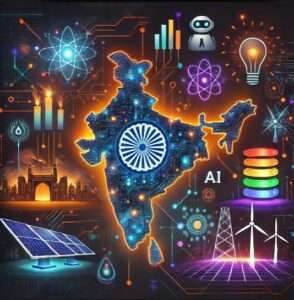
The startup story is equally remarkable. According to Nasscom’s 2025 GenAI landscape, India’s GenAI startup base expanded 3.7 times to more than 890 companies, making Bharat the world’s second-largest GenAI startup hub. Importantly, the ecosystem is moving towards application-focused innovation, vertical SaaS and domain-specific AI rather than merely attempting to replicate large global foundation models.
The rise of Global Capability Centres (GCCs) provides another compelling measure of this transformation. Bharat now hosts more than 1,700 GCCs, which have evolved from conventional back-office and support operations into centres for research, engineering, product development and innovation.
For someone who remembers a Bharat where access to advanced technology was limited and expensive, this transformation is nothing short of remarkable.
Yet, the journey is unfinished. Bharat must move decisively from being a major consumer and service provider to becoming a global creator of technology. Semiconductor manufacturing, indigenous electronics, quantum computing, cybersecurity, robotics, deep-tech research and high-end manufacturing require sustained investment. Equally important is the need to continuously reskill millions of young Indians as AI changes traditional employment models.
The technological revolution has therefore not merely changed Bharat’s economy; it has changed the relationship between the citizen, the State and the world.
From the transistor and the telephone to the smartphone and artificial intelligence, Bharat’s 80-year technological journey tells one unmistakable story: we are no longer merely catching up with the world. In several areas, the world is beginning to catch up with Bharat.
That, perhaps, is one of the most consequential achievements of eight decades of Independence.