
When the Editor asked me to write about the transformation of the Indian Armed Forces over the past 79-years as part of celebrating 80th Independence of Bharat, my immediate reaction was blunt: What exactly is there to boast about?
The editor was understandably annoyed. But when I explained why I felt that way, he perhaps began to understand that my frustration was not born out of cynicism or political opposition. It comes from the heart of a soldier.
I joined the Army in the first part of 1960, served in uniform, fought three wars, IPKF and counter insurgency operations and spent the better part of my life understanding what war actually means—not from television studios, PowerPoint presentations or social-media posts, but from the ground. Even today, despite retired from service, I would not hesitate for a moment to wear the uniform again if the nation required my services.
That is precisely why my yardstick is different.
I acknowledge that the Narendra Modi government has done more for defence production, indigenisation and military modernisation than many previous governments. The numbers themselves tell the story. Defence production reached a record ₹1.78 lakh crore in 2025-26, according to the Ministry of Defence, up from ₹1.54 lakh crore in the previous year and nearly four times the level of 2013-14. Defence exports also reached a record ₹38,424 crore in 2025-26.
The 2026-27 Defence Budget has crossed another historic milestone: ₹7.85 lakh crore, 15.19 per cent higher than the previous year’s Budget Estimate. Capital expenditure has been raised to ₹2.19 lakh crore, while ₹1.39 lakh crore has been earmarked for procurement from domestic defence industries, including private companies.
These are not small achievements.
Yet my answer remains the same: Yeh dil mange more, Modi ji.
Integrated Theatre Commands?????
Because a soldier does not fight a war with production statistics. He fights with weapons, ammunition, sensors, aircraft, missiles, drones, ships and submarines, communications, logistics, electronic warfare systems and, above all, technological superiority.
And that is where my frustration begins.
The war has changed. The threat is from “Muslim NATO – Turkey, Saudi Arabia and Pakistan”.
The battlefield of my generation is not the battlefield of today.
Modern warfare is increasingly about drones, autonomous systems, artificial intelligence, electronic warfare, cyber capabilities, precision-guided weapons, satellite intelligence, long-range missiles and networked command-and-control systems.
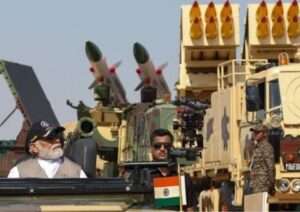
The Defence Ministry itself now recognises this transformation. The Raksha Mantri has repeatedly emphasised that future wars will be fought with algorithms, autonomous systems and AI, with drones, counter-drone systems, quantum technologies and directed-energy weapons becoming increasingly important.
The May 2025 India-Pakistan conflict demonstrated this dramatically. Large-scale drone warfare became a feature of the confrontation, underlining how inexpensive unmanned systems can alter the battlefield. Reuters reported that Pakistan was working with China and Turkey to advance indigenous drone production, while India too was accelerating investment in developing UAV capabilities.
However, my question is simple: Are we moving fast enough?
I acknowledge that India has progressed in all fields particularly armed forces.
My question is simple: Are progressing fast enough for the threats we are likely to face?
The next leap or transformation is most critical – from importer to producer. For decades, India was heavily dependent on foreign suppliers. That dependence is now being reduced. Defence exports, which were below ₹1,000 crore in 2014, have grown enormously, reaching ₹23,622 crore in 2024-25 and ₹38,424 crore in 2025-26.
The private sector is also finally becoming a serious participant in defence manufacturing. In 2025-26, private industry accounted for about 24 per cent of total defence production, with its output reaching around ₹42,000 crore.

The iDEX ecosystem has brought hundreds of start-ups and MSMEs into defence innovation. By 2026, 676 start-ups, MSMEs and innovators had joined the ecosystem, while 58 prototypes worth ₹3,853 crore had received procurement clearance and 45 procurement contracts worth ₹2,326 crore had been signed.
This is precisely the direction India should take.
But production is only one part of the equation.
The real test is whether our armed forces receive the right equipment, in sufficient numbers, at the right time.
A weapon that arrives ten years after the operational requirement has been identified is not a technological triumph. It is a procurement failure.
We cannot fight tomorrow’s war with yesterday’s inventory.
I urge our serving commanders to tell the Prime Minister what they need. Not what is politically convenient. Not what makes a good presentation. Not what looks impressive in a parade.
Tell him what is missing.
Tell him where we are vulnerable.
Tell him what must be acquired immediately and what must be developed indigenously by 2026, 2027, 2028, 2029 … seven or ten years.
And tell him without hesitation that quantity and quality cannot be sacrificed at the altar of bureaucratic procedure laid-back technology research and development. For example, development of jet fighter aircraft engines remains in limbo.
I am not suggesting that India should recklessly buy every weapon available in the international market. Nor am I advocating dependence on foreign suppliers.
Quite the opposite.
We should buy what we urgently need while simultaneously creating the domestic capability to replace it.
The mantra should be simple:
Buy where necessary. Build where possible. Innovations were strategically essential.
Drones deserve special attention. “HUBS” with the capability to manufacture drones in adequate quantities.
Russia is capable of producing up to 80 Banderol missiles per month. Russia produces around 3,000 Geran-4/5 Kamikaze Drones per month.
If there is one lesson from recent wars, it is that drones have fundamentally altered the economics of warfare. The financial implications of producing large-scale inventories of drones need to be identified and allocated. So also, the entire supply chain ecosystem needs to ensure large-scale production of drones in case of outbreak of the next war.

A sophisticated fighter aircraft can cost hundreds of millions of dollars. A swarm of relatively inexpensive unmanned systems can nevertheless create serious problems for even advanced militaries.
India therefore needs an enormous drone ecosystem—not merely a few spectacular prototypes.
We need reconnaissance drones, armed drones, loitering munitions, swarm drones, counter-drone systems, autonomous platforms and, equally importantly, the electronics, sensors, communications and propulsion systems that make them effective.
The Defence Ministry has itself called for India to become a global hub for indigenous drone manufacturing and has stressed that self-reliance must extend beyond finished platforms to critical components.
I would go one step further.
Strategically sensitive drone technologies should not be exported indiscriminately merely because there is a commercial market. Export controls must protect India’s technological advantage. At the same time, Indian companies should be encouraged to build a global defence business around systems that do not compromise national security.
That is how serious military powers behave.
And what about our fighter aircraft?
This is another area where my impatience is justified.
India’s ambition cannot stop at producing competent fourth-generation or 4.5-generation platforms. The country must move decisively towards fifth-generation capabilities and beyond.
The Advanced Medium Combat Aircraft programme is therefore strategically important. But we must also be realistic: there is no magical “sixth- or seventh-generation” aircraft sitting on a shelf waiting to be purchased. Even the world’s most advanced military powers are still developing and defining those future systems.
So the demand should not be for fashionable labels.
The demand should be for stealth, sensors, electronic warfare, long-range weapons, artificial intelligence, unmanned teaming, network-centric warfare and survivability.
That is what future air power will be about.
There is another uncomfortable issue that needs attention: utilisation of defence land and infrastructure.
Having spent considerable time in Secunderabad Cantonment after retirement, I have often wondered whether we are making the best use of the enormous land and infrastructure resources under defence establishments.
I have seen old, dilapidated colonial-era structures and large parcels of land that appear to have little operational utility today. Add to it, the massive total area of Military Dairy Farm of 4,000 acres with 1,000 acres of the Core Dairy Farm located in the midst of Secunderabad.
Yet another example is the large MES Barrack and Stores yard (nearly 10 acres) next to Lal Bazaar and over 40 dilapidated Old Bungalows each in nearly 4-5 acres with some near the Parade Ground.
I am not suggesting that operational land should be sold or that military security should be compromised for money.
Absolutely not.
But where land and obsolete structures have genuinely lost strategic utility, why should they remain locked away indefinitely?
Why cannot the Ministry of Defence undertake a transparent, professional, nationwide audit of defence land and obsolete infrastructure?
If some properties can be legally and safely monetised, the proceeds could be channelled into modernisation.
The point is not to sell the Army’s assets.
The point is to ensure that every national asset works for national security.
There may be similar opportunities in other cantonments across the country. A carefully designed land-monetisation policy, subject to security clearance, environmental safeguards, legal scrutiny and parliamentary accountability, could potentially unlock resources for military modernisation.
But this must be done professionally—not through ad hoc disposal, and certainly not through any arrangement that creates opportunities for corruption.
The bigger challenge is speed
The Modi government has already demonstrated that it can change policy.
The defence industry has responded.
Production is rising.
Exports are rising.
Start-ups are entering the sector.
Private companies are investing.
But the next revolution must be about speed.
A war does not wait for a five-year procurement cycle.
Technology does not wait for a file to move from one office to another.
Our adversaries certainly do not wait.
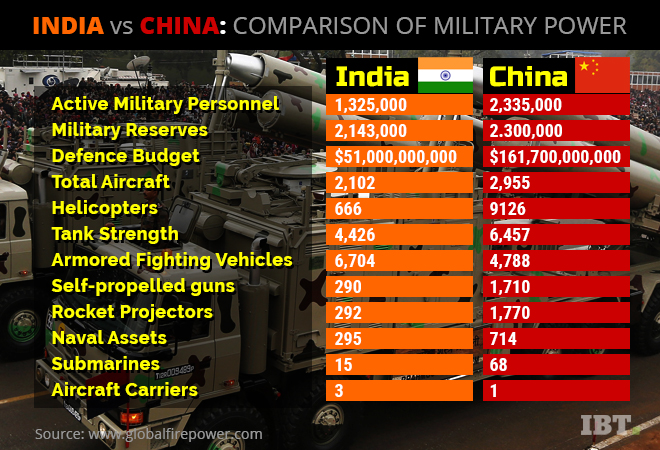
China is investing heavily in advanced aircraft, missiles, drones, space capabilities, cyber warfare and autonomous systems. Pakistan, despite its economic constraints, continues to acquire sophisticated Chinese-origin aircraft, missiles and unmanned systems and has deepened defence cooperation with Turkey and China. The 2025 conflict showed that we can no longer treat drones and networked warfare as peripheral capabilities.
India therefore needs a defence acquisition system that rewards urgency, innovation and accountability.
A commander should be able to say: I need this capability now.
An innovator should be able to say: Give me 3 to 6 months and I will develop it.
And the government should be able to say: If you deliver, we will buy it.