



Duryodhana, consumed by grief, frustration, and foreboding, approached Dronacharya and poured forth his anguish. His words were heavy with disappointment and accusation. “The mighty Bhishma, whom neither gods nor demons united could subdue, has fallen because of Sikhandi. The Pandavas now flourish in splendour and confidence, surrounded by their allies and brothers, while our vast force of seven Akshauhinis has been reduced to ruin. Arjuna has slain Jayadratha despite all our efforts to protect him. This fills my companions and me with astonishment and despair. Numerous kings and warriors, disregarding their own lives, came to support me and have fallen upon the battlefield. Only two paths now remain before me—to attain the heaven reserved for heroes through valiant death, or to destroy Yudhishthira, his brothers, and their followers. Having sacrificed the lives of so many princes and kings, how else can I repay the debt I owe them? If there is a third path, O Acharya, reveal it to me.”
His bitterness then turned toward his preceptor. “Arjuna is your beloved disciple. Perhaps that affection prevents you from seeking his defeat. Among those who remain, only Karna is a man of straightforward conduct, unwavering courage, and sincere devotion to my cause. Yet even he lacks the strategic foresight that ensures easy victory. Your immeasurable wisdom, your methodical prowess, and your unconquerable abilities seem to have turned against me. Karna exhausted every effort to save Jayadratha, but when fate surpassed his strength, he left him to destiny. Yet all blame falls upon us.”
The words pierced Drona’s heart. Though wounded by the injustice of the accusations, he controlled his emotions and replied with solemn dignity. “Why do you torment me with words sharper than arrows? Have I not repeatedly told you that Arjuna is exceedingly difficult to conquer? The day Arjuna brought down Bhishma, whom even celestial hosts could not overcome, I realised that it was not defeat but death itself that had drawn near to the Kauravas. I continue to fight not because I foresee victory, but because honour compels me to uphold my duty and preserve my self-respect.”
Drona then spoke with remarkable candour. “My son, there is no warrior within the Kaurava ranks who can equal the ambidextrous Arjuna. The dice once cast by Shakuni now return in another form. Today they fly as arrows from the Gandiva, and no being in the universe can halt their course. In the royal assembly, before the eyes of all, you humiliated the virtuous and chaste Draupadi. The consequences of that cruel deed now stand before you. You, Dushasana, Karna, and your companions committed acts born of arrogance and injustice. Such actions never perish without yielding fruit. They return with multiplied force.”
“The Pandavas earned the affection of the people through righteousness, restraint, and noble conduct. Their accumulated merit has become a blazing fire that now threatens to consume those who wronged them. Whatever efforts we make against them are as futile as sprinkling perfume upon dust. You insulted them in every conceivable manner. They endured your wickedness, entrusting their suffering to the Divine. Without compassion, you drove them into exile and concealment for fourteen years. They fulfilled every condition imposed upon them and later sought only their rightful share of the kingdom. Every peaceful avenue was explored, yet every effort was frustrated by your obstinacy. Left with no alternative, they turned to war. Even then, you confronted them through means contrary to royal ethics and honour.”
Drona’s voice deepened with self-reflection. “If I remain silent before such injustice, what meaning does my Brahmin birth hold? Can I truly call myself a Brahmin if I tolerate unrighteous conduct without protest? You accuse me of failing to protect Jayadratha, yet Karna and many others also stood guard and failed. Why do you not reproach them? Are they not your own? Am I no longer dear to you? Why then do you place the burden of blame solely upon my shoulders?”
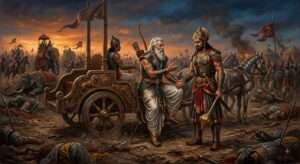
Having spoken firmly, Drona softened his tone. He realised that this was not the moment to extinguish what little courage remained in Duryodhana’s heart. “The enemy’s arrows scorch my body, while your accusations torment my mind. Is this fitting in the midst of war? Do not demean yourself through despair. The past cannot now be altered. Prepare instead to strike terror into the hearts of your enemies. I shall not remove this armour until I have destroyed the Panchalas, Sikhandi, and those who stand with them. Go forth and inspire the princes and warriors. Strengthen their confidence and restore their resolve.”
In those few words Drona revealed the profound distinction between ambition, destiny, and duty. He sought, if only for a moment, to lift Duryodhana from the fog of illusion and self-deception. Then, sensing the uncertainty of his own fate, he entrusted a final message to the Kaurava king.
“My son Ashwatthama must hear these words. I go now to battle, and I do not know whether I shall return. Should some extraordinary fate overtake me, grief may overwhelm him. Therefore convey this message faithfully. Tell him that the foremost duties of a Brahmin are reverence toward learned sages, service to those superior in wisdom, penance, and knowledge, unwavering adherence to righteousness, and steadfast devotion to truth and honesty. These principles must never be abandoned under any circumstances. Let him regard this as my final instruction.”
He paused briefly and added, “If any Panchala king or prince escapes my hand, let him pursue them relentlessly and send them to the abode of Yama. Deliver these words to him as my last communication.”
Having spoken thus, Dronacharya assembled his forces and infused them with renewed determination for the fierce struggle ahead. Yet Duryodhana departed from his presence with a troubled mind and a face darkened by disappointment. His confidence had not been restored.
Soon he approached Karna and voiced fresh grievances. “Drona constructed the formidable Chakra-vyuha to protect Jayadratha, yet he allowed the enemy to penetrate it. When I reflect upon these events, I wonder whether our guru has become our greatest danger. How could Arjuna alone break through the formation, slaughter princes and kings, and slay Jayadratha? How could Drona fail to restrain his pride and prowess? The pledge he gave to protect Jayadratha has proved worthless. We trusted his assurance; otherwise we would have kept Jayadratha safely within the palace. Drona treats us as strangers, while his affection for Arjuna grows ever stronger. In such circumstances, is it wise to continue this war relying upon him?”
Karna listened patiently before responding with calm reason. “Why do you accuse the Acharya? He has fought with all the strength available to him. Even if he had overcome Arjuna, could he truly have brought himself to kill his beloved disciple? Consider also our own history. We poisoned Bhima. We attempted to burn the Pandavas alive in the house of lac. Through deceitful gambling we drove them into exile. Yet what harm came to them? Not even the smallest fraction of destruction touched them. This teaches us that only the will of the Divine determines the final outcome. Human effort alone cannot destroy those whom destiny protects.”
“Why then should we blame Drona? Fate has consistently favoured the Pandavas. Jayadratha was not slain by Drona’s failure but by the decree of destiny itself. Do not lose faith or weaken the confidence of those who depend upon you. Our duty is to fight with courage and skill. We left no effort untried in defending Jayadratha. Let the future unfold according to the will of God.”
Within this exchange unfolded a profound study of human nature. There was critical analysis and blame-shifting, cunning attempts to reshape reality, efforts to justify failure, appeals to faith, and the search for meaning amidst catastrophe. Confidence transformed into doubt, certainty into confusion, and ambition into surrender before destiny. Each speaker interpreted events according to his own fears, loyalties, and desires. Through these varied shades of emotion, the epic revealed the complexity of the human heart and the endless struggle between responsibility and self-deception.
Thus Sanjaya narrated to Dhritarashtra the unfolding events of Kurukshetra, where men fought not only against their enemies but also against the consequences of their own choices, and where destiny moved silently through the battlefield, shaping the fate of kings and kingdoms alike.

