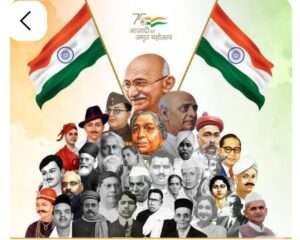
Let me share my thoughts while extending warm greetings to Team Orangenews9 and its readers on the eve of our 80th Independence Day. May the years ahead take Bharat towards becoming a stronger, more developed nation by 2047, when it celebrates its centenary, and beyond.
They say a few minutes is a long time in politics. For an independent nation, however, every minute must count towards development and change. When India became independent, much of the previous generation had grown accustomed to obedience under centuries of rule by kings and colonial rulers. This mentality, combined with divisions among rulers and communities, made it easier for the British to govern a vast and diverse nation. It took years of effort by national leaders to unite the people and integrate the princely states. Post-Independence integration was therefore a formidable task, with Jammu and Kashmir remaining a contentious issue for decades.
Independence itself came amid great haste, resulting in a geographical division whose consequences are still debated. India also began its journey without an established electoral system through which its people could directly choose their governments. The national leadership therefore had to make crucial decisions. Mahatma Gandhi favoured Jawaharlal Nehru as Prime Minister and Sardar Patel for a key role in the government, with distinct but complementary responsibilities—building India’s external relations and strengthening the nation internally.
The economy was in deep distress, although India inherited basic infrastructure such as roads and railways from the British. Rebuilding was necessarily slow, with the early years focused on large public-sector enterprises, infrastructure projects and state-led economic planning, while private investment remained relatively limited. Despite criticism, the leadership faced enormous challenges, including wars with Pakistan and China. The relationship with Pakistan remains abnormal even today.
The following decades brought both achievements and setbacks: food shortages, inflation and rationing; the Green Revolution; the 1971 war and the creation of Bangladesh; abolition of privy purses; bank nationalisation; and growing political unrest over corruption and unemployment. The Emergency was a particularly dark chapter that curtailed civil liberties and freedom of expression. Yet, unlike many countries that succumbed to prolonged authoritarian rule, India corrected its course through the ballot box.
The economic reforms of the early 1990s marked another turning point. Liberalisation opened the economy further, strengthened private investment and created new opportunities and employment across sectors. Coalition governments thereafter produced a mixed record of progress, controversies and setbacks. The political transition of 2014 ushered in another phase, marked by an emphasis on infrastructure, digital governance, welfare delivery and faster execution of major development programmes.
Since 2014, several major decisions—including demonetisation, the abrogation of Article 370 and the reorganisation of Jammu and Kashmir and Ladakh—have had far-reaching consequences, though their outcomes and implementation continue to be debated. The long-pending Ayodhya dispute ultimately culminated in the construction and consecration of the Ram Temple. Meanwhile, technology has transformed governance, digital payments, communications and public-service delivery, helping accelerate economic and social change.
Yet progress has also brought concerns. Political defections, personality-driven politics and the weakening of a credible opposition can damage democratic choice. Opposition-ruled States should have the space to govern effectively and provide voters with a meaningful alternative. Political expansion without adherence to principles can eventually undermine public confidence in democratic institutions.
Technology is also creating new challenges, including employment disruption and growing dependence on government jobs. Competitive examinations, paper leaks and student unrest are warning signs that merit-based opportunities and institutional credibility require greater attention. The emergence of non-political initiatives such as CJP, attracting interest among Gen Z and Gen Alpha, perhaps reflects a wider demand for greater attention to education, institutions and basic needs such as healthcare, housing and civic infrastructure—areas that have not always received the attention they deserve from either ruling or opposition parties.
This Independence Day should therefore serve as a wake-up call. India’s progress must move beyond grand narratives and reach the micro level, touching every community and household. Economic growth, social harmony, democratic choice and opportunities for young people must advance together.
Let every minute count. Let development move from the micro to the macro. Let Bharat continue its march towards a stronger, more prosperous and confident future.
Long live Bharat.