



What if one of the oldest images of human relationships found in India quietly challenges one of our most familiar assumptions about women in the past?
At Bhimbetka in Madhya Pradesh, among hundreds of prehistoric rock paintings preserved across natural shelters, there is an intriguing depiction of a man and a woman in which the woman appears to hold the man’s hand. It has been interpreted by some as a scene of courtship or partner selection, with the visual emphasis appearing to place the woman in an active rather than merely passive role.
That interpretation deserves attention—not because one painting can tell us everything about prehistoric society, but because it forces us to ask a larger question: were women in ancient societies always as powerless and submissive as modern popular narratives sometimes portray them?
The answer may be considerably more complicated.
Bhimbetka is not an ordinary archaeological site. Discovered by archaeologist V. S. Wakankar in 1957, the rock shelters contain more than 700 paintings and traces of human interaction with the landscape stretching across immense periods of time. UNESCO describes the paintings as ranging from the Mesolithic period through later historical periods, while archaeological evidence from the site demonstrates a much deeper human presence. The Mesolithic paintings alone take us back roughly 10,000 years.
These paintings depict hunting, dancing, animals, rituals and aspects of everyday life. They are, in a very real sense, fragments of a prehistoric visual archive.
And that is precisely why the image of a woman apparently taking the initiative in a relationship is fascinating.
For generations, discussions of women’s status in India’s past have often been presented through a relatively linear framework: ancient societies were patriarchal, women were progressively subordinated, and meaningful female agency arrived much later through modernity, education and social reform.
There is certainly abundant evidence of patriarchal institutions in different periods of Indian history. But history is rarely so neat.
The Bhimbetka paintings remind us that prehistoric communities cannot simply be fitted into modern ideological categories. Nor can every image be treated as a literal documentary record. Rock art is symbolic, selective and open to interpretation. Yet precisely because of that, it should be studied—not dismissed—when it presents possibilities that complicate established assumptions.
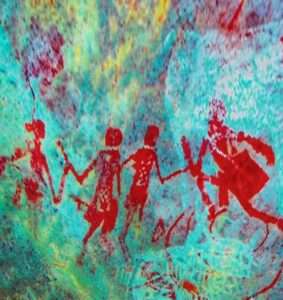
The larger problem is not that textbooks fail to tell children that a particular woman at Bhimbetka may have selected a partner. No responsible history curriculum can turn every prehistoric painting into a social rule.
The problem is what questions we choose to ask of the evidence.
If students are taught about women’s history primarily through later legal, religious or colonial-era sources, they may naturally inherit the impression that female agency was either exceptional or a relatively recent achievement. Archaeology offers a much messier and more fascinating picture.
Bhimbetka shows people dancing, hunting, travelling, interacting and participating in communal life. UNESCO itself describes the site as evidence of a long interaction between people and their landscape and notes the close relationship between the rock art and traditions of neighbouring communities.
That is why the woman holding the man’s hand deserves more than a passing glance.
Perhaps she was choosing a partner. Perhaps the scene represented courtship. Perhaps it meant something entirely different to the people who painted it thousands of years ago. We cannot know with certainty.
But we can ask the question.
And perhaps that is the most important lesson Bhimbetka offers modern India: women’s agency did not suddenly arrive with the 20th or 21st century. It is worth looking for it much further back.
The rock shelters survived changing climates, civilizations and empires. Their paintings survived because the artists put their world on stone.
What we do with that evidence is our responsibility.
History should not be rewritten to fit a preferred ideology—colonial, nationalist, Marxist, feminist or otherwise. It should be expanded whenever new evidence demands that we look again.
The real lesson of Bhimbetka, therefore, is not that one painting proves women were always free, nor that patriarchy never existed.
It is something more important.
Our ancestors may have been far more complex than the stories we inherited about them. And sometimes, the stone remembers what the textbook forgot to ask.




A very insightful and thought-provoking perspective. The way you have connected the Bhimbetka rock paintings with the question of women’s agency makes history feel much more nuanced and meaningful. I especially appreciate the reminder that we should examine evidence with an open mind rather than viewing the past through fixed assumptions. Truly an enlightening read! 👏