



For decades, India lived with a dangerous contradiction. We celebrated our engineers, scientists and entrepreneurs, yet remained heavily dependent on foreign countries for a wide range of critical industrial products. From sophisticated electronics and industrial machinery to components powering renewable energy, pharmaceuticals and electric vehicles, India often remained a buyer rather than a builder.
That dependency came at a price—not merely economic, but strategic.
The Narendra Modi-led NDA government’s reported decision to identify nearly 100 critical imported products, collectively valued at around ₹5 lakh crore, for indigenous manufacturing could well become one of the most consequential industrial policy decisions since the launch of the Make in India initiative. More importantly, it signals a decisive shift in thinking—from chasing the cheapest imports to building national capability, economic resilience and strategic autonomy.
The world has changed dramatically over the past few years. The COVID-19 pandemic exposed how fragile global supply chains really were. Factories shut overnight, shipping came to a standstill and nations discovered that even life-saving medicines, electronic chips and essential industrial inputs could become inaccessible. Then came the Russia-Ukraine conflict, disruptions in the Red Sea, rising geopolitical tensions in West Asia and the intensifying strategic rivalry between the United States and China. Together, these developments shattered the illusion that globalization alone could guarantee uninterrupted supplies.
Every disruption served as a reminder that excessive import dependence is not merely an economic weakness; it is a national security vulnerability.
It is precisely this lesson that appears to have shaped the Modi government’s latest initiative.
Unlike earlier programmes that largely focused on encouraging investment, this initiative reportedly seeks to identify products that are strategically critical and economically viable for domestic production. It complements rather than replaces flagship programmes such as Make in India, the Production Linked Incentive (PLI) schemes and the push towards Atmanirbhar Bharat. Together, they represent a coherent industrial strategy aimed at making India not just a manufacturing destination but a trusted global manufacturing power.
The sectors expected to receive priority are no coincidence. Electronics, electric vehicle components, solar equipment, pharmaceuticals, industrial machinery, textile manufacturing equipment and footwear manufacturing components are precisely the industries that will define global competitiveness over the coming decades. These are also sectors that generate high-quality employment, encourage technological innovation and create extensive supply chains benefiting thousands of MSMEs.
Critics may dismiss such policies as protectionism. They would be mistaken.
There is a vast difference between closing markets and strengthening domestic capability. Even the world’s most advanced economies are aggressively reshoring manufacturing and securing strategic supply chains. The United States is investing billions through industrial legislation, Europe is seeking greater technological sovereignty, while China continues to strengthen its manufacturing dominance. India cannot afford to remain merely a consumer in a world where production capacity increasingly determines geopolitical influence.
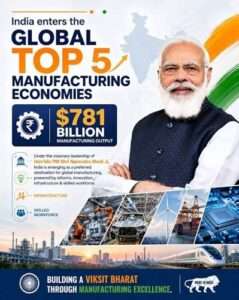
Of course, not every import can or should be replaced. India will continue to import crude oil and certain natural resources because geography dictates those realities. But importing products that can be competitively manufactured at home represents an avoidable strategic weakness. Reducing such dependence improves foreign exchange stability, creates skilled employment, encourages research and development, strengthens domestic industry and cushions the economy against external shocks.
The real success of this initiative, however, will depend on implementation. Identifying products is only the beginning. Ensuring policy stability, improving logistics, simplifying regulations, supporting innovation, strengthening MSMEs and integrating Indian manufacturers into global value chains will determine whether this ambitious vision translates into lasting industrial transformation.
Prime Minister Narendra Modi has consistently argued that economic strength is inseparable from national strength. This latest move reinforces that philosophy. Industrial self-reliance is no longer just an economic aspiration; it is a strategic imperative in an increasingly uncertain world.
If pursued with the same determination that characterised India’s digital revolution and infrastructure expansion, this initiative could fundamentally alter India’s manufacturing landscape. It is not about shutting the door on global trade. It is about ensuring that when the next global crisis strikes, India stands not as a vulnerable importer waiting for supplies, but as a confident producer capable of meeting its own needs while supplying the world.
That is the true meaning of Atmanirbhar Bharat—not isolation, but strength through capability, resilience and self-confidence. It is a vision worthy of wholehearted support.


