
Navi Mumbai’s first international flight isn’t the real story. The new economic geography taking shape around it is.
Airports possess an odd talent for misleading people. They appear to exist so that aircraft can land, passengers can depart and duty-free shops can persuade travellers that another bottle of perfume is somehow an investment.
In reality, the aircraft are often the least interesting part of the story. Long before the departure boards begin filling up, airports have already started attracting warehouses, hotels, logistics companies, office parks, and industries that would never have looked twice at the surrounding landscape a decade earlier. The runway is simply the most visible sign that an entirely different economy has begun looking for a new address.
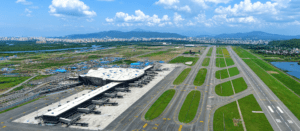
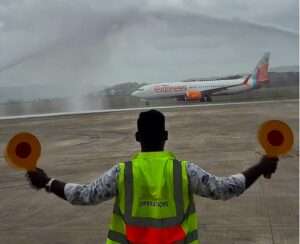
That thought came to mind this week as an Air India Express aircraft lifted off from Navi Mumbai International Airport for Abu Dhabi, inaugurating the airport's first scheduled international service on 15 July 2026. The flight itself lasted barely three hours. The journey that really matters will take considerably longer.
Beyond aviation
Barely seven months have passed since the airport quietly entered commercial domestic operations on 25 December 2025, ending one of the longest waits in Indian infrastructure. The celebrations surrounding the first international flight were entirely justified. Mumbai had finally acquired the second global gateway that planners, governments and industry had debated for more than two decades. Yet the significance of the moment lies less in another overseas destination than in what has quietly begun taking shape on the ground.
Changing landscape
Drive eastwards across the Atal Setu towards Ulwe early in the morning and the transformation becomes difficult to miss. Roads that once appeared to disappear into open land now seem to know exactly where they are heading. Tower cranes interrupt the skyline with surprising confidence, survey markers occupy spaces that recently belonged to paddy fields, while construction sites appear with such regularity that one almost expects the concrete mixers to have acquired permanent addresses. Mumbai has always expanded reluctantly, one neighbourhood at a time. Navi Mumbai feels different. It has the unmistakable air of a city trying to catch up with a future that arrived slightly ahead of schedule.
Strategic scale
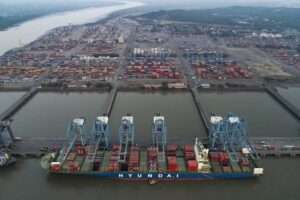
That impression is hardly accidental. Navi Mumbai International Airport was never conceived merely as a relief airport for an overburdened Mumbai. Its first phase has capacity to handle around 20 million passengers annually, but the master plan envisages expansion to about 90 million passengers and more than 3 million tonnes of cargo every year. Airports built simply to reduce congestion are rarely planned on that scale. What makes the project particularly unusual is the company it keeps. Within a relatively compact geography lie the Jawaharlal Nehru Port Authority, India's largest container gateway, the Navi Mumbai Airport Influence Notified Area (NAINA) spread across roughly 170 villages, the Mumbai Trans Harbour Link, expanding metro corridors and highways that connect the region with Pune, Nashik and western India’s industrial heartland. Viewed individually, these are substantial infrastructure projects but when positioned together, they begin to resemble something rather more ambitious—an attempt to reorganise the economic geography of the Mumbai Metropolitan Region.
Airport economics
The distinction matters because airports have quietly changed their profession. They still move passengers and cargo, of course, but the world's successful airports increasingly earn their reputation by persuading businesses to move closer to them.
Freight operators follow first, warehouses appear almost immediately afterwards, hotels arrive with remarkable optimism, office buildings begin replacing empty plots and, before long, an airport that was expected to serve a city finds itself helping create a new commercial district. Singapore understood that years ago. So did Seoul, Amsterdam and Dubai. They built airports, but what emerged around them were logistics hubs, business ecosystems and entirely new centres of economic activity.
Ground signals
The signs are already visible in Navi Mumbai. Cargo operators have announced expansion plans, logistics companies are evaluating facilities around the airport, developers are repositioning commercial projects and land that once struggled to attract serious investors is being discussed in terms of connectivity rather than distance. None of these developments, taken individually, would justify extravagant conclusions. Collectively, however, they suggest that the airport may eventually prove more influential outside its perimeter fence than within it. Airports have a curious habit of changing maps without ever appearing to move.
That is why passenger statistics, important though they are, tell only part of the story. The more revealing numbers will emerge gradually over the coming decade. How much additional cargo begins moving through western India? How many export-oriented industries decide that proximity to an international cargo hub justifies relocating operations? How much private investment finds its way into logistics parks, commercial districts, hotels and business services because the airport has altered the region’s economic calculations? Those decisions will not be announced with inaugural ceremonies, yet they are likely to determine whether the project fulfils the ambitions with which it was conceived.
New yardsticks
There is already precedent for viewing airports through that wider economic lens. In 2015, the National Council of Applied Economic Research (NCAER) published an economic impact assessment of Mumbai's existing airport, projecting that by 2022–23 its direct, indirect and induced income effects would amount to around 4.02 percent of Maharashtra's Gross State Domestic Product.
It is my view that the precise percentage is less important than the principle behind it. The study recognises that an airport's influence extends far beyond aircraft movements and terminal buildings; it becomes part of the productive economy itself. Therefore, as
Navi Mumbai begins international operations, a similarly comprehensive public benchmark outlining its expected long-term contribution to employment, exports, logistics, investment, and regional growth would provide an equally valuable yardstick against which its progress could eventually be measured.
The discussion becomes even more relevant because the way major infrastructure projects are assessed has changed significantly over the past two decades. Around the world, governments increasingly look beyond construction costs and engineering milestones to examine the wider economic value created by airports, ports and transport corridors. Passenger traffic and cargo volumes remain important, but they are no longer the only measures of success. Equal attention is paid to private investment attracted, supply chains strengthened, export competitiveness, employment generated and the productivity gains that ripple through the wider economy. Delays, consequently, are viewed not merely as extensions of construction schedules but as postponements of economic benefits that the infrastructure was expected to deliver.
Evolving ecosystem
That broader perspective sits comfortably with the ambitions behind Navi Mumbai International Airport. The airport has now entered commercial domestic and international operations, yet much of the ecosystem that gives the project its strategic importance is still evolving. Metro corridors will need to reach completion, logistics parks will have to fill with occupiers, commercial districts must attract businesses,
Aerocity plans have to move from drawings to functioning neighbourhoods, while industries, hotels and service providers gradually decide whether this side of the harbour deserves to become their next address. None of that diminishes what has already been achieved. Rather, it recognises that airports derive their greatest economic value not from the runway alone but from the network of enterprises that gradually assembles around it.
Measuring success
That, perhaps, is where the conversation should now move. India has become considerably more confident about building world-class infrastructure, and Navi Mumbai International Airport is evidence of that growing capability. The next challenge is not simply to celebrate what has been built, but to measure what it enables. How much investment does it attract? How many jobs does it support? What additional exports move through its cargo terminals? How significantly does it alter the economic geography of the Mumbai Metropolitan Region? Those questions are no less important than passenger numbers because they go to the heart of why projects of this scale are undertaken in the first place.

Long view
Cities seldom change because of a single project. They change when several investments begin reinforcing one another over many years. Mumbai has experienced that transformation before, whether around Nariman Point, the Bandra-Kurla Complex or Navi Mumbai itself. Infrastructure redraws maps only when businesses, investors and people gradually decide to follow it. That process is rarely dramatic, seldom linear and almost never visible amid the excitement surrounding an inaugural flight.
This week’s first international service from Navi Mumbai will rightly be remembered as an aviation milestone. Its larger significance may become apparent only over time, as cargo volumes rise, logistics networks deepen, industries choose new locations and investment begins responding to opportunities that did not exist a few years ago. Those developments are unlikely to generate the same excitement as the departure of an inaugural flight, yet they will provide a far more meaningful measure of whether one of India’ s most ambitious infrastructure projects fulfilled the purpose for which it was conceived.
Real test
Long after the photographs of the inaugural flight have faded and the speeches have been forgotten, the airport will be judged by a far simpler question. Did it merely connect Mumbai to another destination, or did it persuade a new economy to change its address? The answer could shape western India's economic geography for years to come.
(The author is a Mumbai-based Editor, Industrial Analyst, and Chronicler of India’s industrial growth story with over four decades of experience covering construction, infrastructure, manufacturing, mining, mobility, and equipment sectors. He is the Founder of SriViKaS Global, a strategic media and industrial intelligence initiative focused on manufacturing, infrastructure and cross-border industrial collaborations.
Connect with him on his LinkedIn hyperlink https://www.linkedin.com/in/shrikant-rao-875b344/ or write to: shrikant.rao.professional@gmail.com)