


A 48-year-old businessman had just returned home after a long international flight. Apart from a mild pain in his left calf, which he dismissed as a simple muscle strain from travelling, he felt perfectly well. Two days later, while climbing the stairs at home, he suddenly became breathless and developed severe chest pain.
Within minutes, he collapsed and was rushed to the hospital. The diagnosis was not a heart attack, as his family had feared, but a pulmonary embolism—a blood clot that had silently travelled from the veins of his leg to his lungs. Such incidents are more common than many people realize.
Blood clots often develop silently, producing few warning signs until they suddenly block the blood supply to a vital organ. What begins as a seemingly harmless clot in one part of the body can rapidly become a life-threatening emergency elsewhere. Blood is often associated with life. One of its most remarkable properties is its ability to clot.
Most people think blood clots are harmful. In reality, clotting is one of the body’s most important protective mechanisms. Without it, even a small cut could lead to excessive bleeding. However, the same natural process that saves lives can also threaten them.
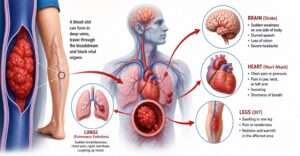
When a clot forms inside a blood vessel instead of over a wound, it can suddenly block the supply of blood to vital organs. If the blockage occurs in the heart, it may cause a heart attack. In the brain, it can result in a stroke. In the deep veins of the leg, it is known as Deep Vein Thrombosis (DVT). If part of that clot breaks away and travels to the lungs, it can block the lung’s blood vessels, causing a Pulmonary Embolism (PE) —a medical emergency that can be life-threatening.
Although these conditions may appear different, they are all linked by one common culprit: an abnormal blood clot.
Why do clots form?
Normally, blood flows smoothly through healthy blood vessels. Clotting begins only when the body needs to stop bleeding after an injury. Problems arise when clots develop without an external wound. Doctors have long understood that three major factors increase the likelihood of abnormal clot formation: slowing of blood flow, injury to the inner lining of blood vessels, and conditions that make the blood clot more easily than normal.
A single factor may be sufficient in some individuals, while several factors often act together. Prolonged bed rest after surgery, major trauma, fractures, 1cancers, pregnancy, obesity, smoking, increasing age, inherited clotting disorders, hormone therapy, oral contraceptive pills, and long-distance travel without break or rest can all increase the risk. According to the American Society of Haematology Guidelines (2024), recognising these risk factors allows preventive measures to be taken before a clot develops.
When minutes matter
The symptoms of a blood clot depend entirely on where it occurs. A clot blocking an artery supplying the heart may produce severe chest pain, sweating, breathlessness and pain radiating to the left arm or jaw—which is nothing but a heart attack. A clot affecting the brain may cause sudden weakness of one side of the body, difficulty speaking, facial deviation or sudden loss of vision— which are the classic warning signs of a stroke. When a clot forms in the deep veins of the leg, the affected limb may become swollen, painful, warm, and tender.
This condition, called Deep Vein Thrombosis, is often underestimated because the symptoms may initially appear mild. The greatest danger arises when part of that clot breaks away, travels through the bloodstream, and lodges in the lungs, producing a Pulmonary Embolism. This may present with sudden breathlessness, chest pain, coughing up blood, rapid heartbeat or collapse. Without prompt treatment, it can rapidly become fatal. According to the 2024 European Society of Cardiology Guidelines on Acute Pulmonary Embolism, early recognition and immediate medical treatment significantly improve survival.
The hidden risk
Many people assume blood clots occur only in elderly individuals. Besides, as narrated earlier— long flights, prolonged sitting during travel, extended immobilisation following illness or surgery, obesity, smoking, pregnancy and certain cancers all increase the risk—even in relatively younger individuals. In some cases, hospital admission itself may increase the risk because prolonged immobility slows blood circulation.
This is why doctors often encourage patients to walk as early as possible after surgery or prescribe blood-thinning medicines for those at high risk. In fact, even people who spend long hours sitting at home or in the office should make it a habit to take regular breaks and walk for about 15 minutes. This simple practice can help reduce the risk of the said illness.
Recent reviews published in the Journal of Thrombosis and Haemostasis (2025) highlight that early mobilisation and appropriate preventive treatment can substantially reduce the occurrence of hospital-acquired blood clots.
Prevention is possible
Fortunately, many blood clots can be prevented. Maintaining regular physical activity, yoga, avoiding prolonged periods of sitting, staying well hydrated during long journeys, maintaining a healthy body weight, quitting smoking, and controlling chronic illnesses such as diabetes and hypertension all help to reduce risk.
For individuals undergoing major surgery, prolonged hospitalisation or cancer treatment, doctors may recommend compression stockings or anticoagulant medicines (blood thinners) to reduce the chance of clot formation. These medicines should always be taken strictly under medical supervision because they also increase the risk of bleeding.
According to the International Society on Thrombosis and Haemostasis (ISTH) Scientific Updates (2025), identifying high-risk individuals and providing timely preventive measures remain among the most effective strategies for reducing clot-related illness and death.
Be cautious….
One of the greatest dangers of blood clots is delay. Chest pain is sometimes dismissed as acidity.
Sudden breathlessness may be mistaken for fatigue or asthma. Leg swelling is often ignored until the pain becomes severe. A transient episode of slurred speech may be attributed to exhaustion. Such delays can prove life-threatening. Therefore, it is advised not to ignore these warning signs.
The American Heart Association, in its Circulation Scientific Statement (2025), emphasizes that rapid recognition and immediate medical evaluation are critical because many clot-related emergencies respond remarkably well when treatment begins early and appropriately. Every second counts.
A blockage can be deadly
Modern medicine has made enormous progress in diagnosing and treating blood clots. Advanced imaging, clot-dissolving medicines, minimally invasive procedures, and effective blood-thinning drugs have saved countless lives. Yet the greatest weapon remains awareness. Recognising the warning signs, understanding the risk factors and seeking timely medical attention can prevent permanent disability and save lives. A blood clot may be invisible, but its consequences can be devastating. Fortunately, with greater awareness, many of these tragedies are preventable.

