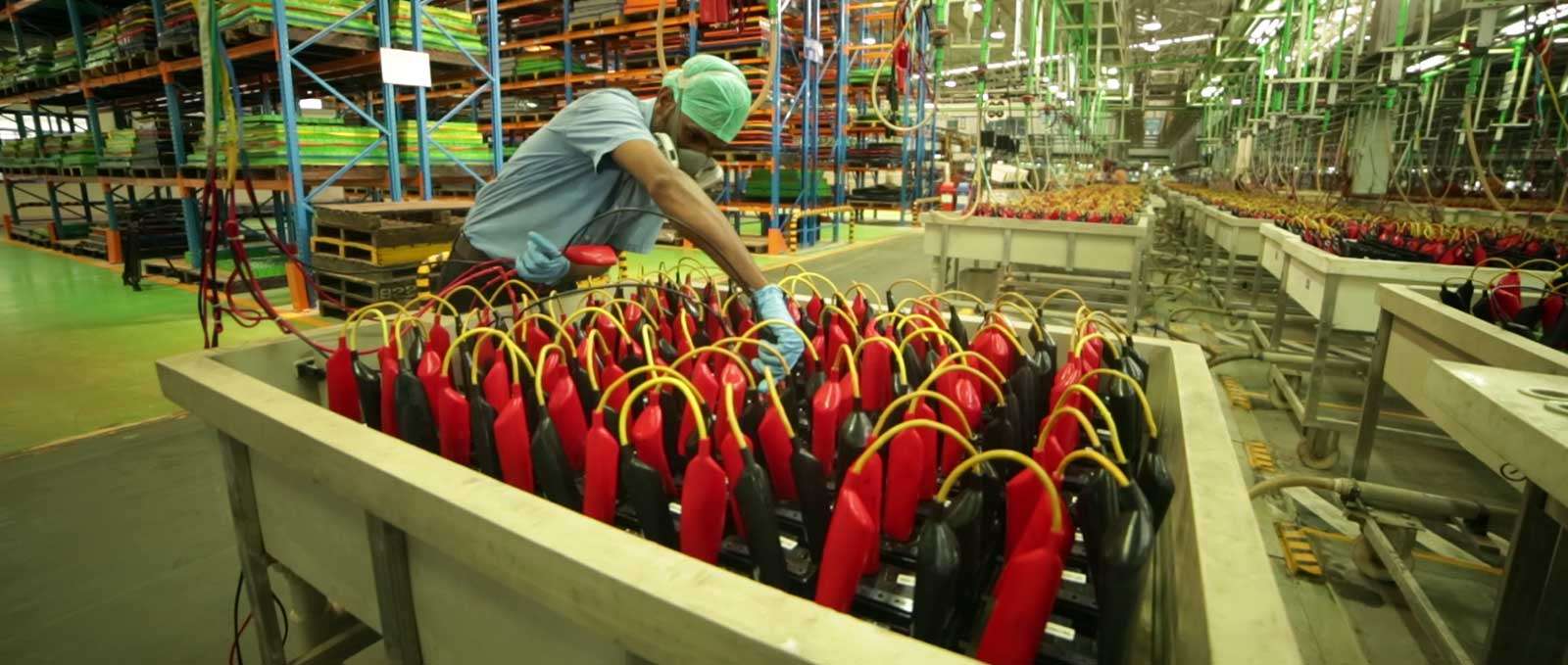
Why Amara Raja’s Customer Qualification Plant in Telangana signals a new phase in India’s manufacturing journey.
Shrikant Rao
When Amara Raja commissioned its Customer Qualification Plant (CQP) at the company’s emerging Giga Corridor in Mahabubnagar recently, the headlines were almost predictable. A Rs 500-crore investment. Another milestone in India’s lithium-ion battery ambitions: a step towards commercial cell manufacturing expected next year.
Yet the real story was tucked away inside three words that most readers probably skimmed past – Customer Qualification Plant.
It hardly sounds like the sort of phrase that launches a manufacturing revolution. In fact, it sounds faintly bureaucratic. But spend enough time around the automotive industry and those words begin to carry a very different meaning. Anyone can announce a factory. The real examination begins only after the ribbon has been cut.
For decades, India has measured manufacturing success in acres of factory space, installed capacity, and investment commitments.
Those metrics still matter. Increasingly, however, global manufacturing asks a different question. Can the product coming off the line survive the scrutiny of customers who have spent decades perfecting their own quality systems? That answer cannot be printed in a press release. It has to be earned.
Too often, manufacturing debates end when the factory opens. In reality, the real work has only just begun.

Spend time with automotive suppliers and the pattern becomes familiar. Prototype components disappear into laboratories. Engineers return with fresh observations. Tests are repeated under different temperatures, charging cycles and operating conditions. Weeks become months and, not infrequently, more than a year passes before the first commercial order arrives. Building the factory is often the easier assignment. Convincing the customer usually takes longer.
Trust Test
That is precisely the role of Amara Raja’s new facility. The plant will manufacture cylindrical and prismatic lithium-ion cells for customer validation across multiple chemistries, including lithium iron phosphate (LFP) and nickel manganese cobalt (NMC).
Automotive OEMs are expected to begin evaluating production-line-ready cells this year, well before commercial-scale production begins.
They will be subjected to exhaustive testing for safety, durability, charging behaviour, thermal stability and cycle life before they are approved for commercial applications.
The first product leaving this factory, therefore, is not a battery. Some might call it confidence.
Factories manufacture products. Qualification manufactures markets.
Approval Race
Another detail is equally revealing. At an initial 60 MWh, the Customer Qualification Plant is tiny beside the company’s planned 16 GWh gigafactory.
Commercial production from the company’s first 2 GWh cell manufacturing facility is expected to commence by June 2027, making the qualification phase the critical link between product development and volume manufacturing.
That is entirely the point. It is not trying to win the capacity race. It is trying to win the approval race. Only after customers validate products manufactured on this line will Amara Raja scale production through its commercial facilities.
Industry Race
Nor is the company making this journey alone. India’s battery race has gathered remarkable pace. Tata Group’s Agratas, Exide Energy Solutions, Reliance Industries and Ola Electric are investing heavily in advanced energy technologies, while global leaders such as CATL, BYD, Panasonic Energy, LG Energy Solution, Samsung SDI, and SK On continue setting the benchmark. Against that backdrop, competitive advantage is no longer measured by the size of the factory alone. It is measured by how quickly the market is prepared to trust what the factory produces.

The broader significance extends beyond Amara Raja. As global customers increasingly diversify battery sourcing, Indian manufacturers are no longer competing only with domestic peers but with some of the world’s most experienced cell producers. Qualification, consistency and process discipline therefore become as important as installed capacity.
The wider industrial backdrop explains why this matters. Amara Raja’s larger Rs 9,500-crore Giga Corridor is planned with 16 GWh of lithium-ion cell manufacturing capacity and 5 GWh of battery pack production. At the national level, India’s Production Linked Incentive programme for Advanced Chemistry Cells seeks to accelerate domestic manufacturing, while industry estimates suggest the country could require well over 200 GWh of battery manufacturing capacity before the decade closes as electric mobility, renewable energy and Battery Energy Storage Systems continue expanding.
Industrial Climb
In that context, the Mahabubnagar facility represents far more than another factory. It marks India’s gradual shift from assembling technologies developed elsewhere towards qualifying technologies the world may eventually buy from here.
Less noticed is another shift taking place. Much of the advanced cell manufacturing team has been built around Indian engineers and scientists who have previously worked with leading global battery manufacturers. In many ways, the project reflects not only the localisation of manufacturing, but also the return of specialised industrial talent.
Seen from a distance, it is tempting to conclude that India is simply adding another battery factory to an already crowded industrial landscape. Look a little closer, and a different picture emerges. For years, Indian companies assembled battery packs while importing the cells that carried most of the technological value. It was commercially sensible, but it also meant the country captured only part of the value chain.
Manufacturing the cell changes the equation. It demands mastery over chemistry, advanced materials, process engineering, and quality systems that leave very little room for approximation. The conversation moves from assembly to precision.
Process Discipline
That challenge extends well beyond batteries. Modern cell manufacturing resembles semiconductor production more than the conventional factory most people imagine. Automated production lines, precision coating, robotics, digital process control, ultra-clean environments and relentless quality assurance leave little space for improvisation. Even atmospheric moisture is monitored because microscopic variations can influence product performance. There was a time when manufacturing strength was measured by the size of the workforce. Increasingly, it is measured by the stability of the process.
Industrial Ecosystem
The implications spread across the wider industrial economy. Every gigafactory demands sophisticated construction, clean-room engineering, precision HVAC systems, industrial automation, robotics, specialised material handling, fire protection, testing laboratories and highly skilled engineers. Battery manufacturing facilities are becoming some of the country’s most sophisticated industrial projects. Before they manufacture cells, they generate work for an entire ecosystem of technology providers, equipment manufacturers and engineering specialists.
The Customer Qualification Plant itself has already brought together more than 100 specialised professionals, while the wider Giga Corridor is expected to generate significant employment, attract allied industries and reinforce Telangana’s emergence as one of India’s principal destinations for advanced energy storage, electric mobility and clean manufacturing investments.
Changing Measure
That is why the Mahabubnagar development deserves attention beyond the electric vehicle industry. India’s ambition is no longer confined to producing at scale. Increasingly, it is about manufacturing components that global customers are prepared to qualify, certify, and integrate into their own supply chains.
That distinction matters because qualification sits at the heart of advanced manufacturing. It is the stage at which engineering capability, manufacturing discipline and customer confidence converge.
Without it, a gigafactory is simply another manufacturing facility. With it, the factory begins its journey towards becoming part of a global supply chain.
Gigawatt-hours dominate headlines. Qualification determines who survives after the headlines fade.
The harder metric to quantify is confidence—the willingness of customers to redesign products around components manufactured in India.
Factories have always symbolised industrial progress. Industrial turning points are far rarer. They arrive when a country’s products begin earning a place in global supply chains, not because they are cheaper, but because they are trusted. The commissioning at Mahabubnagar may one day be remembered in that light.
Factories are commissioned every year. Industries are not. They are built slowly, one qualified product, one satisfied customer and one hard-earned reputation at a time.
The author is a Mumbai-based Editor, Industrial Analyst, and Chronicler of India’s industrial growth story with over four decades of experience covering construction, infrastructure, manufacturing, mining, mobility, and equipment sectors. He is the Founder of SriViKaS Global, a strategic media and industrial intelligence initiative focused on manufacturing, infrastructure and cross-border industrial collaborations.
Connect with him on his LinkedIn hyperlink https://www.linkedin.com/in/shrikant-rao-875b344/ or write to: shrikant.rao.professional@gmail.com