Lakshmanrao Upadhyayula
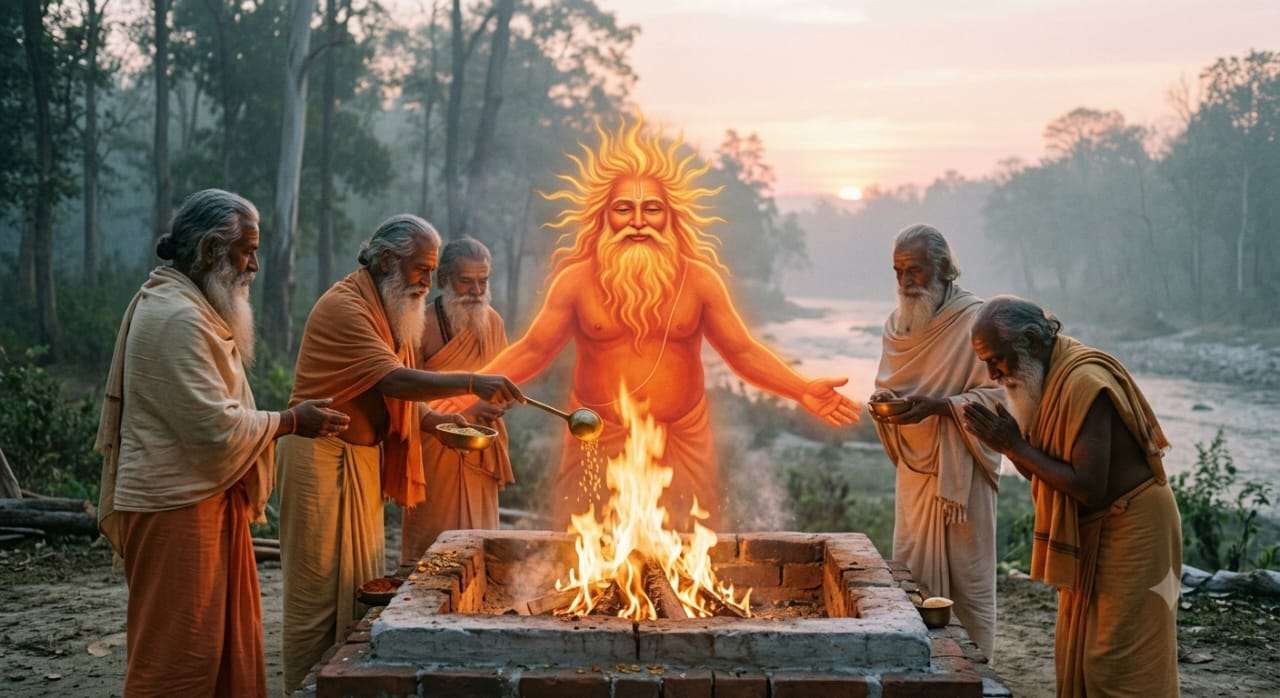
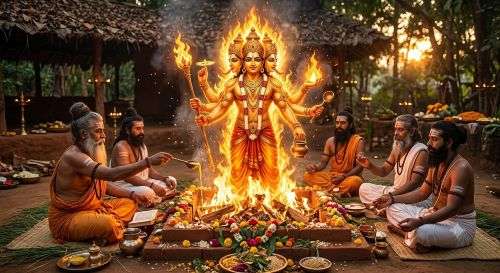
In the sacred cadence of the Jagatī chandas, the venerable sages Sounaka and Grutsamada raise their luminous invocation to Agni, the divine mediator who stands at the confluence of the mortal and the immortal. Their hymn, woven within the timeless fabric of the Rigveda, reveals not merely a ritualistic appeal but a profound metaphysical insight into the nature of existence. Agni is not approached as a mere elemental fire; he is invoked as the sovereign Lord of both gods and human beings, manifesting during the sacred yajna as the visible embodiment of divine presence. He shines in the ritual space, in the rising sun, in the hidden spark within waters, stones, forests, and medicinal herbs, symbolizing the latent energy pervading all matter.
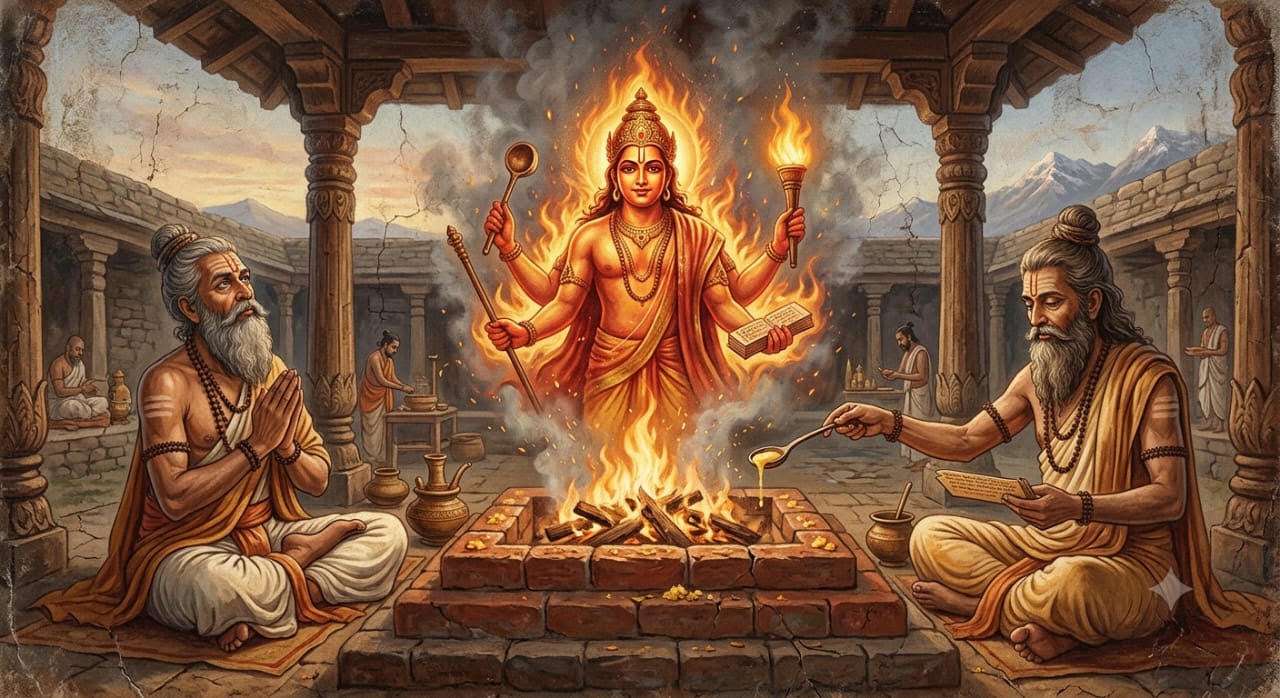
The sages perceive Agni as the Hota, the invoker; the Sota, the purifier; and the Ritwij, the knower of cosmic order. Every sacred rite unfolds through his agency, and all offerings reach the celestial realms only through his luminous channel. In this, Agni represents a universal principle akin to transformation itself, where matter becomes energy and intention becomes realization. From a scientific perspective, Agni mirrors the fundamental processes of thermodynamics, where energy is neither created nor destroyed but transformed, sustaining the continuity of life and cosmos. Thus, the Vedic seers, through intuitive wisdom, recognized in Agni the dynamic principle governing both ritual and reality.
Agni is praised as the Adhvaryu and the Brahma among priests, embodying both action and knowledge. He is the lord of the household, the silent witness to human endeavor, and the fulfiller of divine aspirations. Because he pervades all and fulfills all desires, he is identified with Vishnu, the all-encompassing sustainer. As the master of sacred speech and मंत्र (mantra), Agni becomes the living vibration that bridges thought and manifestation. His presence in diverse forms reflects the unification of multiplicity into a single cosmic energy, an idea that resonates with modern scientific understandings of unified fields.
Assuming the moral authority of Varuna, Agni upholds cosmic law and order, while as Aryaman, he protects the noble and ensures harmony within society. The generosity attributed to Aryaman is seen in Agni’s capacity to distribute the fruits of yajna to all beings. As the radiant sun, he nourishes life; as Tvastar, he shapes and strengthens existence. The sages recognize that all hymns ultimately converge upon Agni, for he is both the source and the receiver of sacred expression. His brilliance inspires enthusiasm, fortifies human strength, and bestows prosperity symbolized by horses and cattle, the ancient emblems of vitality and wealth.
In the vast expanse of space, Agni is understood as a confluence of complex forces, manifesting as the life-sustaining principle within the Maruts and as the lord of nourishment. His association with movement, symbolized by the wind-like horse, reflects the kinetic aspect of energy. As Pushan, he guides and protects humanity, ensuring safe passage through both physical and spiritual journeys. Those who worship and embellish him with devotion are believed to attain higher realms, for Agni elevates consciousness just as fire rises upward, transcending inertia.
Agni is hailed as the brilliant sun, the source of gems, and the donor of riches. His worship in the sacred halls of yajna ensures protection and prosperity. In every household, he is both witness and guardian, illuminating human life with his benevolence. As the ruler of humanity and the bestower of kindness, Agni governs all oblations and grants innumerable merits to the deserving. His service is regarded as supreme because it aligns human intention with cosmic order.
The sages also approach Agni with intimate reverence, seeing him as father, brother, and companion. This relational understanding reflects a deep psychological insight: divinity is not distant but intimately woven into human experience. Agni, when invoked through disciplined ritual, purifies the body and mind, dispelling darkness and ignorance. As the fierce yet benevolent force, he consumes the sacred twigs slowly, symbolizing the gradual transformation of the self. He is the organizer and expander of yajna, ensuring that every act performed in alignment with dharma yields multiplied merit.
Agni is further identified with Aditi, the infinite mother, and with Bharati, Ila, and Saraswati, representing speech, nourishment, and wisdom. He is also the slayer of Vritra, embodying the triumph of light over obstruction. His rays, majestic and far-reaching, are the sources of wealth and sustenance, reinforcing his role as the lord of nourishment and protector of all beings. Broad and all-pervading, Agni stands as the cosmic principle that integrates creation.
The divine constitution of Agni is poetically described: the Adityas lend him form, the gods grant him speech, and all offerings made by priests reach the immortals through him alone. Mortals too depend on him for sustenance, for he resides in the very essence of plants and herbs, enabling growth and nourishment. Agni thus bridges the biological and the spiritual, embodying the life-force that sustains ecosystems and consciousness alike.
In the narrative of sage Grutsamada, born of the Angirasa lineage and son of Sunahotra, we find a historical and spiritual dimension. Once captured by hostile forces, he was liberated through the grace of Indra, symbolizing the triumph of divine intervention over adversity. Under Indra’s guidance, he became associated with Sounaka, continuing the sacred lineage of wisdom. This episode reflects the perennial Vedic theme: knowledge, when protected and guided by divine forces, becomes a beacon for humanity.
Thus, the hymn stands not merely as praise but as a multidimensional exploration of Agni—as energy, consciousness, moral force, and cosmic connector. It reveals a vision where spirituality and scientific temperament are not opposed but harmonized, where the fire of ritual becomes the fire of understanding, illuminating both the outer universe and the inner self.