



The commissioning of INS Mahendragiri at Visakhapatnam on Saturday is much more than the induction of another frontline warship into the Indian Navy. It is a powerful statement that Bharat is steadily transforming itself into a formidable maritime power, capable of safeguarding its national interests far beyond its coastline while contributing to peace and stability across the Indo-Pacific.
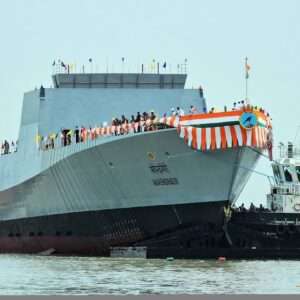
As the sixth and final stealth frigate under the prestigious Project 17A programme, INS Mahendragiri symbolizes the remarkable progress Bharat has made in indigenous warship design and construction. Designed entirely by the Indian Navy’s Warship Design Bureau and built by Mazagon Dock Shipbuilders Limited, the 6,670-ton warship carries more than 75 per cent indigenous content—a reflection of the success of the ‘Aatmanirbhar Bharat’ vision in one of the world’s most technology-intensive defence sectors.
The strategic importance of the Indian Ocean Region has grown enormously over the past decade. Nearly 80 per cent of global maritime oil trade and a substantial share of international commerce pass through these waters. As geopolitical competition intensifies and maritime security challenges multiply, India, that’s Bharat, can no longer remain a coastal navy. It needs a blue-water navy capable of protecting sea lanes, responding to humanitarian crises, deterring hostile forces, and projecting credible power whenever national interests demand.
INS Mahendragiri is built precisely for that role.
At first glance, the sleek frigate reflects modern naval engineering. Beneath its elegant lines lies cutting-edge stealth technology that significantly reduces its radar, acoustic and infrared signatures, making detection by adversaries considerably more difficult. In modern naval warfare, remaining unseen often determines who gains the tactical advantage, and Mahendragiri has been designed with precisely that objective.
Its firepower is equally impressive. Armed with eight BrahMos supersonic cruise missiles, the warship possesses one of the world’s fastest and most potent anti-ship strike capabilities. Complementing this offensive punch are 32 Barak-8 medium-range surface-to-air missiles, capable of defending the vessel and accompanying naval assets against multiple aerial threats including aircraft, helicopters, drones and incoming missiles.
The warship is equally formidable beneath the waves. Advanced anti-submarine torpedoes, rocket launchers and sophisticated underwater sensors enable Mahendragiri to detect, track and neutralise hostile submarines operating in increasingly contested waters. Given the expanding submarine fleets across the Indo-Pacific, such capabilities are becoming indispensable.
One of the ship’s most significant strengths lies in its technological sophistication. Equipped with the advanced MF-STAR Active Electronically Scanned Array (AESA) radar, the frigate can detect, track and engage multiple targets simultaneously over long distances. This integrated sensor network transforms the vessel into a highly capable command-and-control platform, allowing seamless coordination with other ships, aircraft and maritime surveillance assets.
INS Mahendragiri also serves as a versatile operational platform. It can simultaneously operate two helicopters, including the Sea King and the indigenous HAL Dhruv, substantially extending its surveillance, anti-submarine and search-and-rescue capabilities far beyond the ship’s own sensors. Its Combined Diesel or Gas (CODOG) propulsion system enables speeds exceeding 28 knots while offering operational flexibility, fuel efficiency and rapid response during diverse missions.
Perhaps the greatest significance of INS Mahendragiri lies not merely in its weapons but in what it represents. Every indigenous warship inducted into the fleet strengthens India’s defence industrial ecosystem, creates highly skilled employment, reduces dependence on foreign suppliers and accelerates technological innovation across multiple sectors.
The transformation of the Indian Navy over the past decade has been remarkable. Indigenous aircraft carriers, nuclear submarines, destroyers, frigates, offshore patrol vessels and missile systems are steadily expanding the Navy’s operational reach. Together, they are reshaping India’s maritime capabilities and reinforcing its position as the preferred security partner for many nations across the Indian Ocean Region.
As Bharat’s economic ambitions increasingly depend upon secure maritime trade and uninterrupted energy supplies, naval strength will remain central to national security. INS Mahendragiri therefore is not merely another addition to the fleet. It is a visible manifestation of a confident, self-reliant and technologically advanced Bharat that is prepared to protect its interests across the high seas while contributing to a free, open and rules-based maritime order.
With every indigenous warship that joins the White Ensign, Bharat sails one step closer to its aspiration of becoming a leading maritime power of the 21st century


