

“The greatest enemy of a good investment plan is often the investor himself.” That observation has become a staple of financial advisory circles, and much of the evidence behind it comes from one of the world’s most respected investor behaviour studies.
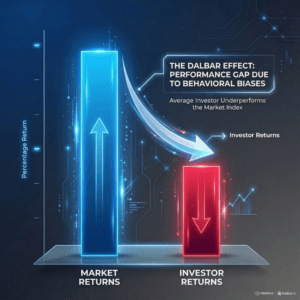
For over three decades, DALBAR Inc., a Boston-based financial services market research firm, has published its annual Quantitative Analysis of Investor Behavior (QAIB). Unlike conventional performance reports that evaluate how mutual funds or stock market indices perform, QAIB asks a more important question: How do investors themselves perform?
The distinction is crucial. A mutual fund may generate returns comparable to its benchmark over a long period, yet the average investor in that very fund could end up earning significantly less. The reason lies not in fund selection, but in investor behaviour—when money is invested, when it is withdrawn and how frequently investors alter their course.
Rather than measuring fund performance, DALBAR analyses aggregate investor cash flows into and out of mutual funds to calculate what is commonly known as the investor return or dollar-weighted return, comparing it with the market’s time-weighted return. In simple terms, it measures the real-world returns investors actually experience after accounting for their own decisions.
The findings remain remarkably consistent.
According to DALBAR’s 2026 QAIB Report, which covers the period ending December 2025, the S&P 500 delivered a return of 17.88 per cent during 2025, while the average equity investor earned approximately 17.16 per cent, leaving a relatively modest gap of about 72 basis points—the third narrowest disparity since 1985.
At first glance, the numbers suggest improving investor discipline. However, a longer perspective tells a very different story.
Over the twenty years ending December 2024, the average U.S. equity investor compounded wealth at 9.24 per cent annually, compared with 10.35 per cent for the S&P 500. An annual behavioural drag of roughly 111 basis points may appear insignificant, but over two decades it compounds into a portfolio worth roughly 22 per cent less than that of an investor who simply remained invested throughout.
Looking even further back, DALBAR’s long-term research shows that relatively small annual behavioural mistakes can erode hundreds of thousands of dollars in wealth over an investment lifetime, highlighting the enormous cost of poor investment decisions when compounded over several decades.
The year 2024 itself offers perhaps the most revealing example. While the S&P 500 returned more than 25 per cent, the average equity investor captured only 16.54 per cent, an underperformance of about 848 basis points, one of the widest gaps recorded in recent years. There was no major financial crisis to explain the difference. Markets rose strongly, but investor conviction failed to keep pace. Many investors remained under-invested, entered too late after markets had already rallied or booked profits prematurely.
Equally revealing was DALBAR’s Guess Right Ratio, a measure of how often investors correctly timed their purchases and withdrawals relative to market movements. In 2024, the ratio reportedly fell to around 25 per cent, indicating that investors got their timing right only about one out of every four occasions. The conclusion was unmistakable: investors continue trying to time the market, but the market continues to prove a difficult opponent.
Behaviour, Not Intelligence
DALBAR attributes this persistent gap not to poor fund selection or high fees, but to recurring behavioural biases.
Loss aversion prompts investors to sell during market declines, often converting temporary losses into permanent ones. Anchoring causes investors to fixate on purchase prices or previous market highs, distorting rational judgement. Herd behaviour encourages investors to chase yesterday’s winners, ensuring they arrive after much of the gains have already been made. Recency bias convinces investors that the most recent market trend—whether bullish or bearish—will continue indefinitely.
These are not failures of intelligence or information. They are emotional responses triggered precisely when markets become most volatile and when long-term investment plans require the greatest discipline.
Can India Simply Borrow DALBAR’s Numbers?
The temptation is to assume that Indian investors suffer an identical behavioural gap. The available evidence, however, suggests caution.
DALBAR’s methodology is based on more than three decades of U.S. mutual fund flow data using a specific accounting framework. India does not yet have a comparable long-term industry-wide behavioural study employing identical methodology. Therefore, it would be inappropriate to directly apply DALBAR’s numerical findings to Indian investors.
Nevertheless, a growing body of Indian evidence points in the same behavioural direction.
Data released by the Association of Mutual Funds in India (AMFI) showed that nearly five lakh SIP accounts were discontinued during January 2025, even as fresh SIP registrations remained healthy. The trend suggested that while new investors continued entering equity markets, many existing investors chose to stop systematic investments during a period of heightened market volatility rather than remain invested through the cycle.
Academic research has also begun examining this phenomenon. One 2025 study analysing more than two decades of Nifty 50 data suggested that once real-world investor behaviour—including SIP interruptions, delayed re-entry and inconsistent investment patterns—is incorporated into performance calculations, realised investor outcomes may be materially lower than the headline returns commonly illustrated in marketing presentations.
Morningstar India describes this phenomenon as the “Investor Return Gap.” Investment returns assume that money is invested at the beginning of a period and left untouched. Investor returns, however, reflect what savers actually experience after switching funds, chasing recent outperformers, pausing SIPs or exiting during market corrections. The conclusion mirrors DALBAR’s central finding almost perfectly: investors often underperform not because they selected poor investments, but because they failed to remain invested in good ones.
Recognising this challenge, the Securities and Exchange Board of India (SEBI) has consistently emphasised investor education, risk profiling, suitability assessments and long-term investing. These initiatives acknowledge an increasingly accepted truth within financial markets—that sustainable wealth creation depends as much on investor behaviour as on product selection.
Lessons for Indian Investors
Several practical lessons emerge from this growing body of research.
First, automation is a behavioural safeguard rather than merely a convenience. A disciplined SIP that continues uninterrupted during market corrections automatically purchases more units at lower prices, precisely when emotions tempt investors to pause investments. Structuring SIPs around long-term financial goals, with periodic step-ups, can make discontinuation psychologically more difficult and improve long-term outcomes.
Second, performance chasing remains one of the surest ways to underperform the market. Switching into whichever category, sector or mid-cap fund topped last year’s return charts often means buying after much of the upside has already been captured. This mirrors the herd behaviour repeatedly identified by DALBAR as a major contributor to long-term investor underperformance.
Third, the role of the financial advisor extends well beyond recommending investment products. The most valuable advice is often behavioural rather than technical. During market downturns, investors rarely need another fund recommendation—they need reassurance that the financial plan they carefully created still deserves their confidence.
DALBAR’s own conclusion, reiterated in its latest report, is both simple and profound: investment success depends less on the performance of investments than on the behaviour of the investor.
For Indian investors, the message is equally relevant.
Markets reward patience far more consistently than prediction. The greatest threat to long-term wealth creation is seldom volatility, inflation or even temporary market crashes. More often, it is the investor abandoning a carefully constructed plan at precisely the wrong moment.
In an era when financial information is available instantly and market opinions flood social media every minute, discipline has become an even more valuable investment asset. Successful investing is ultimately less about discovering the next winning fund than about developing the conviction to stay invested through both optimism and uncertainty.
Behaviour—not brilliance—remains the true determinant of long-term investment success.