

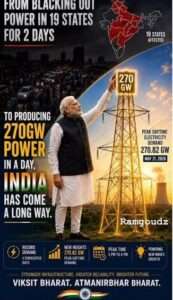
Bharat’s march towards becoming a developed nation is no longer confined to highways, digital infrastructure or manufacturing. A quieter, far more consequential revolution is unfolding in the country’s power sector. It is a transformation that is steadily redefining Bharat’s economic security, strategic autonomy and environmental future. The significance of July 6, 2026, therefore, extends far beyond a statistical milestone. For the first time in history, clean energy—comprising renewable sources, hydroelectricity and nuclear power—briefly supplied more than half of Bharat’s electricity demand. At a peak system demand of 221.5 GW, over 50 per cent of the nation’s electricity came from clean sources, marking a watershed moment in Bharat’s energy journey. More importantly, this was not an isolated occurrence. Energy experts have pointed out that since May, clean energy has met over 45 per cent of Bharat’s electricity demand on nearly fifty occasions. That consistency tells a larger story. India is no longer experimenting with renewable energy; it is integrating it into the very backbone of its power system. This achievement deserves far greater national attention because energy sufficiency has always been one of Bharat’s greatest strategic challenges. For decades, Bharat’s economic growth remained vulnerable to volatile global oil and gas markets, geopolitical conflicts, and disruptions in international supply chains. Every spike in crude oil prices translated into inflation, higher import bills and pressure on public finances.Today, that dependence is gradually beginning to weaken. The rapid expansion of solar parks, wind farms, rooftop installations, pumped hydro storage, battery technologies and nuclear generation is steadily insulating India’s economy from external shocks. Every additional unit of electricity generated from domestic clean energy reduces dependence on imported fossil fuels and strengthens the country’s energy sovereignty. Equally remarkable is the scale at which this transition is taking place. Bharat is not pursuing decarbonisation at the cost of development. It is attempting something no large developing economy has achieved before—providing affordable electricity to over 1.4 billion people while simultaneously expanding the share of clean energy in the national grid. Critics often questioned whether renewable energy could reliably power a country as vast and diverse as Bharat. The events of July 6 provide a convincing answer. While thermal power continues to play a critical balancing role, renewable energy is no longer a peripheral contributor. It is becoming central to India’s energy architecture.
This transformation is also producing significant economic dividends. Lower electricity generation costs from solar and wind are making Indian industry more competitive. Green energy is attracting global investments, generating employment across manufacturing and infrastructure, and creating entirely new sectors around battery storage, green hydrogen and electric mobility. The clean energy transition is no longer merely an environmental agenda—it is rapidly emerging as an economic growth engine. The geopolitical implications are equally profound. Nations that possess secure and diversified domestic energy resources enjoy greater strategic flexibility. As Bharat reduces its exposure to imported energy, it strengthens its negotiating position in an increasingly uncertain global order. Energy security today is as vital as food security or national defence. Of course, challenges remain. Grid modernisation, large-scale energy storage, transmission infrastructure, and round-the-clock power reliability will require sustained investments. Coal, too, will continue to remain an important component of India’s energy mix for years to come. The transition must therefore be carefully managed rather than ideologically driven. Yet none of these challenges diminish the significance of the direction India has chosen. The country’s clean energy achievements are the result of long-term policy continuity, technological innovation, public investment and growing private sector participation. They demonstrate that development and sustainability need not be competing objectives. Bharat’s aspiration of becoming an energy-sufficient nation is no longer a distant vision—it is steadily becoming reality. The milestone achieved on July 6 should be viewed not as the destination but as evidence that the nation is firmly on the right path. History often remembers dramatic events. But sometimes, the defining moments are measured not by headlines, but by the silent hum of a power grid increasingly fuelled by the sun, the wind, flowing rivers and the atom. That silent revolution may well become one of the strongest foundations of India’s journey towards becoming a global economic powerhouse.