Online Desk
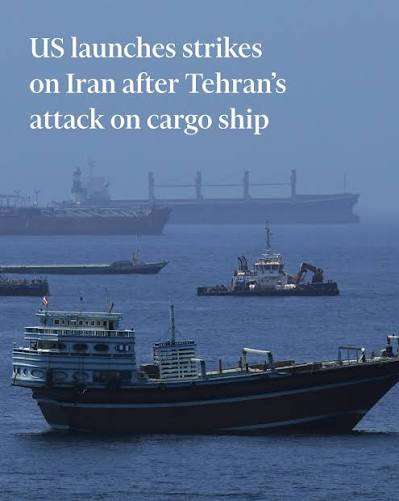
The U.S. military launched new attacks on Iran on Tuesday in retaliation for its attacks against commercial ships in the Strait of Hormuz, U.S. Central Command said.
“U.S. Central Command forces have begun launching a series of powerful strikes against Iran to impose heavy costs for targeting and attacking commercial shipping crewed by innocent civilians in an international waterway,” CENTCOM said on X. “The U.S. strikes are in response to Iranian attacks on three commercial vessels that were transiting the Strait of Hormuz. Iran’s demonstrated aggression was unwarranted, dangerous, and a clear violation of the ceasefire.”
A U.S. official also told NBC News that the U.S. attacks were carried out specifically because of Iranian strikes on ships in the strait.
“This response is a direct result of the acts of international terrorism that have been perpetrated by Iran on innocent ships transiting the Strait of Hormuz,” the U.S. official said. “The Iranians know the consequences to their ridiculous actions, yet they still chose to carry out these attacks.”
U.S. and Iranian officials have been negotiating about maritime traffic in the Strait of Hormuz, a key waterway through which 20% of the world’s oil passed before the war.
Iran has argued that it has a right to charge fees for ships passing through the strait.
U.S. military strikes against Iran continued Tuesday evening and were described by a U.S. official as bigger than previous U.S. retaliatory strikes against the Islamic Republic.
The U.S. military is targeting air defenses, coastal surveillance sites, surface-to-air missile sites, anti-ship cruise missile sites, drone launch sites and port facilities, the U.S. official said.
The strikes are being carried out with Air Force jets and Navy tactical aircraft, according to the U.S. official.
A video posted online and verified by NBC News shows multiple explosions at a port in the city of Bandar Abbas in southern Iran as a stream of cars drives by on a nearby road.
The U.S. on Tuesday also revoked its waiver of temporary sanctions, which had allowed the sale of Iranian oil on the global market, because of Iran’s attacks.
The revoked waiver, listed on the Treasury Department’s website said the move was effective immediately. It also said any production, delivery or sale of Iranian oil must be wound down by July 17.
The waiver had originally allowed sales until Aug. 21.
One tanker was traveling off Oman when it was hit and caught fire, the United Kingdom Maritime Trade Operations center said. Iranian state television said the liquefied natural gas tanker came under attack after it ignored warnings but did not directly claim the assault.
The two other ships sustained some damage, but no one was injured, and both continued on their way, the U.K. maritime agency said.
Oil prices surged from around $69 a barrel to nearly $73 with the latest Iran developments, a nearly 6% increase after weeks of relative calm in oil markets.
A similar exchange of attacks took place in late June when Iran attacked a commercial ship in the Strait of Hormuz and the U.S. military retaliated with 10 attacks on what it described as ‘miliary targets” in and around the strait. Iran then escalated the situation further by carrying out attacks on Bahrain and Kuwait.
The new attacks raise questions about finalizing a lasting agreement to end the war, which the U.S. and Israel launched Feb. 28.
President Donald Trump and Iranian officials signed a memorandum of understanding in mid-June, which kicked off a 60-day period to negotiate a deal.
Trump’s special envoy Steve Witkoff and son-in-law Jared Kushner traveled to Doha, Qatar, last week and held talks with Qatari mediators but did not meet directly with Iranian negotiators who were also in Doha.
Among the most difficult issues to be negotiated are possible restrictions on Iran’s nuclear program and its stockpile of enriched uranium.
The talks appear to have been paused this week as Iran has held massive funeral events for former Supreme Leader Ayatollah Ali Khamenei, who was killed in the opening salvo of the war.
Mojtaba Khamenei, 56, his son, was named his successor in March but has not appeared in public or even issued an audio statement since he assumed the highest post in the country.
Khamenei’s casket was displayed Tuesday in Qom, the Iranian seat of religious scholarship, and Iranian officials have said funeral events will take place Wednesday in Iraq, which is home to two of the holiest shrines for Shiites.
Taking the funeral across the border to Iraq will allow the Islamic Revolutionary Guard Corps, the most powerful military, political and economic force in Iran, to highlight its regional prominence.