



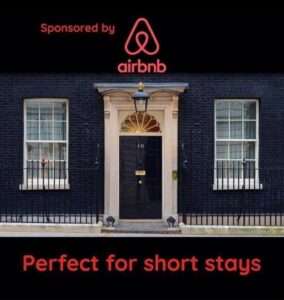
The latest meme doing the rounds on social media deserves preservation in the British Library, right next to the Magna Carta.
It carries an image of the famous black door at 10 Downing Street and the caption: ‘Sponsored by Airbnb – Perfect for short stays.’ One cannot disagree with the description.
For generations, occupying No. 10 was considered the pinnacle of a political career. A leader fought elections, climbed party ranks, stabbed a few colleagues discreetly, and finally earned the right to step through that iconic door. These days, however, the British prime minister appears to arrive with a cabin bag.
The revolving door syndrome
Britain, which taught much of the world the finer points of parliamentary democracy, has lately transformed Downing Street into a political transit lounge.
Margaret Thatcher occupied No. 10 for more than 11 years. Since the Brexit referendum in 2016, however, six distinguished guests have checked into the famous residence – David Cameron, Theresa May, Boris Johnson, Liz Truss, Rishi Sunak and now Keir Starmer.
Even Starmer’s tenancy appears less secure than the average Airbnb booking. Rumblings within the Labour Party have already triggered speculation about his future. At this rate, No. 10 may have to replace the brass nameplate with a whiteboard and marker pen.
Brexit did it
The roots of Britain’s instability lie largely in Brexit, a portmanteau for ‘Britain’ and ‘Exit’ – Britain’s messy divorce from the European Union.
The 2016 referendum fractured both major parties, divided the electorate, and redrew political loyalties. Every prime minister since has had to navigate the political minefield created by that single vote.
Brexit also generated expectations that no government could easily satisfy. Add sluggish economic growth, a cost-of-living crisis and increasingly rebellious MPs, and the result is a revolving door at Downing Street.
Aya Ram, Gaya Ram, and all that
India, too, has had its moments of political musical chairs.
The phrase ‘Aya Ram, Gaya Ram’ originated in Haryana in 1967 after legislator Gaya Lal switched parties repeatedly in quick succession. It predates Indira Gandhi, although defections and opportunism certainly flourished during later decades.
In 1985, the Constitution was amended to curb such defections. Politicians, however, merely innovated. Earlier, individuals defected. Today, entire flocks migrate together.
One nevertheless objects to the phrase. Why should political opportunism always borrow names associated with the Hindu pantheon? Opportunists come in every religion, caste, and ideology. Secular Bharath deserves a more inclusive expression.
Backstabbing, horse-trading, blackmail, and inducements have long been part of the unofficial handbook of politics everywhere.
One Bharath’s prime ministerial experiment lasted just 13 days. Atal Bihari Vajpayee’s first government in 1996 lost the confidence motion by a solitary vote.
Democracy in a monarchy
Kuwait offers another fascinating example. Although it is a monarchy, the country has an elected parliament and an active political life.
The Emir appoints the prime minister, but repeated confrontations between the government and legislators have frequently resulted in resignations, dissolutions, and fresh elections. Even monarchies, it seems, are not immune to democratic turbulence.
Frequent-flyer governments
Britain is not alone. Italy has had nearly seventy governments since the Second World War, averaging one new administration every 1.1 years.
Japan went through a phase in which prime ministers changed so frequently that citizens may have needed monthly updates. Governments there have often collapsed amid scandals or low approval ratings rather than due to scheduled elections.
Meanwhile, Israel has transformed coalition management into a branch of advanced mathematics. Fighting Hamas, Hezbollah, and Iran is often easier than keeping coalition partners happy.
Nepal has elevated political instability to a Himalayan tradition.
Pakistan, meanwhile, has long demonstrated that prime ministers need not necessarily complete their terms.
The management at No. 10 Downing Street may seriously consider partnering with Airbnb. The guests are changing too frequently.

