Upadhyayula Lakshman Rao
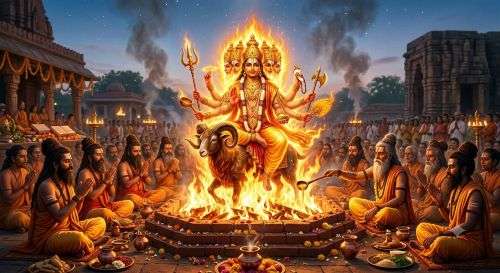
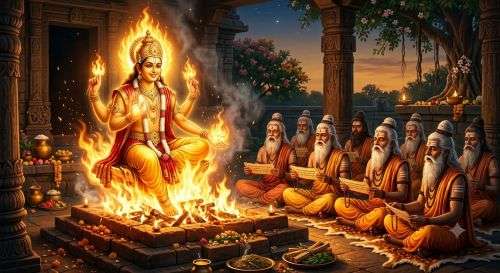
In the ancient vision of the seer Deerghatama, the universe is not a silent expanse but a living hymn, woven through the sacred metres of Rigveda—Anustubh, Tristubh, Jagati, Gayatri, and Pankti—each rhythm embodying a dimension of cosmic order. The sage, in humility, does not declare knowledge but seeks it, for true wisdom in the Vedic mind begins with wonder. He invokes the triad of deities—Surya, Vayu, and Agni—as brothers born of Aditi, representing the visible and invisible forces that sustain existence. Surya radiates as the all-seeing eye, Vayu moves as the unseen breath of life, and Agni receives offerings as the transformative medium between mortal and divine.
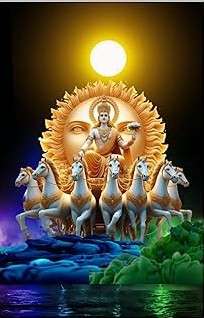
The imagery of Surya’s chariot, with its single wheel and seven horses, is both symbolic and profound. The one wheel represents the unified cycle of time, while the seven horses signify the spectrum of light, the seven meters of hymns, or the seven days that structure human perception of time. The notion that a single horse bears seven names suggests unity within multiplicity, a central principle in Vedic philosophy. The three axes of the wheel that neither decay nor falter evoke a timeless mechanism, hinting at an understanding of cosmic stability akin to modern concepts of orbital balance and universal constants. Every realm seeks refuge in this eternal motion, indicating that time itself is the shelter of existence.
The sage’s inquiry deepens into metaphysical terrain as he questions the origin of life: how the boneless formed bones, how life and blood arose from the earth, and from where the soul emerged. These are not merely poetic musings but early reflections on biological formation and consciousness. His questions echo the spirit of scientific inquiry—an admission of ignorance paired with an unyielding desire to know. He speaks of one year of the Sun, divided into ritual cycles such as Soma sacrifices, which correspond to seasonal and agricultural rhythms, revealing an early synchronization between celestial observation and earthly life.
The depiction of the cosmos as sustained by a twelve-spoked wheel reflects the twelve months, while the 360 days and nights suggest an ancient calendrical system. Agni residing within this wheel symbolizes energy permeating time. The five or six seasons described are not rigid divisions but fluid transitions, showing an awareness of climatic variation. The idea that one season stands apart while others are paired mirrors ecological cycles where certain phases are transitional or dominant. These observations, though wrapped in allegory, reflect a keen sensitivity to environmental patterns and temporal rhythms.
The relationship between heaven and earth is portrayed as a sacred union, where the father sky and mother earth release essence that becomes vegetation. The role of clouds and air in fertilizing the earth points to an intuitive grasp of the water cycle. Rain, held in the womb of clouds and released through the interplay of air, transforms the barren into the fertile. This poetic articulation aligns with scientific understanding of evaporation, condensation, and precipitation, demonstrating how Vedic thought bridges symbolism and observation.
The notion that Aditya has three mothers—earth, sky, and space—and three fathers—Agni, Vayu, and Surya—reveals a multidimensional origin of energy and life. It suggests that existence is born from the convergence of elements and forces rather than a singular source. The gods themselves are depicted as seekers, discussing the nature of the Sun without पूर्ण comprehension, emphasizing that even divine intelligence is engaged in continuous exploration. This humility before the infinite is a hallmark of Vedic wisdom.
The allegory of two birds on a single tree—one consuming the fruit and the other merely witnessing—captures the distinction between the individual soul and the universal आत्मन्. The experiencing self engages with the world, while the witnessing self remains untouched, a concept later elaborated in the Upanishads. This duality reflects psychological awareness of action and awareness, paralleling modern distinctions between ego and consciousness.
The rays of the Sun are described as both feminine and masculine, depending on perception, indicating that reality transcends binary categorization. These rays absorb water, sustain life, and illuminate the world, embodying both nurturing and dynamic qualities. Their nightly rest upon trees and radiant return at dawn symbolize cycles of rest and renewal, essential to both nature and human life. The one who understands these patterns is said to attain immortality—not in body, but in knowledge and alignment with the eternal.
The sage concludes with reverence for the structure of sacred sound, where metres like Gayatri, Tristubh, and Jagati are not mere poetic forms but frameworks of cosmic resonance. The गायत्री, with its threefold structure, is exalted as a vessel of illumination. The milking of the cosmic cow becomes a metaphor for extracting wisdom from the universe, where only the skilled and attentive can draw the essence. Thus, the hymn stands as both a prayer and a philosophical treatise, where spirituality and scientific temperament are not opposed but harmonized in the pursuit of truth.