Rahul Gandhi and Donald Trump may disagree on almost everything under the sun, but they have inadvertently formed one of the most productive political partnerships in recent times.
Trump speaks. Rahul amplifies. Trump speculates, Rahul celebrates. Trump attacks Modi, and Rahul treats it as certified truth.
One can almost imagine the LOO (Leader of the Opposition) keeping a permanent alert on his phone for every utterance emerging from Mar-a-Lago or the White House.
The gospel according to Donald
When Operation Sindoor was underway and Bharatiya forces were striking terrorist infrastructure and strategic targets across the border with surgical precision, Trump reportedly tried repeatedly [17 times as the New York Times reports] to get through to Prime Minister Narendra Modi.
Bharat was carrying out military operations. Trump, meanwhile, appeared to be pursuing his perennial dream of a Nobel Peace Prize.
If there was a conflict anywhere on the planet, he wanted his fingerprints on the peace agreement, his signature on the ceasefire, and preferably his name engraved on a medal in Oslo.
When a ceasefire followed, Trump declared himself the central character and claimed credit for ending the conflict.
Enter Rahul Gandhi. Without wasting a moment, he embraced Trump’s version as if it had descended from the heavens engraved on stone tablets.
Soon came the slogan ‘Narender Surrender’. It was clever and catchy. It was also built entirely on the assumption that Trump’s version of events was the only one worth believing.
For a politician who regularly warns Indians about misinformation, Rahul displayed remarkable faith in a man not universally known for restraint in self-promotion.
Selective faith
The irony is impossible to miss. When Trump criticises Bharat, he is suddenly a reliable witness. When he criticises Modi, he becomes an authoritative source.
When Trump says Bharat’s economy is ‘dead’, Rahul clings to the statement like a limpet. The economy, unfortunately for both men, refused to cooperate. Growth, investments, and businesses continued.
India remained one of the world’s fastest-growing major economies. Reality once again proved inconvenient.
The Iran conundrum
Now, let us come to the latest chapter. After more than four months of conflict involving Iran, Israel and the Gulf region, Trump has announced an end to hostilities.
The conflict disrupted trade, rattled energy markets, and threatened the global economy through concerns surrounding the Strait of Hormuz.
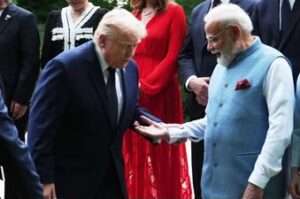
Eventually, Trump stepped back. Fair enough. Wars often end through negotiation rather than total victory. But the obvious question remains. Who made him do it?
Did Vladimir Putin pick up the phone and issue instructions? Did Xi Jinping twist his arm? Or, did Narendra Modi thunder from New Delhi, ‘Donald Surrender’?
Will Rahul Gandhi now accuse Trump of capitulation? Will he organise press conferences explaining how the American President meekly obeyed a foreign leader?
Will he demand answers every day in Parliament? One suspects not. Apparently surrender is a flexible concept. Its meaning changes according to the political requirements of the moment.
Waiting for Bharat to fail
Perhaps the most troubling aspect of this politics is the eagerness with which every negative prediction about India is embraced.
When foreign commentators predict economic collapse, some Opposition leaders cheer. When external critics attack India, they are instantly elevated into prophets.
Sometimes we get the impression that certain politicians would rather see their predictions come true than see their country succeed.
If Bharat prospers, their narrative suffers. If it stumbles, they believe their opportunity arrives. It is politics reduced to a peculiar form of national pessimism.
The Prince of La Mancha
Rahul Gandhi often speaks as though he is battling invisible enemies visible only to him. In one viral clip, he even suggested that Modi is not really the prime minister.
In his political universe, institutions are compromised, victories are illegitimate, successes are imaginary, and reality itself requires correction.
Like Cervantes’ famous knight, our Rahul de la Mancha charges endlessly at windmills, convinced they are giants threatening civilisation. The difference is that Don Quixote was fictional.
The consequences of political delusion in a democracy are very real. A strong Opposition is indispensable, and a vigilant Opposition strengthens democracy. But a LOO who treats every Trumpism as gospel when it serves a partisan purpose risks becoming a parody of itself.
As for ‘Narender Surrender’, the slogan has aged rather badly. The man who was supposedly surrendering appears to have continued governing.
The economy that was supposedly dead appears stubbornly alive. And the politician who coined the slogan continues wandering through his own political La Mancha, lance in hand, chasing windmills and mistaking echoes for evidence.