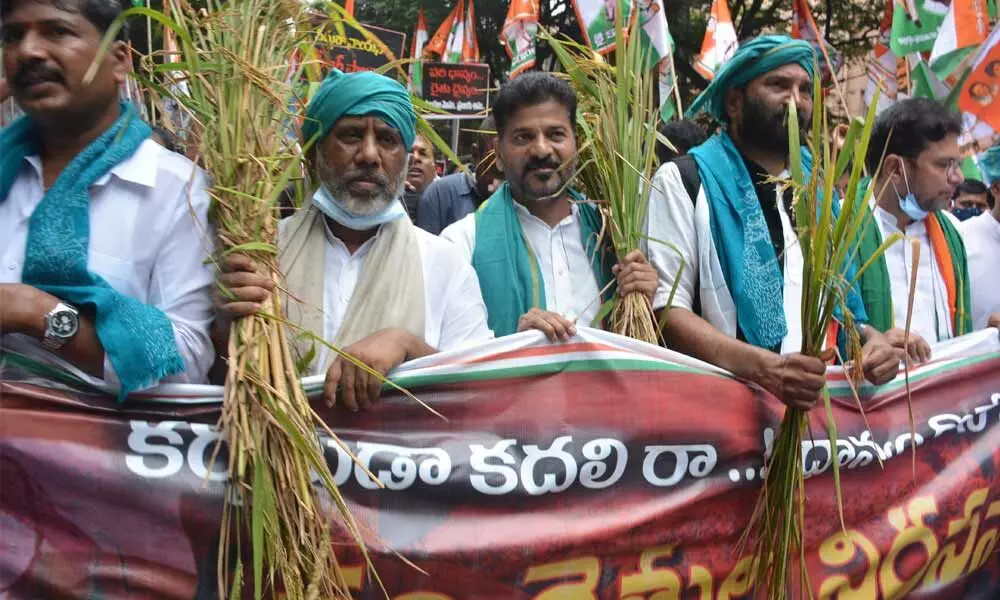
For yet another year, Telangana’s paddy procurement issue has transformed into a predictable political spectacle rather than a serious exercise in agricultural governance. Every harvest season, the same script unfolds: farmers wait anxiously, procurement centres struggle to cope, paddy piles up in the open, and the ruling dispensation in Hyderabad rushes to accuse the Narendra Modi-led Centre of abandoning the state’s farmers.
Before the Congress, the Bharat Rashtra Samithi (BRS) government perfected this strategy. Today, the Congress government led by Chief Minister A. Revanth Reddy has simply inherited and repackaged the same narrative. The players may have changed, but the politics remains exactly the same.
The unfortunate truth is that Telangana’s farmers are being used as instruments in a perpetual blame game.
There is no denying that the Union Government has a significant responsibility in ensuring food security and maintaining an effective procurement ecosystem through the Minimum Support Price (MSP) mechanism. However, it is equally true that there are practical and constitutional limitations to what the Centre can do.
No government in New Delhi, irrespective of which party is in power, can be expected to purchase every single grain of paddy produced by every state every year. Such an expectation is neither economically sustainable nor administratively feasible.
Procurement targets are determined after considering national demand, storage capacities, existing food grain stocks and consumer preferences. The Food Corporation of India (FCI) is not an unlimited warehouse with an endless budget.
Yet, successive governments in Telangana have conveniently ignored these realities.
A particularly inconvenient truth is that Telangana produces substantial quantities of parboiled rice during the Yasangi or Rabi season. Over the years, the FCI has repeatedly conveyed that its ability to procure parboiled rice is constrained because of surplus national stocks and limited consumer demand.
This is not a policy suddenly invented to target Telangana. It is an economic reality that state governments were made aware of well in advance.
In fact, even former Chief Minister K. Chandrasekhar Rao had at one stage advised farmers to diversify and adopt alternative crops. While his government too frequently blamed the Centre, it at least acknowledged that continuously increasing paddy cultivation without considering market realities would eventually become unsustainable.
The present Congress government, however, appears more interested in political confrontation than practical solutions.
The demand that the Centre should compulsorily purchase the entire paddy output simply because it announces MSP is both misleading and irresponsible. MSP is a price assurance mechanism; it is not an unconditional guarantee that every kilogram produced in every state will be purchased regardless of quality, demand, or logistics.
If Telangana possesses the capacity to procure 75 lakh metric tonnes, it cannot automatically insist that the Centre absorb all of it.
That raises an uncomfortable question: what long-term agricultural planning has the state government undertaken to reduce overdependence on a single crop?
Have farmers been adequately educated about crop diversification? Have incentives been provided for pulses, oilseeds or other commercially viable alternatives? Have local procurement systems been strengthened?
Unfortunately, the answer remains unsatisfactory.
It is also unfair to blame New Delhi for every logistical failure on the ground. Under the established procurement framework, state governments bear substantial responsibility for operationalising procurement centres, ensuring the availability of gunny bags, organising transportation, coordinating with rice mills, and protecting harvested grain from adverse weather conditions.
When paddy lies exposed to unseasonal rains, accountability cannot automatically be shifted to Delhi.
Equally questionable are allegations that Punjab and Haryana are receiving preferential treatment. Such comparisons deliberately ignore historical procurement patterns, consumer demand profiles and established grain supply chains that have evolved over decades.
Political rhetoric may generate headlines, but it does not solve farmers’ problems.
The larger issue is the absence of a coherent agricultural strategy in Telangana. Encouraging unrestricted paddy cultivation year after year, despite repeated warnings about procurement constraints, only sets farmers up for disappointment. Governments cannot continue making promises they know cannot be fulfilled.
Farmers deserve honesty, not theatrics.
The Centre, for its part, must continue engaging constructively with states and provide procurement clarity well before sowing seasons begin. But state governments, irrespective of political affiliation, must stop treating the Union Government as a convenient punching bag whenever their own planning falls short.
Agriculture cannot be run through press conferences and political accusations.
The annual paddy row has become less about farmers’ welfare and more about political survival. Telangana’s farmers deserve far better than being caught between Hyderabad’s rhetoric and Delhi’s limitations.
The time for blame games is over. The time for responsible governance, realistic crop planning and genuine cooperation has arrived.
Anything less would amount to a betrayal of the very farmers in whose name these political battles are being fought.