


MS Shanker
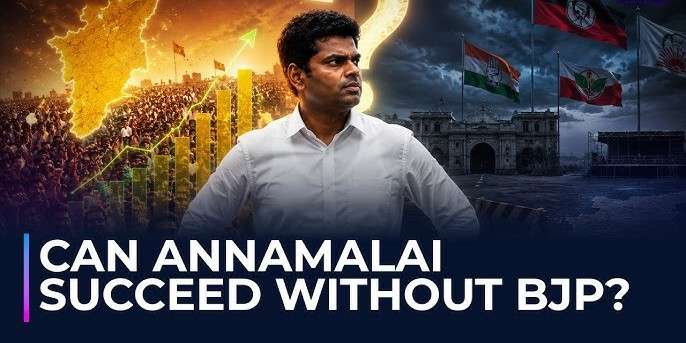
The departure of K. Annamalai from the Tamil Nadu BJP has triggered intense speculation about his future political course. While the separation between the party and the present state chief appears cordial, the larger question remains: has Annamalai become overconfident about his political prospects, or is he positioning himself for a bigger role in Tamil Nadu’s rapidly evolving political landscape?
Annamalai’s political journey has been anything but conventional. A former IPS officer who walked away from a prestigious career in public service, he entered politics with the kind of media attention few first-time politicians receive. His rise within the BJP was swift, and his aggressive, no-holds-barred style helped him emerge as one of the most recognizable political faces in Tamil Nadu.
However, popularity and political success are not always synonymous.
Tamil Nadu has historically been a graveyard of political ambitions built solely on personal charisma. The state’s politics has largely been shaped by powerful ideological movements, entrenched party structures, and larger-than-life personalities who spent decades cultivating public support.
Many film stars have attempted the transition from cinema to politics with varying degrees of success. The late M.G. Ramachandran and J. Jayalalithaa remain exceptional cases rather than the norm. Even superstars with enormous fan followings have often hesitated to take the plunge. Rajinikanth ultimately chose not to enter active electoral politics despite years of speculation. Kamal Haasan launched his own party but struggled to convert popularity into substantial electoral gains. Eventually, he aligned with the DMK-led alliance and secured a Rajya Sabha berth, underscoring the harsh realities of electoral politics.
Against this backdrop, Annamalai appears to be studying another emerging phenomenon — actor Vijay’s political entry.
Vijay’s launch of a political movement has altered the political conversation in Tamil Nadu. Unlike traditional politicians, he commands a vast youth following and possesses immense visibility. Yet political visibility alone does not guarantee organizational strength or electoral success.
Annamalai appears to be positioning himself as a contrasting alternative. While Vijay brings cinematic appeal and Udayanidhi Stalin carries the advantage of a powerful political surname, Annamalai seeks to project himself as a self-made leader with administrative experience, nationalist credentials, and a reputation for personal integrity.
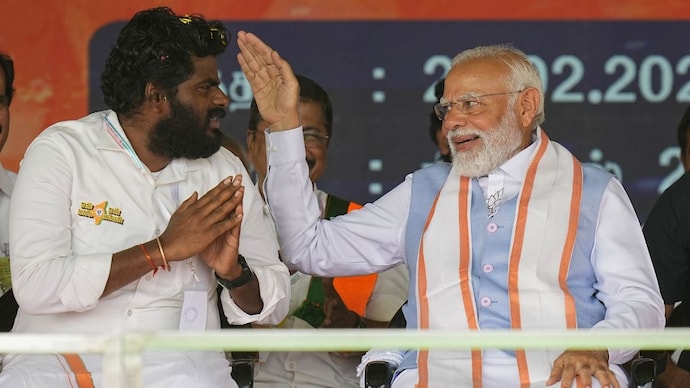
In that sense, he occupies a unique political space. But that space was not created by Annamalai alone. It was also built on the foundation provided by the BJP and, more importantly, the popularity of Prime Minister Narendra Modi. If Annamalai believes that the BJP’s improved vote share in Tamil Nadu was solely his achievement, he may be overestimating his individual contribution. He would not have reached his current stature without the backing, resources, and national visibility provided by a party that has spent decades building its political footprint across the country.
History offers several examples of highly respected bureaucrats who entered public life with enormous goodwill and impeccable credentials, only to discover that personal integrity and administrative experience do not automatically translate into electoral success. Politics ultimately requires not only credibility and communication skills but also organizational strength, grassroots networks, sustained funding, and the ability to convert admiration into votes.
That said, Annamalai’s supporters would argue that he possesses qualities that distinguish him from many of his contemporaries. He is intellectually sharp, an effective communicator, and among the few Tamil politicians capable of combining regional pride with a broader national outlook. Unlike many BJP leaders in southern India, he has attempted to localize his politics rather than merely echoing national narratives.
All that may be true. But the larger question remains: can any individual politician, however talented, succeed without a robust organizational structure and substantial financial resources?
One of the biggest challenges Annamalai faced during his tenure as BJP state president was the perception among sections of Tamil voters that he represented a “North Indian party.” Whether justified or not, that label limited his appeal beyond the BJP’s traditional support base. Ironically, such criticism often ignores the fact that Tamil Nadu has repeatedly sent leaders from Dravidian parties to serve as Union Ministers in governments led by both the Congress and the BJP. Participation in national politics has never prevented regional leaders from asserting Tamil identity.
In that context, it is understandable why some of Annamalai’s supporters believe that he could eventually seek to reposition himself primarily as a Tamil leader who also happens to be a nationalist, rather than as a BJP leader first and foremost. Such a repositioning, if it ever occurs, could potentially broaden his appeal among voters who remain skeptical of the BJP brand.
Whether such a strategy succeeds remains uncertain.
The manner in which Annamalai’s transition unfolded is also noteworthy. There has been little public bitterness. Neither BJP leaders nor Annamalai himself have indulged in criticism. The separation resembles a strategic pause rather than a political divorce.
This has naturally fuelled speculation about his next move. Some believe he could eventually assume a larger national role within the BJP. Others see the possibility of a regional political platform emerging around him. There are even those who speculate about future alignments with political forces seeking an alternative to the DMK-AIADMK duopoly.
Yet politics is rarely as straightforward as public enthusiasm suggests.
Annamalai’s greatest asset today is also his greatest risk. Expectations surrounding him have risen dramatically. The image of a clean, articulate, educated and energetic leader can generate excitement, but it can also create immense pressure. Tamil Nadu voters have historically demanded not merely charisma but also organizational depth, electoral machinery, and long-term commitment.
The state is clearly entering a period of political transition. The dominance of the traditional Dravidian giants is being challenged by demographic changes, social media-driven politics, growing voter aspirations, and the emergence of new personalities. Vijay is attempting to capitalize on this moment. Udayanidhi Stalin represents the next generation of the DMK. Annamalai is trying to carve out his own space between them.
Whether this confidence ultimately turns into overconfidence or proves to be strategic foresight will only become clear in the years ahead.
One thing, however, is certain: Tamil Nadu politics is becoming more competitive, more unpredictable, and far more interesting than it has been in decades. In such a fluid environment, Annamalai’s next move may determine not only his own political future but also whether a genuine third political space can emerge in a state long dominated by two Dravidian giants.


There is no denying that his exit is BJP’s loss in TN and in the south in general. Conversely whose gain it is only time will tell. He faces many challenges in founding and sustaining a political party in the prevailing political ecosystem. To be fair to him he proved himself as an upright civil servant and an able organiser with persuasive power. Age is on his side. There is everything going in his favour. One can only wish him good luck.