



Democracy in India is deeply rooted not only in Parliament, the Legislative Assembly, and larger political forums, but also in the local institutions of villages, towns, and cities. Panchayats and municipal bodies are the smallest but most vibrant units of democracy, where the public participates in governance through their direct representatives. To increase women’s participation in these institutions, the Constitution provided for reservations so that they are not confined to the domestic sphere but can play an active role in the decision-making process. However, the harsh reality today is that in many places, women Sarpanchs and women Councillors are merely nominal representatives, while their husbands or male family members handle the actual work. This situation gives rise to terms like “Sarpanch Pati” and “Councillor Pati.”
This question is not merely a formality, but one that touches the very essence of democracy. When a woman is elected to office, it is backed by public trust, constitutional rights, and political participation. If someone else makes decisions, participates in meetings, or performs administrative duties in her place, it is an affront to the mandate given by the voters. Allowing a man to exercise power in the name of a female representative not only violates democratic norms but also undermines the very spirit of the reservation policy.
The 73rd and 74th Constitutional Amendments gave a new dimension to local self-governance in India. These amendments ensured reservations for women in Panchayats and municipal bodies. The objective was to ensure that women were not merely visible in Panchayats as a number, but rather participated in leadership, administration, planning, and policy implementation. This brought millions of women into local politics, many of whom demonstrated exceptional ability, sensitivity, and public relations skills. Many women Sarpanches accomplished remarkable work in areas such as water, sanitation, education, health, and social justice. This also proved that, given the opportunity, women are in no way inferior to men.
Yet, it is also true that the broader social structure remains patriarchal. In villages, especially in many areas of North India, women lack sufficient social acceptance to participate freely in public life. Even with education, they often refrain from making decisions due to traditional pressures, family control, and fear. In some places, after marriage, the political identity of a female representative virtually disappears, and her husband takes her place. As a result, her constitutional rights remain on paper, but in practice, those rights are transferred to the male members of the family. This is a matter of serious concern for a democratic system.
The root of the problem is not merely personal, but also social and institutional. In many families, the mindset has developed that the position of a female representative is essentially a “family position” to be held by the husband or father-in-law. People who think this way forget that an elected position is held by an individual, not a family. Legally, the officeholder is the one elected by the people. If someone else begins making decisions on their behalf, it violates the concept of representative governance. This not only limits women’s freedom but also sends a negative message to future generations of female leaders.
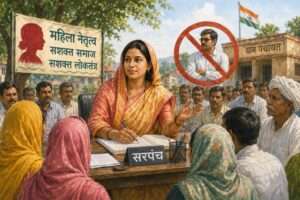
The Haryana State Information Commission’s comments on this issue are particularly significant. The Commission clearly stated that it is wrong for women Sarpanches’ husbands to participate in government meetings or administrative work in their place. This statement not only reflects administrative rigidity, but also points to the fact that women’s reservation still needs to be implemented seriously. If the powers of elected representatives are being delegated to someone else, then what is the meaning of the electoral process? The Commission’s comments have brought back into the national discourse the debate: are we truly empowering women, or merely using their name?
Many argue that rural women are often uneducated, inexperienced, or under social pressure, so their husbands take over administrative tasks. This argument may be partially correct, but it is not a solution to the problem. It is not fair to take away a woman’s rights because of her weakness. If a woman is uneducated, she should be educated. If she lacks administrative experience, she should be trained. If there is social pressure, society and the administration should provide her with protection and support. The solution to the problem is not power transfer, but empowerment.
This is where the role of the state and society becomes crucial. The government must ensure that elected women representatives are properly educated on procedures, financial management, laws, Gram Sabha operations, development plans, and grievance redressal. Simply holding elections and leaving it at that is not enough. If women receive regular training, guidance, and institutional support, they can confidently lead. Training programs for women Sarpanches have been conducted in several states, and these have yielded positive results. This clearly demonstrates that women are capable of leadership; they simply need the opportunity and the environment.
But administrative measures alone will not suffice. Until societal thinking changes, the culture of “Sarpanch Pati” (Sarpanch Pati) and “Parshad Pati” (Councilor’s Husband) will persist. In villages and small towns, political power is often associated with male dominance. Women hold positions, but are not allowed to have the final say in decisions. Sometimes, even though they are present in meetings, it is their husband who speaks. Sometimes, even officials find it more convenient to communicate with their husbands rather than with female representatives. This convenience is detrimental to democracy, as it implicitly legitimizes wrongdoing.
Political representation isn’t just about sitting on a chair. It involves understanding public issues, setting priorities, equitably distributing resources, and maintaining accountability. When a man replaces a female representative, the woman’s political identity is diminished. The long-term impact is that the perception in society that women are unsuitable for leadership is reinforced. The reality is that women can provide more sensitive, practical, and public-oriented leadership. Numerous studies and local experiences show that women’s leadership often increases transparency and social concerns.
It must also be remembered that women’s reservation is not the result of any mercy or grace. It is a constitutional measure to balance historical injustice. For centuries, women were excluded from politics, public life, and property-related decisions. They were confined to the confines of family and home. Reservation is an attempt to mitigate this inequality. Therefore, if male control continues in the name of reservation, it is tantamount to perpetuating historical injustice. In fact, the culture of “Sarpanch Pati” undermines the achievement of reservation.
In this context, it is also essential that the presence of elected women representatives be accepted as mandatory in meetings with elected women representatives. The administration should establish a clear rule that no one can participate in any government proceedings, meetings, documentation, or decision-making in place of the representative. This is not just a matter of discipline, but of constitutional decorum. If officials themselves adhere to this rule, bad practices will be weakened. Furthermore, accountability should be fixed for the absence of public representatives to curb the practice of nominal participation.

