



The debate begins in Rohtak
Democracy is not merely a means of winning elections and gaining power; it is also a continuous process of improving conduct, dignity, and respect for institutions. The true strength of a democratic system lies in its constitution, laws, and institutions. Democracy is strengthened when public representatives and administrative officials perform their duties with respect. However, when conflict between these two becomes public, it becomes more than just a personal dispute but raises serious questions about democratic values, administrative autonomy, and political culture. The recent altercation between Indian National Lok Dal MLA Arjun Chautala and Superintendent of Police Gaurav Rajpurohit in Rohtak, Haryana, has sparked such debate. The viral video on social media and the subsequent reactions have not only confined this incident to a political controversy, but have also linked it to questions of democratic decorum and institutional respect.
Indian democracy empowers public representatives to raise the voice of the people. Protests, sit-ins, memorandums, and movements are integral to the democratic system. Opposing the policies of any government is not only the opposition’s right but also its responsibility. Political parties raising voices on issues related to inflation, unemployment, education, health, and public interest is part of the democratic process. However, democracy also requires that dissent be expressed with decency and within constitutional limits. When public representatives themselves begin to overstep the boundaries they expect others to uphold, democratic culture is undermined.
In the Rohtak incident, based on available video and public reports, it is clear that a heated exchange occurred between the MLA and the Superintendent of Police during the protest. The language and tone of the conversation in the video generated widespread public discussion. The Haryana IPS Association’s public outreach and statement in support of the police officer following the controversy adds further significance to the matter. Generally, administrative organizations rarely comment publicly on political controversies. When a professional organization openly supports its officer, it indicates that the matter is not being viewed as limited to a mere personal disagreement.
It is true that the final assessment of any incident should be made only after an impartial investigation of the facts. In a democratic system, it is not appropriate to blame anyone solely on the basis of a viral video or social media. Any party has the right to present its side. The MLA also stated in his defense that he did not intend to insult any official and that the dispute arose due to circumstances. From the perspective of democratic justice, this side should also be heard. But equally important is the question: can any circumstance grant a public representative the moral right to publicly use abusive language against an official? Disagreement is natural in democratic politics, but there is a clear line between disagreement and indecency.
India’s administrative system is governed by the Constitution. Police officers and other administrative officials are not elected, but they are a vital part of the state’s institutional structure. Their job is to ensure the impartial implementation of the law. On the other hand, public representatives are elected by the people and are responsible for conveying issues of public interest to the government and administration. Cooperation and dialogue between these two roles are the cornerstone of democratic governance. If public representatives begin to view administrative officials as mere subordinates, or if administrative officials begin to view public representatives as unimportant, the balance in governance will be lost.
Therefore, respectful behavior between both parties is essential.
It must also be understood that public representatives in a democracy enjoy privileges, but they are not above the law. The Constitution does not grant any elected representative the right to behave disrespectfully toward any official holding a public office. The position of a public representative is honorable, but this honor is accompanied by responsibility. The public expects not only political struggle from their representatives, but also restraint, decency, and exemplary behavior. When a public representative loses control of their language and behavior on a public platform, the impact is not limited to that incident alone. It also sends a message to society that decorum can be circumvented based on power and influence.
Unfortunately, such incidents are not new to Indian politics. From time to time, reports of conflicts between public representatives and officials have surfaced in various states. Sometimes, allegations of intimidation of an official surface, sometimes cases of mistreatment of an employee arise, and sometimes controversies arise over political interference in administrative decisions. The biggest harm of these incidents is that public trust in institutions begins to weaken. When people see those in power publicly insulting officials, respect for the law is also affected.
An important aspect of this phenomenon is administrative autonomy. There has long been a debate in India that the police and administration should be free from political pressure. Various commissions and courts have also emphasized the need for police reforms. If officers feel they may face political pressure or public humiliation at any time, their impartial performance may be affected. On the other hand, if officers become uncooperative or insensitive toward public representatives, democratic accountability may be weakened. Therefore, both balance and dialogue are essential.
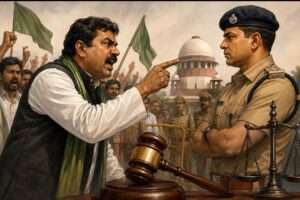
Social media turned this entire controversy into a national topic of discussion. Today, videos of any incident reach millions of people within minutes. This is a positive aspect of transparency, as it increases accountability for both the government and the administration. However, there is a downside. Incomplete information, edited videos, and emotional reactions often overshadow the actual facts. On social media, people often pass judgment first and then seek facts later. Therefore, it is essential to adopt a restrained approach in such matters.
The role of the media is also crucial in this context. The purpose of journalism is not to promote any side but to present the facts. If the media focuses solely on sensationalism and abandons objectivity, it can lead to confusion in society. In a democracy, the media is called the fourth pillar because it is expected to ensure accountability for all – power, politics, and administration. In reporting this incident, the media should give equal importance to facts, context, and the perspectives of all parties.
The public response clearly demonstrates that society now expects decency and accountability in public life. While political parties may differ in their ideologies, most citizens believe that the level of dialogue in a democracy should not be lowered. Protest is a democratic right, but the language and style of protest must also be democratic. If political competition devolves into personal insults and displays of power, the level of democratic discourse is weakened.
This entire episode sends a broader message: India’s democratic institutions must strengthen a culture of mutual respect. Public representatives must understand that administrative officials are not their political rivals but partners in governance. Officials must also remember that public representatives represent the aspirations and expectations of the people. Only dialogue and cooperation between the two parties can form the basis of good governance.
Today, there is a need for political parties to sensitize their leaders and workers to democratic conduct. Political training should not be limited to election-winning strategies, but should also include the decorum of public life, constitutional values, and institutional respect. Similarly, communication skills and the ability to coordinate with public representatives should be promoted in the administrative services.
The power of democracy lies not in any one individual, party, or institution, but in the balance and respect among them all. If public representatives and officials begin to view each other as rivals, governance will weaken. But if both act in accordance with the spirit of the Constitution, democracy will be strengthened. The Rohtak incident should be viewed not merely as a political controversy but as a test of democratic norms. This is an opportunity for introspection, to understand that the true meaning of power is not authority but responsibility.
Ultimately, in a democracy, no matter how high a person’s position, they are expected to respect the law, the Constitution, and public decorum. Public representatives are role models for the public, and administrative officials are the guardians of the law. The dignity of both is linked to the dignity of the democratic system. Therefore, under any circumstances, communication should be polite, behavior respectful, and conduct democratic. This is the hallmark of a healthy democracy, and this is the biggest lesson to be learned from this entire controversy.

