



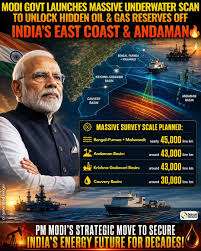
For a nation of 1.4 billion people aspiring to become a developed economy by 2047, energy is not merely a commodity. It is strategic power. It fuels industries, protects economic stability, sustains military preparedness, and ultimately determines whether Bharat rises as a global power or remains vulnerable to external shocks. The Narendra Modi-led NDA government appears to have understood this reality better than many of its predecessors. Instead of panicking amid global turmoil, it has chosen an aggressive and calculated “energy hunt.” The timing is hardly accidental. The prolonged Russia-Ukraine war, instability in West Asia, attacks on shipping routes, and rising geopolitical rivalries have exposed the dangerous fragility of global energy supply chains. Bharat imports nearly 85 percent of its crude oil requirements and over 50 percent of its natural gas needs. Every spike in international oil prices directly hits the Bharat economy, weakens the rupee, widens the fiscal deficit, and increases inflationary pressure on ordinary citizens. No responsible government can afford complacency under such circumstances. That explains why Bharat has simultaneously launched deep-sea hydrocarbon exploration, expanded renewable energy capacity, strengthened strategic petroleum reserves, and accelerated nuclear capability. This is not random policymaking. It is strategic diversification. Perhaps the most fascinating aspect of this energy hunt lies beneath Bharat’s waters. Geological assessments suggest that India’s offshore sedimentary basins may still hold massive untapped hydrocarbon wealth. The Krishna-Godavari (KG) Basin alone is estimated to contain several trillion cubic feet of natural gas reserves. The Andaman offshore region, often compared geologically to prolific Southeast Asian energy zones, is increasingly being viewed as a potential game changer. Some exploratory estimates indicate the Andaman Basin may hold enormous untapped gas reserves, though commercial viability still requires confirmation through extensive seismic surveys and drilling. The Bay of Bengal has similarly emerged as a strategic frontier. India’s Directorate General of Hydrocarbons has repeatedly indicated that nearly 42 percent of Bharat’s sedimentary basin area remains underexplored. That statistic alone explains why the Ministry of Petroleum is aggressively inviting bids for deep-sea geological and seismic mapping. India is effectively searching for hidden economic sovereignty buried beneath the ocean floor. Critics may dismiss this as expensive risk-taking. But nations do not become energy secure by waiting for perfect conditions. They become secure by investing before crisis deepens.
Simultaneously, New Delhi is wisely ensuring that short-term energy survival does not compromise long-term sustainability. India’s non-fossil fuel power capacity has already crossed 200 GW, including solar, wind, hydro, and nuclear sectors. India today ranks among the world’s fastest-growing renewable energy markets. The government’s target of achieving 500 GW of non-fossil capacity by 2030 is ambitious, but strategically necessary. Solar parks across Rajasthan and Gujarat, offshore wind projects, green hydrogen missions, and domestic battery manufacturing are not simply environmental projects. They are economic shields against future import dependency. Equally important is India’s nuclear push. The successful first criticality of the Prototype Fast Breeder Reactor (PFBR) at Kalpakkam in Tamil Nadu is a milestone with enormous strategic significance. Unlike conventional reactors, breeder reactors can generate more fissile material than they consume, making them critical for India’s long-term three-stage nuclear program built around the country’s vast thorium reserves. Bharat possesses one of the world’s largest thorium deposits, particularly along the coastal sands of Kerala, Tamil Nadu, Andhra Pradesh, and Odisha. If fully harnessed over the coming decades, thorium-based nuclear energy could fundamentally alter India’s energy equation. Meanwhile, strategic agreements with partners such as ADNOC in the UAE help India maintain emergency supply stability. Strategic petroleum reserves at Visakhapatnam, Mangaluru, and Padur are designed precisely for moments when global markets become unpredictable. Yet the challenge remains enormous. Bharat’s manufacturing ambitions, electric mobility expansion, digital economy growth, and rising middle-class consumption will continuously increase energy demand. The International Energy Agency estimates Bharat could account for one-quarter of global energy demand growth over the next two decades. That means Bharat’s energy hunt is not temporary. It is civilizational. The harsh truth is simple: no major power in history has risen without securing reliable energy access. Bharat cannot become a $10 trillion economy while remaining hostage to foreign supply disruptions. The Modi government’s multi-front strategy — offshore exploration, renewables, nuclear expansion, and strategic reserves — may not produce instant miracles, but it reflects realism, urgency, and strategic foresight. Energy security is no longer just an economic issue. It is national security itself.



Hello MS garu
A well researched article with details of what and how Modi’s Government is exploring for energy of various forms in various ways aggressively. Your input with details is appreciated. Thank you
Apt reality to be focused upon .. very well exposed through your article. Definitely our Nation needs to maximise the enrichment of sea potential which has long been overdue.. 👏🏻👌🏼👍🏼