



India is set to conduct its first fully digital census in 2027. This is not just an administrative exercise, but marks a historic shift in India’s governance, development policy, and democratic framework. Just as the first census of independent India provided the newly formed nation with a foundation to understand its population, resources, and social structure, the 2027 digital census will usher India into a new era of data-driven governance. This initiative is considered one of the most ambitious projects of the Digital India campaign, utilizing cutting-edge technologies such as mobile applications, self-enumeration portals, cloud-based real-time data uploads, geo-tagging, and digital dashboards.
The last census in India was conducted in 2011. Since then, the 2021 census has been postponed for various reasons, including the COVID-19 pandemic. As a result, the country has had to rely on outdated data for nearly 14 years. During this time, India has undergone significant changes in urbanization, migration, employment structure, digital use, education, health, and population distribution. Therefore, the 2027 census will not be merely a statistical exercise, but will provide a true picture of modern India. Significantly, this will be the first time such a large census will be conducted digitally in a country as vast and diverse as India.
The biggest advantage of a digital census lies in its speed and efficiency. Traditional paper censuses often took two years or more to collect, verify, code, enter, and analyze data. However, in a digital system, data will be uploaded directly to a server, allowing for automated verification and analysis. This could result in preliminary results within ten days, and a final detailed report within six to nine months. This change not only saves time but also significantly increases the speed and accuracy of policymaking. If the government has access to timely, reliable data, schemes related to employment, health, education, food security, housing, and urban planning can be implemented more effectively.
The digital system also has immense potential to reduce errors. The mobile application will have features like pre-coded options, auto-fill, real-time validation, and geo-coding, reducing the likelihood of incorrect entries. Each building will be linked to a specific geographic coordinate, which will not only enable accurate counting of buildings but also facilitate location-based analysis for development plans. For example, the availability of schools, hospitals, or water sources in an area can be analyzed in conjunction with population density. This will help the government understand which areas are lacking resources and where investment is most needed.
Another important aspect of the digital census is transparency. Citizens will be able to enter and verify their information themselves through an online portal. This could increase public trust in government data. Monitoring progress at various levels will also be possible through a digital dashboard. This system could strengthen administrative accountability and make the data collection process more transparent. If implemented successfully, India could offer a new model of digital governance to the world.
However, these possibilities also come with serious challenges. The biggest challenge is India’s digital divide. Even today, millions of people in the country lack equal access to the internet and digital devices. Internet connectivity is weak or unavailable in rural areas, mountainous regions, tribal areas, and many parts of the Northeast. If the census relies heavily on digital means, the poorest and most marginalized sections of society may be left out. This will not be merely a technical problem, but could become a serious social issue, affecting democratic representation and the distribution of resources.
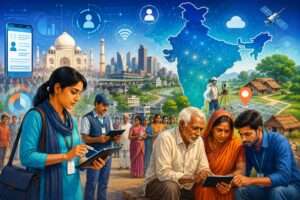
Digital literacy is also a major challenge in India. The elderly, illiterate people, rural women, and migrant workers are often not comfortable using smartphone applications or online forms. Relying solely on technology for data collection will increase the likelihood of inaccurate information, incomplete entries, and undercounting. Some digital census experiments in African countries have shown significantly higher error rates in areas with low literacy. This challenge may be even more complex in India, given its vast linguistic, social, and economic diversity. Therefore, simply being “digital” will not be enough; it must also be ensured that technology is inclusive and user-friendly.
This makes the need for an “offline-first” model crucial. Census applications should be able to collect data even when the internet is not available and then synchronize with the server when the network is available. This will enable seamless data collection even in remote areas. Furthermore, applications and voice-based assistance systems must be developed in local languages so that even those with less education can participate seamlessly in the process.
Another major challenge facing the digital census is the accurate enumeration of migrant populations and those in the unorganized sector. During the COVID-19 pandemic, the country witnessed the lack of reliable data on millions of migrant workers. This resulted in significant difficulties in relief and rehabilitation efforts. A large number of people in India work temporarily in cities and often live away from their permanent addresses. If they are not in their villages or places of origin during the census, they may be missed. The same problem can arise with homeless people, street dwellers, and those living in informal settlements. Therefore, the digital system must be flexible enough to accurately assess the dynamic population.
The issue of caste-based data is also extremely sensitive and complex. India has thousands of castes and sub-castes, whose names and social identities vary by region. A lack of standardization in the digital coding system could lead to misclassification and data inconsistency. Caste data is directly linked to social justice, reservation policies, and political representation, so any errors could lead to serious controversy. The government will need to exercise extreme caution, expertise, and transparency in this matter.
Another critical issue is the training of enumerators. It is estimated that over 3 million enumerators will be required, a large number of whom will be school teachers. All of them will need extensive training on digital tools, application operation, data validation, cybersecurity, ethics, and privacy. Inadequate training can lead to technical errors and deterioration of data quality. Often, technology failures are not due to the machine itself, but rather due to inadequate understanding by its users. Therefore, robust human resources training will be key to the success of this entire project.
Cybersecurity and privacy concerns are also extremely serious. The census will collect citizens’ personal information, such as family structure, education, employment, migration history, and possibly caste details. If this data is subject to cyberattacks, data theft, or political misuse, public trust could be severely compromised. Fears of political use or misuse of data, especially in an electoral context, will also persist. Therefore, the government must implement robust mechanisms such as data encryption, secure servers, access controls, and independent data security audits. Furthermore, citizens must be assured that their data will only be used for statistical and policy purposes.
This census will also be extremely politically sensitive. Based on census data, future delimitation of constituencies may be undertaken. Due to differences in population growth rates between northern and southern Indian states, the issue of redistribution of parliamentary seats could become a subject of political debate. If a state’s population has grown relatively rapidly, it may receive greater representation. This could impact the federal balance and the distribution of political power. Therefore, it will be essential to ensure the census process is completely impartial, transparent, and free from political interference.
India’s linguistic and cultural diversity also complicates the digital census. Hundreds of languages and dialects are spoken in the country. If applications are available only in a limited number of languages, participation by many communities could be affected. Implementing a uniform digital framework without taking into account local cultural contexts and regional characteristics would be impractical. Therefore, regional adaptation, multilingual support, and local administrative cooperation will be essential.
Excessive use of technology can also pose the risk of algorithmic bias. If there is a complete reliance on AI and GIS-based systems, automated errors could have widespread impacts. For example, incorrect geo-mapping or algorithmic classification of an area could affect thousands of people. Therefore, it will be essential to maintain systems of human oversight, third-party audits, and independent quality control. Technology should be viewed as a supporting tool, not a substitute for human judgment.
India’s Digital Census 2027 is both an opportunity and a responsibility. It will propel the country toward data-driven governance and make planning more scientific and accurate. However, its success will depend not only on technical efficiency, but also on its inclusiveness, fairness, and reliability. If the poor, migrants, uneducated, and remote communities are not effectively involved in the process, the purpose of the Digital Census will be lost.
The government should adopt a balanced mix of both digital and traditional methods. While technology can provide speed and accuracy, human interaction ensures social inclusion and trust. Offline data collection, extensive training, robust cybersecurity, local linguistic support, and independent monitoring mechanisms will be essential for the success of this project. It will also be essential to educate and convince the public that the census is a vital process related to their rights and development.
Ultimately, the 2027 Digital Census will not just be a collection of data; it will also be a test of India’s democratic character, administrative capacity, and technological maturity. If India successfully conducts a digital census amidst such a vast and diverse population, it will be a unique achievement in world history. It will make future policymaking more transparent, scientific, and accountable. But the true value of this technological revolution will be realized only when it reaches the last person in society and ensures equal representation. India’s democratic strength lies in the accurate identification of its population and the trust of every citizen. Therefore, the 2027 Digital Census is not just a technological innovation, but a historic step towards inclusive nation-building.

