



The king of Trigartha, Susharma, infused his forces with renewed enthusiasm, and a marked preparedness arose among the ranks. In due course, the formidable Narayani army of Krishna, which had earlier been granted to Duryodhana in fulfillment of a solemn promise, was invoked to stand on the side of the Kauravas. Conches, kettle drums, tabors, and horns resounded in unison, while the clash of weapons rang sharply, creating a tumultuous yet harmonious uproar across the battlefield.
Beholding the fierce disposition of the Trigartha warriors, Arjuna spoke to Krishna, declaring that they would resist valiantly until their final breath and urging him to drive the chariot toward them. With serene delight at this righteous resolve, Krishna guided the chariot forward against the amassed Trigartha forces and their allies. Drawn by swift white steeds resembling the celestial horse Uchchaihshravas, the chariot sped forth like a mass of pure white clouds descending upon the enemy. Its majestic motion stirred wonder and curiosity among all who beheld it.
The clarity of purpose and precision of strategy shone brightly in the divine partnership of Krishna and Arjuna. Yet the Narayani troops, stirred with resentment at the sight of Krishna—who had consigned them to the service of Duryodhana—and imagining Arjuna to be the cause of their perceived slight, grew enraged. They discharged a relentless shower of arrows, their sharp shafts piercing the air with fury.
In response, Arjuna blew his divine conch, Devadatta, whose resounding echoes swelled with pride and vigor. Then, invoking a celestial weapon sanctified and bestowed by Vishvakarma, he unleashed a mighty missile of bewildering power. Under its influence, each warrior perceived others as Arjuna himself, bearing the Gandiva, and in delusion they turned upon one another, striking down their own ranks. Having fulfilled its dreadful purpose, the weapon returned calmly to Arjuna.
Those who survived rallied with boldness and pressed their attack, raining arrows upon him. Yet Arjuna, swift in thought and resolute in aim, routed the remaining forces with fierce intensity. He countered the combined assault of the warriors from Tundi, Magadha, Kerala, and Machillika, laying waste to vast numbers and turning the battlefield into a grim expanse of fallen men.
Still, the surviving warriors, desperate and unyielding, advanced in dense formations, weaving a carpet of arrows before him. The clash of the fourfold armies—infantry, cavalry, chariots, and elephants—filled the air with dreadful cries, flashes of steel, and the clangor of arms. Arjuna shattered their formations and reduced them to fragments, leaving no semblance of order behind.
Elite divisions then converged upon Krishna and Arjuna, swarming them like bees around honey. Their assault bore a cunning design, akin to crows harassing monkeys to snatch their food, seeking to distract and confine Arjuna. The battle grew increasingly severe, for the intent of the enemy was clear—to keep Arjuna far from Yudhishthira and the main Pandava forces.
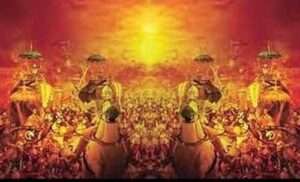
Meanwhile, the Pandava army, inspired by the son of Dharma, fought with renewed vigor and drove their adversaries into confusion. At that moment, Drona surged forward with fierce determination, striking violently at the forces guarding Yudhishthira. Durmukha, son of Dhritarashtra, engaged Dhrishtadyumna in a formidable duel, earning even the approval of Drona for his valor.
As Kuru and Panchala princes gathered in combat, Drona advanced toward Yudhishthira like a tempestuous wind dispersing clouds. The protective ranks around the king faltered under his fierce assault, while Yudhishthira signaled his forces to press forward and counter the advancing tide.
The collision of armies raised vast clouds of dust that veiled the sun itself. Sparks flew from clashing weapons, while ornaments glimmered in shifting hues, lending the scene a dreadful yet resplendent grandeur. For a moment, warriors stood transfixed by the overwhelming spectacle. Soon, the dust settled, mingling with the crimson drizzle of blood from men and beasts alike, staining the earth with grim testimony.
The battle descended into utter chaos. Some slew, others fell; none could discern who struck whom or who perished by whose hand. Foot soldiers and charioteers alike collapsed in equal measure. Combatants whirled, stumbled, struck, and fell in a relentless storm of violence, where swords missed their mark, spears pierced through bodies, and both attacker and victim tumbled together upon the ground.
The gleam of weapons and ornaments flickered like fallen stars across the blood-soaked field. Paths were strewn with the carcasses of elephants, horses, and men, while shattered chariots lay scattered like broken relics. From the flowing streams of blood, fragments of yokes and wheels jutted forth like frogs peering from crimson waters.
Yet neither side yielded. Despite the horrors that surrounded them, the warriors stood firm. Drona, roaring like a lion, pressed onward toward Yudhishthira, and the guarding forces trembled at the relentless advance of the venerable preceptor. The battlefield, haunted by death and terror, seemed a realm of spirits and demons.
Thus, with grim resolve, Drona and his allies pursued their design of capturing Yudhishthira, even as the carnage deepened. In this manner, Sanjaya reported the dreadful course of events to Dhritarashtra, recounting the relentless fury and unyielding purpose that defined the day’s battle.

