



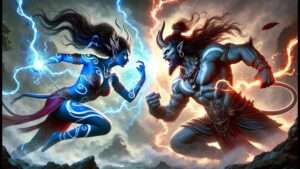
The formidable and cunning demon Alambusha confronted the youthful hero Abhimanyu upon the battlefield. Both warriors fought with relentless vigor, discharging volleys of arrows that struck one another with fierce precision. Their bodies bled from countless wounds, yet they stood unwavering, resembling crimson coral mountains rising proudly from the sea.
Perceiving the growing power of his opponent, the demon resorted to deceit and conjured a vast illusory darkness that enveloped the battlefield. A dreadful gloom spread everywhere, and the warriors could scarcely see one another in that pitch-dark confusion. Abhimanyu, however, remained undisturbed. With calm resolve, he invoked the radiant Suryastra, whose blazing brilliance dispelled the illusory night in an instant. The celestial beings who watched the battle from the heavens admired the young warrior and praised his extraordinary skill.
Alambusha then devised many cunning tricks and illusions, hoping to confound his opponent. Yet every deceptive stratagem of the demon was neutralized by the divine astras wielded by Abhimanyu. Finding no advantage and seeing his powers rendered futile, the demon abandoned his chariot and withdrew from the field, retreating into safety. The fierce valor and astonishing mastery displayed by Abhimanyu greatly disturbed the Kaurava forces, who beheld in him the rising brilliance of Arjuna himself.
The grandsire Bhishma, perceiving the turmoil caused by the young warrior, advanced toward Abhimanyu, accompanied by a vast protecting force. Abhimanyu, however, stood fearless before them. With swift dexterity and blazing energy, he resisted Bhishma and his warriors, scattering their formations with a storm of arrows. At that moment, Arjuna arrived swiftly to aid his son and began attacking Bhishma with formidable skill. Around these mighty heroes gathered the armies of both sides, and a massive conflict erupted between the Kaurava and Pandava forces.
In the terrible confusion of battle, soldiers and animals mingled together without knowing to which side they belonged. Chariots clashed, elephants roared, and warriors fought amidst deafening tumult. Kripacharya prepared to strike at Abhimanyu, but Satyaki swiftly intervened and halted him. A fierce duel followed between them as both warriors discharged torrents of arrows that pierced their armor and drew streams of blood.
Ashwatthama soon came forward to aid Kripa and engaged Satyaki in combat. With a powerful shot he shattered Satyaki’s bow. Sanjaya, narrating these events, said that Satyaki immediately seized another bow and released a ruthless arrow that struck Ashwatthama with great force, causing him to faint and collapse upon his chariot. Yet the son of Drona soon regained his composure and retaliated with deadly precision. His arrow pierced Satyaki’s chest, and another shaft struck down the banner and flagstaff of Satyaki’s chariot.
The wound inflicted by Ashwatthama only strengthened Satyaki’s resolve. Enraged, he rained arrows upon his adversary with relentless fury. Surrounded by the blazing shafts of Satyaki, Ashwatthama appeared like the sun momentarily eclipsed by Rahu. Seeing his son endangered, Dronacharya hastened to his aid and confronted Satyaki upon the battlefield.
The pride of Drona in his mastery of archery drove him to fight with fierce determination. Arjuna, perceiving the situation, quickly arrived and engaged his revered teacher in combat. Witnessing this encounter, King Dhritarashtra spoke anxiously to Sanjaya. He said that Arjuna was the beloved disciple and foremost warrior trained by Drona, and wondered how such a devoted student could raise his weapons against his own teacher. He desired to understand the deeper meaning of this conflict between master and disciple.
Sanjaya, endowed with divine vision and guided by righteousness, replied with solemn wisdom. When a warrior enters the battlefield in pursuit of royal duty and justice, he must abandon all personal ties. The bonds of teacher and student, father and son, uncle and nephew must be set aside. In the arena of war only the duty of combat remains, and every soldier is trained to uphold this sacred principle. A noble hero like Arjuna observes this code faithfully and without hesitation.
Then Sanjaya continued his narration. Arjuna struck Drona with three swift shafts that checked the movement of the venerable warrior, and thereafter he rained arrows upon him in rapid succession. At the same time Bhishma released a fierce volley of arrows against Arjuna. At Duryodhana’s command, the sons of the Trigarta king advanced before Drona and attacked Arjuna. In response, Arjuna invoked the mighty Vayavyastra, whose violent winds scattered them like dry leaves before a tempest. Drona countered this attack with the powerful Shailastra.
Arjuna, slightly angered by the resistance of his opponents, unleashed an overwhelming storm of arrows that suffocated the enemy warriors. The kings and princes of Trigarta fled in disorder. Duryodhana, Kripa, Shalya, and Bahlika then rushed forward to support Dronacharya. Duryodhana and his chariot guards confronted Arjuna, but the Pandava hero bewildered them with arrows of mysterious origin that shattered their pride and arrogance.
Meanwhile, Bhishma advanced beyond the strategic position of Yudhishthira and began severing the heads of soldiers with ruthless precision. Shakuni and Bhurisravas confronted the twin warriors Nakula and Sahadeva. The king of Kalinga and the mighty Bhagadatta attacked Bhimasena with powerful elephant forces.
Bhima descended from his chariot like a lion leaping from the mountain heights. Whirling his enormous mace, he charged into the elephant army. The elephants, terrified by his fury, scattered across the battlefield like clouds torn apart by violent winds. Yet Srutayu and Bhagadatta remained steadfast even as their elephant herds fled. They struck Bhima with sharp arrows that pierced his armor and wounded his body, provoking his anger still further.
Elsewhere, Yudhishthira found it difficult to withstand the relentless assault of Bhishma and called loudly for support. Hearing this call, Bhimasena left his combat with Srutayu and Bhagadatta and rushed toward his elder brother. Bleeding from many wounds, Bhima appeared like a mango tree adorned with tender crimson leaves.
Before Bhima arrived, Dhrishtadyumna, Shikhandi, Virata, and Drupada had already formed a protective guard around Yudhishthira. They discharged numerous arrows that irritated and challenged Bhishma. The grandsire, filled with wrath, ignored Shikhandi and directed his arrows against the other three warriors. Like blazing fires, they resisted him boldly and fought with admirable composure.
Soon Bhima joined the defense, advancing like a towering inferno. The Kekaya princes, Satyaki, and the sons of Draupadi also rallied to his side. Seeing this formidable resistance, the leading warriors of the Kaurava army rushed forward to assist Bhishma.
Thus kings, generals, and mighty warriors from both armies engaged in a fierce and merciless struggle. By midday, the lines between the two forces were almost erased in the intensity of combat. Sanjaya’s narration flowed like a mighty river as he described these events to Dhritarashtra, whose heart was overwhelmed with conflicting emotions while hearing the dreadful progress of the war.

