
The dog lifts its hind leg against a lamppost. The cat scratches a tree trunk. The tiger sprays a bush. Different rituals, same message – this patch is mine, and I was here before you.
Humans, being the most evolved species on the planet, carve their names on monuments, fort walls, temple pillars, mountain rocks and occasionally on public toilets.
Among them, Indians have elevated this instinct into an art form. Visit any historical monument, and you will find evidence that Balu loves Swapna, Ravi was here, and Bujjigadu conquered the fort before the invading armies arrived.
The Archaeological Survey may not know who built the structure, but it can certainly tell you who visited it last Sunday.
For generations, we assumed this was a modern affliction born of poor civic sense. It now appears we were wrong.
We have archaeological proof that Indians have been defacing heritage structures for at least 2,000 years.
An ancient tourist leaves a review
Meet Cikai Korran. The gentleman apparently travelled from Tamil-speaking India to Egypt nearly two millennia ago. This was no easy feat. There were no budget airlines, no package tours, no visa consultants, and certainly no influencers posting reels from the Nile.
Yet he made the arduous journey. And what did he do after reaching one of humanity’s greatest archaeological treasures, the Valley of the Kings?
He scratched his name on the walls using the Old Tamil (Tamil-Brahmi) script. Not once. Not twice. Eight times. Across five tombs. Modern tourists leave selfies. Cikai Korran left graffiti.
Consistency is a virtue
One has to admire his dedication. Most tourists scribble their names on one wall and move on. Cikai Korran appears to have treated the Valley of the Kings like a guest register.
Perhaps he feared future generations might miss his presence, or he believed one inscription was insufficient publicity.
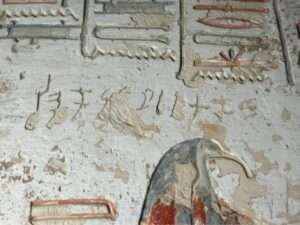
Or perhaps he was the ancient equivalent of those people who comment ‘First!’ under every social media post.
Whatever the reason, he was determined that Egyptian pharaohs resting peacefully for thousands of years should know that Cikai had arrived from India.
Globalisation before LinkedIn
Researchers have now discovered nearly 30 inscriptions in Indian languages across six tombs. This is being hailed as evidence of ancient globalisation. And rightly so.
The findings prove that Indians were travelling internationally, conducting trade, exchanging cultures and, most importantly, writing on walls long before the invention of passports.
Researchers believe he was likely an elite merchant, traveler, or someone associated with early South Indian warrior traditions.
A timeless tradition
Something is reassuring about this discovery. Civilisations rise and fall. Empires vanish. Languages evolve. Borders change. But some traditions endure.
The urge to immortalise oneself by scratching a name on somebody else’s property appears to be one of them.
Every generation believes it is inventing something new. Yet somewhere in an Egyptian tomb, carved into an ancient wall, is proof that the ancestor of today’s monument vandal was already hard at work twenty centuries ago.
The more things change, the more they remain etched in stone. Quite literally.