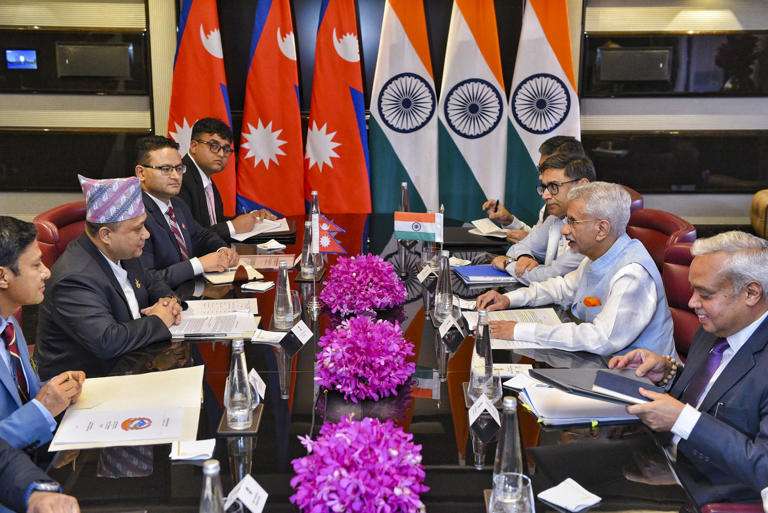
New Delhi: India and Nepal share a “special” relationship and there is an opportunity to “decisively” shift the engagement to realise its full potential, External Affairs Minister S Jaishankar said on Saturday during a meeting with his Nepalese counterpart Shishir Khanal.
Jaishankar reiterated Prime Minister Narendra Modi’s “sentiment regarding India’s commitment to working with Nepal for mutual prosperity, progress and well-being of the two countries”.
Khanal kicked off a three-day trip to New Delhi on Friday to strengthen bilateral ties, a visit overshadowed by a raging controversy triggered by Nepalese Prime Minister Balendra Shah’s recent remarks on the boundary row between the two sides.
He called for transforming the two countries’ centuries-old civilisational links into a modern development partnership.
“We must transform our old civilisational bonding into a new development-oriented partnership. Nepal has placed the highest priority on its relationship with India under the new government and is willing to engage substantively and purposefully at the highest possible level,” he said.
Khanal also underlined India’s role as a dependable partner during times of crisis, citing New Delhi’s support in ensuring uninterrupted supplies of fuel and fertilisers to Nepal amid global disruptions.
Referring to the planned visit of Prime Minister Balendra Shah, he said the “forthcoming high-level visit will mark the beginning of a new chapter in Nepal-India relations.”
During the visit, Khanal also met National Security Adviser Ajit Doval and held discussions on a range of bilateral issues, including security cooperation and regional developments.
The positive messaging from Kathmandu was matched by India’s response, with External Affairs Minister S Jaishankar describing the current moment as an opportunity to fundamentally strengthen bilateral ties.
“India and Nepal share a very special relationship, built on vibrant people-to-people ties, cross-border connectivity, and shared cultural and religious traditions. It is anchored in trust, goodwill and mutual benefit,” Jaishankar said during talks with Khanal.
Highlighting the broadening scope of cooperation, Jaishankar noted that bilateral ties had expanded steadily across trade, investment, energy, development partnership, education, disaster response and cultural exchanges.
“Today, we have an opportunity to take this relationship forward into newer domains such as startups, artificial intelligence, information technology and renewable energy,” he said.
The External Affairs Minister also pointed to the close coordination between the two countries on border management and regional security.
“We collaborate closely to maintain security along our long and uniquely open border. Our two countries have always stood by each other in times of need,” he said, noting that India had ensured uninterrupted fuel supplies to Nepal despite disruptions caused by the ongoing crisis in West Asia.
Sending a strong political signal, Jaishankar said New Delhi sees a chance to “decisively shift the trajectory of India-Nepal relations and realise the full potential of our ties,” adding that India’s neighbourhood initiatives closely complement the priorities outlined by Nepal’s new government.
In his recent meeting with the Chairman of the Rastriya Swantra Party of Nepal, the country’s ruling party, Prime Minister Narendra Modi had said that Nepal is a priority partner under the Neighbourhood First policy.
The Prime Minister also highlighted that India looks forward to collaborating with the new government to elevate the special and multifaceted relationship between the two countries to greater heights. “Nepal is a priority partner under our Neighbourhood First policy and we look forward to collaborating with the new government to elevate the special and multifaceted relationship between our two countries to greater heights,” Modi said.