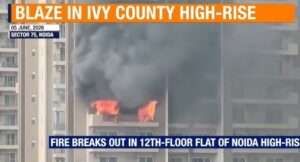
The devastating fires in Noida and Lucknow are not isolated accidents. They are yet another reminder that in India, disasters are too often manufactured by human negligence and institutional apathy. Every time innocent lives are lost, governments express grief, announce compensation, suspend a few officials, and order inquiries. Weeks later, everything returns to normal—until the next inferno claims another set of victims.
The real culprit is not merely a short circuit or an electrical spark. It is a broken system that allows unsafe buildings to function with official approval. These are not accidents; they are preventable tragedies.
One glaring danger that continues to escape serious scrutiny is the rampant use of false ceilings in commercial establishments, coaching centres, hospitals, schools, and office complexes. Marketed as modern interior décor or “space management”, false ceilings have become ticking time bombs. They conceal a maze of electrical wiring, internet cables, air-conditioning ducts, and other utilities, making regular inspection virtually impossible.
When an electrical fault occurs above the false ceiling, it often remains undetected until flames have already spread across the entire roof. Worse, many false ceilings are constructed using combustible materials that release dense, toxic smoke, suffocating occupants long before the fire reaches them. In most fatal fires, smoke inhalation—not burns—is what kills.
Yet, municipal authorities continue to approve such designs without insisting on fire-resistant materials, accessible inspection panels, compartmentalisation or mandatory fire detection systems above these concealed spaces. If false ceilings are to remain part of modern architecture, building regulations must be rewritten to reflect modern fire risks rather than outdated assumptions.
The rot extends far beyond interior design.

Across Indian cities, residential buildings are routinely converted into commercial establishments with little regard for safety norms. Coaching centres, hostels, clinics and offices mushroom inside narrow lanes never designed to handle heavy footfall or emergency evacuation. Fire tenders struggle to reach these congested localities because corrupt officials have looked the other way while granting permissions. Every illegal conversion approved by a municipal official is an invitation to disaster.
Equally alarming is India’s primitive approach to utility infrastructure. In countless cities, electric wires, internet cables, television lines and communication networks continue to hang precariously from poles in tangled clusters. Besides being an eyesore, they pose a constant risk of short circuits and electrical fires.
Why should India, aspiring to become a developed nation, continue to rely on infrastructure that belongs to another century? Underground utility corridors carrying electricity, communication cables, gas pipelines and other services are no longer futuristic concepts. They are standard urban planning practices across much of the developed world. Modern technologies even allow faults to be detected and isolated quickly without endangering public safety. The cost of such infrastructure is insignificant when compared to the price paid in human lives.
Perhaps the biggest institutional failure lies in the Fire Services Department itself. Fire departments across the country are largely reactive agencies, called only after disaster strikes. They must instead become powerful preventive regulators with statutory authority to conduct surprise inspections, impose hefty penalties, order immediate closure of unsafe premises and prosecute habitual violators. Fire safety should not be treated as a mere No Objection Certificate obtained once before opening a building. It must be an ongoing compliance requirement.
Urban planning authorities, municipal corporations, electricity departments, revenue officials and fire services must function as an integrated safety mechanism rather than isolated bureaucracies passing responsibility to one another after every tragedy.
The saddest aspect of the Noida and Lucknow fires is that the victims were young students pursuing their dreams. Their deaths were not acts of fate. They were the direct consequence of governmental complacency, administrative corruption and regulatory failure.
India does not lack laws. It lacks enforcement. It does not lack technology. It lacks political will.
Until those in power recognise that every ignored safety violation is a potential death sentence, headlines announcing fire tragedies will continue to appear with depressing regularity. The next victims are already sitting inside another illegally converted building, beneath another concealed false ceiling, waiting for a spark that should never have been allowed to exist.