Online Sports Desk
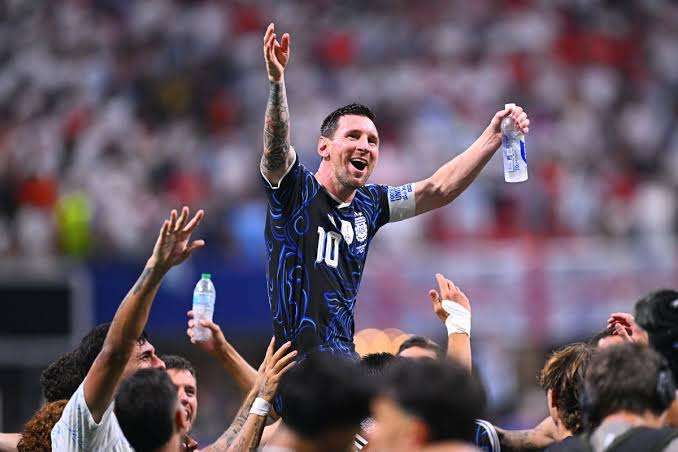
Holders Argentina beat England 2-1 to reach the World Cup final, where they will face Spain after coming from behind to snatch victory with a stoppage-time goal from substitute Lautaro Martínez in a highly-charged encounter.
Lionel Messi again proved the talisman for Argentina as he provided the pass for Enzo Fernández to strike the equaliser and the cross for Martínez’s winner.
Anthony Gordon had put England ahead with a back post tap-in from a cross by Morgan Rogers in the 55th minute.
Argentina’s pressure saw them equalise in the 85th minute as Fernández fired home from outside the box.
Martinez headed the 92nd-minute winner after he stole in between the England defence to put his side into the final.
Alexis Mac Allister twice hit the woodwork , and England keeper Jordan Pickford made a vital one-handed stop in the 69th minute to deny Nico Gonzalez’s goal-bound header.
The match started at a furious tempo and tempers frequently boiled over with American referee Ismail Elfath struggling to keep control.
Argentina players held up a political banner declaring “Las Malvinas Son Argentinas” (“The Falklands are Argentine”) after their 2-1 World Cup semi-final victory over England, in apparent contravention of FIFA rules.
FIFA’s Stadium Code of Conduct bans “banners, flags, flyers, apparel and other paraphernalia that are of a political, offensive, and/or discriminatory nature” inside stadiums.
The question of sovereignty over the islands in the South Atlantic known to the British as the Falklands and the Argentines as the Malvinas has been a long-running sore in relations between the countries.
They fought a short conflict over the islands in 1982, in which 649 Argentine soldiers and 255 British combatants died. Britain ultimately won, and the vast majority of residents of the islands have said they wish to remain part of Britain.
But Argentina has long claimed it inherited the islands from Spain after its independence in 1816 and that Britain took control in 1833 through an illegal colonial act.
Lisandro Martínez and Giovani Lo Celso held up the banner, grinning, and waved to fans in the stands. It was unclear where the banner had come from. It is not the first time the question of political banners has come up during the World Cup.
Last month in Los Angeles, Iranian Americans waved pre-revolutionary flags that are symbols of protest against the Tehran government when Iran played. Those matches proceeded without incident.