



When allegations become a substitute for evidence, constitutional institutions become collateral damage in a politician’s desperate search for relevance.
For nearly two years, Rahul Gandhi, Leader of the Opposition in the Lok Sabha, has kept the political pot boiling with his explosive refrain of “vote chori”. The Congress leader has accused the Election Commission of compromising electoral integrity, questioned the Special Intensive Revision (SIR) of electoral rolls and sought to portray electoral defeats as symptoms of a democracy under siege. Now comes the obvious question: where is the conclusive evidence to substantiate these sweeping charges?
If the answer is that the BJP alone can provide the proof, as Rahul’s reported remarks suggest, then the joke is on the accuser. Since when does the accused become the investigating agency, the evidence custodian and the prosecution witness rolled into one? Is Rahul Gandhi demanding that the BJP investigate itself and then conveniently hand him the evidence required to prosecute his political argument? Such logic belongs in political theatre, not a serious debate about electoral integrity.
There is nothing wrong with questioning the Election Commission. No constitutional institution is beyond scrutiny, and electoral irregularities, wherever established, must be investigated and corrected. But there is a world of difference between identifying a discrepancy and declaring an entire election-management system compromised. Allegations are not evidence, repetition is not verification, and volume is certainly no substitute for proof.
The irony becomes sharper when one examines the Congress’s conduct. If the party believes that “vote chori” has occurred on a scale serious enough to threaten democracy, why approach the President of India with allegations that still require substantiation? Why seek the intervention of the Chief Election Commissioner or the Chief Justice of India without first placing a clear, verifiable evidentiary case before the appropriate authority? Is the objective to establish the truth through due process, or to manufacture a spectacle in which every constitutional office becomes another stage for political performance?
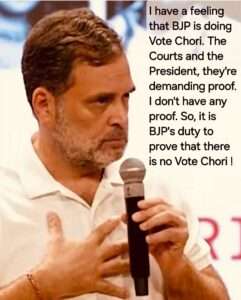
The President is not an electoral investigator. The Chief Election Commissioner cannot be expected to accept accusations as established facts. Nor should the Chief Justice of India be drawn into a political campaign merely because its protagonists wish to amplify their allegations through the prestige of the judiciary. Constitutional authorities deserve reasoned representations, not political theatre masquerading as a constitutional emergency.
The Congress’s contradictory positions also invite uncomfortable questions. If the party accepts electoral victories in Telangana, Karnataka and Himachal Pradesh, why does its rhetoric suggest that electoral processes are inherently suspect whenever the BJP wins? And what of Kerala? If senior Congress leader Ramesh Chennithala has credited the effective implementation of SIR with helping the party’s prospects there, should that observation not prompt the leadership to explain its apparently inconsistent approach? If the revision process is defective, the party must identify the specific defects. If it is legitimate when politically convenient, it cannot become illegitimate merely when the results disappoint.
Rahul Gandhi’s own victories in Wayanad and Amethi do not, by themselves, prove that every electoral process is flawless. But neither can victories be accepted without question while defeats are routinely wrapped in allegations of manipulation. Democracy cannot operate on a convenient rulebook in which victory certifies the system and defeat indicts it.
The greater danger is the normalisation of reckless accusations against constitutional bodies. Repeatedly branding institutions as compromised without establishing the charge can erode public confidence, demoralise officials and weaken the very democratic framework that political leaders claim to defend. Anarchy does not always arrive through the streets; sometimes it begins with the systematic delegitimisation of institutions whenever they refuse to deliver a politically desirable outcome.
The Congress must decide whether it wants to defend democracy or merely weaponise its vocabulary. If it possesses evidence, produce it, authenticate it and pursue the remedies available under law. If there are genuine discrepancies in voter rolls, identify them constituency by constituency and demand corrective action. That is responsible opposition politics.
But if the grand charge of “vote chori” rests on insinuation, selective interpretation and political rhetoric, the country deserves to know that, too.
Democracy cannot be held hostage to an allegation that refuses to produce its evidence. Constitutional institutions are not punching bags for frustrated politicians, and the ballot box is not a conspiracy theory waiting to be invented after every electoral defeat.

