Home Minister dismisses Opposition’s street protests as no substitute for electoral support; says Congress must face voters rather than blame institutions
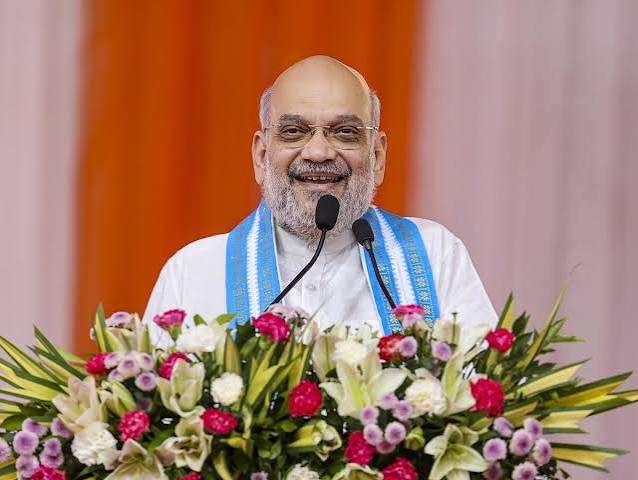
New Delhi: Union Home Minister Amit Shah has mounted a strong counterattack against the Congress and the INDIA bloc amid their protests over alleged electoral irregularities, asserting that the BJP-led National Democratic Alliance (NDA) will return to power in the 2029 Lok Sabha elections under Prime Minister Narendra Modi.
In his remarks to newsmen in New Delhi on Tuesday, Shah challenged Congress leader and Leader of the Opposition in the Lok Sabha, Rahul Gandhi, over the Opposition’s campaign against the Election Commission and its objections to the Special Intensive Revision (SIR) of electoral rolls. He maintained that political parties must ultimately win the confidence of voters rather than attempt to build a narrative around alleged electoral malpractice after facing defeats.
Shah expressed confidence that the BJP-led NDA would continue to receive public support in the coming years, predicting victories in forthcoming Assembly elections as well as a renewed mandate in the 2029 general elections. His assertion comes at a time when the Opposition has intensified its campaign against Chief Election Commissioner Gyanesh Kumar and demanded action over alleged irregularities in the revision of voter lists.
Street protests cannot replace electoral support
Taking aim at the Congress leadership’s reliance on demonstrations and marches in the national capital, Shah argued that mobilising thousands of people in Delhi would not, by itself, translate into electoral victories across the country.
The Home Minister’s argument was that India’s electorate extends far beyond the political circles and protest sites of the national capital. Voters in villages, small towns, remote regions and the country’s far-flung constituencies ultimately determine election outcomes, he maintained, challenging the Congress to demonstrate its support among these sections of the electorate.
The criticism came in the wake of the INDIA bloc’s March for Democracy in Delhi on October 12, when Opposition leaders, including Rahul Gandhi, marched towards the Supreme Court over their objections to the SIR process and alleged electoral irregularities. The Opposition has demanded safeguards against arbitrary deletion of eligible voters and action against the Chief Election Commissioner.
The BJP, on the other hand, has rejected the allegations of electoral manipulation and accused the Congress of turning electoral disputes into a political campaign against constitutional institutions.
Shah’s message was directed at the Opposition’s broader political strategy: street mobilisation and allegations against institutions, he argued, cannot serve as substitutes for rebuilding a party’s electoral base and winning the trust of voters.
Congress under scrutiny over electoral performance
Shah also challenged the Congress to examine its electoral record across states rather than attribute its setbacks to the functioning of the Election Commission or the use of Electronic Voting Machines (EVMs).
According to the Home Minister’s argument, the Congress has continued to face electoral challenges across different regions and levels of government, including parliamentary, Assembly and local-body elections. He cited the party’s performance across states, including Gujarat, Rajasthan, West Bengal, Assam, Tamil Nadu and Tripura, to underline his contention that the Congress must confront the reasons behind its electoral difficulties.
His criticism was that the Opposition’s recurring allegations against election procedures risk diverting attention from the more fundamental question of whether its political message, leadership and organisational network are connecting with voters.
The Congress and other INDIA bloc constituents, however, maintain that their campaign concerns the integrity of elections and the protection of eligible citizens’ voting rights. They have sought judicial intervention in the dispute over electoral-roll revisions, arguing that the process requires greater transparency and safeguards.
The central political disagreement, therefore, is not merely over the size of a protest or the number of people participating in it, but over competing claims about electoral accountability, institutional credibility and the reasons behind election outcomes.
EVM allegations and the ballot-paper argument
Shah also questioned the Opposition’s tendency to raise objections to EVMs after electoral defeats. He argued that parties should not automatically attribute unfavourable results to the voting mechanism without establishing evidence of irregularities.
In making his case, he referred to Tripura and the use of ballot papers, as cited in the account of his remarks, to challenge the Congress’s broader argument that EVMs explain its electoral setbacks. The precise election and the context of the ballot-paper reference would need to be established before this example is treated as a conclusive factual rebuttal.
The larger point of Shah’s criticism was that electoral accountability cannot be reduced to questioning the voting mechanism whenever a political party loses. Allegations of wrongdoing, he suggested, must be supported by evidence rather than advanced as a blanket explanation for an adverse result.
At the same time, concerns about voter-list revisions and the inclusion or exclusion of eligible electors warrant examination through the appropriate legal and electoral procedures. The Opposition’s allegations remain contested, and claims of electoral manipulation must be assessed on the basis of evidence rather than political assertions alone.
BJP projects continuity under Modi
Shah’s prediction of another NDA victory in 2029 also signals the BJP leadership’s intention to frame the coming years as a continuation of the political mandate secured under Modi’s leadership.
By projecting confidence in the NDA’s prospects well before the next general election, the Home Minister sought to counter the Opposition’s attempt to portray the current protests as evidence of a wider loss of confidence in the government.
The BJP’s argument is that electoral performance must be judged by voters across the country, rather than by the intensity of political demonstrations in Delhi. The Congress, conversely, is seeking to turn the controversy over voter lists and the Election Commission into a broader campaign on democratic accountability.
The coming state elections will provide further opportunities for both sides to test their claims against actual electoral outcomes. Shah predicted that the Congress would suffer further setbacks, while expressing confidence that the NDA would secure another mandate in 2029. These remain political forecasts, to be tested by voters in future elections.
A contest over institutions and public confidence
The latest exchange reflects an increasingly sharp political confrontation between the ruling alliance and the Opposition over the Election Commission, voter-list revisions and the legitimacy of electoral outcomes.
For the BJP, Shah’s intervention reinforces its position that political parties must accept electoral verdicts while pursuing specific complaints through established legal channels. For the Opposition, the issue is whether the revision of electoral rolls and the functioning of election authorities provide sufficient transparency and safeguards for every eligible voter.
The two sides are therefore advancing sharply different interpretations of the same controversy. The BJP has dismissed the protests as politically motivated, while the Opposition says its campaign is intended to protect democratic institutions and voting rights.
Shah’s message was unmistakable in its political intent: he expects the BJP-led NDA to remain electorally competitive under Modi and believes the Congress cannot challenge that position merely by organising marches and raising allegations.
His declaration of confidence in a 2029 victory sets the tone for the political battle ahead. Whether that confidence translates into another national mandate will ultimately be determined not by the rhetoric of either side, but by the choices of India’s electorate.