Shrikant Rao
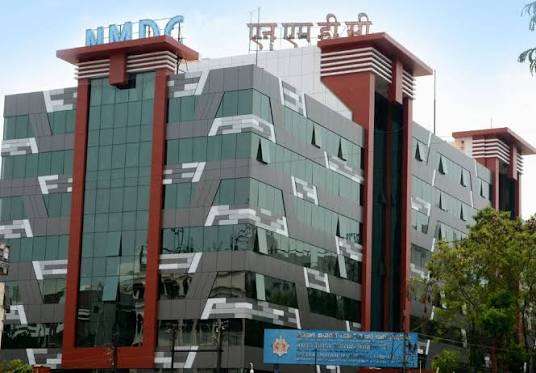
With the commissioning of its landmark Rs 5,427-crore integrated iron ore project in Chhattisgarh on September 27, 2026, the state-owned National Mineral Development Corporation (NMDC), India’s premier public sector mining heavyweight, has unveiled a massive logistics and sustainability breakthrough that permanently alters the economics of India’s domestic steel sector.
The infrastructure launch includes a new ore processing facility at Bacheli, an enhanced 15 million tonne per annum (MTPA) capability network, and a 2 MTPA pellet plant at Nagarnar.
Under the leadership of Chairman and Managing Director Amitava Mukherjee, who monitored the operational launch directly from corporate headquarters after adverse weather grounded onsite travel, the integration of these assets provides the physical foundation for NMDC to target an aggressive 60 million-tonne output for the current financial year.
The company maintains a broader strategic roadmap to reach 100 million tonnes by 2030-31.
The procurement muscle behind this expansion allows the domestic state heavyweight to act as an internal economic stabilizer. NMDC has locked benchmark lump ore prices at Rs 5,400 per tonne and fines at Rs 4,500 per tonne to preserve downstream manufacturing profitability against volatile global import trends.
Underground Logistics
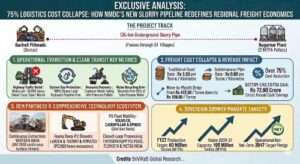
The core of the deployment is a 135-kilometre subterranean slurry pipeline connecting the Bacheli pitheads to the Nagarnar metallurgical plant. Pumping processed high-grade iron ore concentrate underground instantly eliminates roughly 10,000 heavy diesel truck trips every single month along the sensitive Bastar transit corridor, passing through 61 distinct villages.
Logistically, the project shifts transport from variable road freight rates averaging nearly Rs 3.50 per tonne per kilometre to a predictable pipeline operational cost of just Rs 0.80 per tonne per kilometre. This drops mine-to-mouth freight expenses from Rs 472.50 per tonne by truck to a mere Rs 108.00 per tonne through the line.
This structural change translates to a cost reduction of over 75 percent, injecting an estimated Rs 72.90 crore in direct annual operational savings straight back into NMDC’s balance sheet while feeding the new 2 MTPA Nagarnar complex.
Processing Waste
The automated pipeline system also turns environmental liabilities into a commercial asset by actively recovering low-grade ore tailing slimes that were historically written off as waste. Captured at the pithead, these slimes are pumped to the terminus where the Nagarnar complex uses advanced Straight Grate Induration technology to bake the concentrate into premium steelmaking pellets.
This clean raw feed cuts transit outlays by over Rs 350 per tonne on a mine-to-mouth basis, protecting NMDC’s operational margins from domestic logistics inflation and shielding the company from international trade shocks. This infrastructure deployment establishes the reliable, high-volume production anchor needed to support India’s National Steel Policy, which aims for 300 million tonnes of domestic crude steel capacity by 2030, requiring over 430 million tonnes of iron ore annually.
Industrial Alliances
To achieve this aggressive expansion and 2047 operational net-zero targets, NMDC is leaning heavily on a deeply integrated ecosystem of global machinery leaders. These industry actors have moved past standard vendor-buyer transactions to form a deep technical partnership.
Wirtgen India Private Limited anchors this collaboration out of its Pune manufacturing facility, custom-building massive continuous miners, such as the SM 2500 model, with specialized cutting drums engineered specifically to extract dense Indian hematite layer-by-layer without conventional drilling or open blasting. This solution curbs dust emissions and ground vibrations near eco-sensitive zones, allowing the pipeline to operate adjacent to highly stable rock topographies.
Simultaneously, Larsen & Toubro’s Mining Machinery Division provides the essential component distribution, custom structural assembly, and comprehensive on-site maintenance architecture for Komatsu’s ultra-large heavy earthmoving assets, electric mining shovels, and hydraulic mining excavators like the PC2000.
Global Integration
This unified front is mirrored across deep-pit haulage operations, where primary partnerships with Volvo CE for heavy-payload rigid haulers, Caterpillar for high-capacity wheel loaders, and Epiroc for autonomous, smart blast-hole drilling rigs transition primary pit sites away from fossil fuels to clean power drawn directly from high-voltage grid lines.
On the processing front, engineering collaborations with European turnkey specialists like ThyssenKrupp Polysius, FLSmidth, and Metso India introduce advanced wet classification cyclones and thickeners. These high-gravity classification systems enable processing facilities to recycle over 95 percent of their process water, creating a stable closed-loop system that protects local water tables and manages complex fluid dynamics within water-stressed mining districts.
When the exhibition gates open for the 18th International Mining & Machinery Exhibition (IMME 2026) at Kolkata’s Eco Park this December (December 7 to 10, 2026), NMDC’s newly operational pipeline framework will take center stage as a primary case study of domestic engineering capacity and global partnership. At the concurrent Global Mining Summit, corporate leadership is set to utilize high-level B2B forums to review active procurement pipelines for automated, grid-tied extraction assets backed by this proven logistical system. Inside the German and Australian pavilions, international engineering delegations will witness firsthand how the state-owned miner leverages its massive purchasing power to drive high-value OEM collaborations.