
For generations, Indian traditions such as homas and yajnas have often been dismissed in some quarters as superstition, blind faith or meaningless ritual. But what happens when something embedded in an ancient tradition is subjected to a scientific experiment and produces a measurable result?
That is precisely where the conversation about havan smoke becomes interesting.
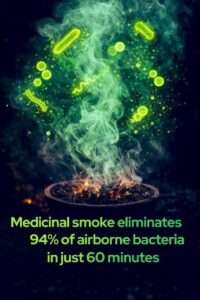
A 2007 study published in the peer-reviewed Journal of Ethnopharmacology examined the effect of smoke produced by burning wood and a mixture of medicinal and aromatic herbs used as havan samagri. The researchers reported a reduction of more than 94 per cent in airborne bacterial counts after 60 minutes of treatment under the experimental conditions. They also reported that the disinfecting effect in a closed room persisted for up to 24 hours.
There is an important correction to the popular version of this story, however. This was not a recent “Western laboratory discovery” suddenly validating an Bharatiyan ritual. The research itself was conducted by scientists associated with India’s National Botanical Research Institute and the Asian Agri-History Foundation. In other words, Indian scientific inquiry had already begun examining scientifically what Indian tradition had practised culturally for centuries.
That makes the larger question even more compelling.
Why should a traditional practice become intellectually respectable only after it is expressed through the vocabulary of modern science?
The ancient vocabulary was havan samagri. Modern terminology speaks of plant-derived compounds, antimicrobial activity and aerosolised constituents. What earlier generations described through ritual, observation and experience can today be examined through microbiology, chemistry and controlled experiments.
But this should not lead to another extreme—claiming that every traditional ritual is automatically scientific. Nor does one study establish that homa smoke is universally beneficial, harmless or a substitute for modern disinfection. Scientific evidence has to be tested, replicated and understood in its proper conditions.
Indeed, modern public-health evidence reminds us that combustion smoke can contain particulate matter and other harmful pollutants. WHO warns that poorly controlled combustion, particularly in enclosed spaces, can create serious health risks.
That qualification actually strengthens the case for scientific inquiry. The answer is not to worship tradition or ridicule it. The answer is to investigate it.
This is where the debate over festivals and firecrackers also deserves greater intellectual honesty. Pollution from firecrackers, biomass combustion, vehicular emissions, construction dust and industrial activity should be examined on their respective emissions, exposure levels and health effects—not through a simplistic assumption that every form of smoke is identical.
A medicinal herbal fumigation experiment in a controlled environment is not the same thing as burning large quantities of firecrackers in a densely populated city. The two should not be conflated. At the same time, scientific policy should not dismiss traditional practices merely because they originate in religion or culture.
The deeper lesson is about the history of knowledge.
India’s ancient intellectual traditions developed through observation, classification, experimentation and transmission long before the modern laboratory became the accepted symbol of scientific authority. Not every ancient claim will survive scientific scrutiny. Some will. Some may demand reinterpretation. Others may turn out to have entirely different explanations.
That is precisely how knowledge progresses.
The real problem begins when either side stops asking questions. Blindly accepting tradition is not science. Blindly rejecting tradition is not science either.
If a laboratory experiment demonstrates antimicrobial properties in a particular herbal fumigation practice, the appropriate response is neither triumphalism nor embarrassment. It is curiosity: What ingredients produced the effect? What compounds were released? Under what conditions did they work? What were the concentrations? What were the health trade-offs? Can the findings be replicated? Can the beneficial components be isolated and applied safely?
That is how ancient knowledge can enter modern science—not as a matter of cultural pride alone, but as a subject worthy of rigorous investigation.
Perhaps, therefore, the real lesson is not that “the West has finally discovered what the rishis knew”.
It is that knowledge should not have a nationality.
The rishis did not have modern laboratories. Modern scientists have laboratories but are still asking many of the questions our ancestors asked in different ways.
Sometimes tradition needs science to test it.
And sometimes science needs the humility to ask what tradition was trying to observe.
The future may not always be a rejection of the past. Sometimes, it is the past being examined again—with better instruments, better questions and, hopefully, an open mind.