



Supported by the invincible Satyaki, the righteous Dharmaraja advanced against the formidable Ashwatthama. The son of Drona, blazing with martial fury, filled the heavens with an unbroken torrent of arrows. Their relentless flight veiled the light of the sky itself, casting a shadow of dread upon Yudhishthira, Satyaki, and the Upapandavas. Yet the sons and allies of the Pandavas stood unwavering. Their counterattack displayed remarkable discipline, each shaft released with measured precision, proving that courage tempered by wisdom could withstand even the fiercest assault.
A defiant smile crossed Ashwatthama’s face as he invoked celestial astras with astonishing mastery. In a flash, he shattered the bow of Shrutakirti. Undeterred, the valiant warrior seized another bow without hesitation and resumed the contest with renewed determination. Dharmaraja, stirred to righteous indignation, saw his eyes blaze with wrath. He answered the challenge by releasing a fierce succession of arrows at his formidable adversary. Ashwatthama swiftly broke Dharmaraja’s bow and struck him with three keen shafts. Assisted by Satyaki, the son of Dharma immediately responded with sixty-three arrows that flew like flashes of lightning across the battlefield. Satyaki then shattered Ashwatthama’s bow, compelling the son of Drona to alter his strategy. Seizing a heavy spear, Ashwatthama slew Satyaki’s charioteer before piercing the Yadava hero with countless arrows.
Narrating these events to King Dhritarashtra, Sanjaya described how Satyaki’s riderless chariot, drawn by wounded and panic-stricken horses, was carried far from the heart of the battle. Seeing their comrade endangered, the warriors fighting under Dharmaraja poured a relentless shower of arrows upon Ashwatthama. Yet the son of Drona revealed a terrifying prowess that astonished every witness. With relentless precision he cut down the supporting divisions protecting Dharmaraja, scattering them like dry leaves before a storm.
Watching this fearful spectacle, your son Duryodhana was overwhelmed with delight. Believing that the Pandava forces had been utterly destroyed by Ashwatthama’s irresistible might, he rejoiced as though victory had already been secured. His confidence, however, proved premature.
Dharmaraja soon returned to the field with unshaken resolve and pursued Ashwatthama once more. Striking him with powerful astras, he addressed the son of Drona with words that carried both rebuke and solemn truth. He acknowledged Ashwatthama’s extraordinary mastery of archery, admitting that few warriors could rival his skill. Yet he reminded him that his conduct before the Pandava commander Dhrishtadyumna had revealed an inner weakness concealed beneath outward pride. “Gratitude and noble affection,” Dharmaraja declared, “find no place within your heart. Born into the loftiest lineage of Brahmins, your life ought to be devoted to penance, self-restraint, and sacred wisdom rather than relentless violence. You cannot stand forever between the Pandavas and their destined triumph. Victory shall ultimately belong to us.”
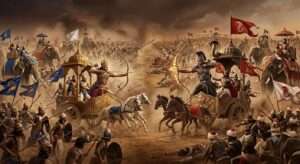
Ashwatthama answered not with words but with another devastating rain of arrows. The relentless fury of his attack became impossible even for Dharmaraja to withstand. Forced to withdraw from the immediate combat, the son of Dharma yielded the field, while Ashwatthama, flushed with the exhilaration of victory, blazed across the battlefield like a consuming fire and turned his wrath upon Bhima.
Elsewhere, Karna confronted the valiant Karusha forces as they moved to reinforce Bhima. The clash was dreadful beyond measure. Warriors fell in countless numbers beneath the irresistible force of their weapons. Among those engaged were the Karusha king Dantavakra, the Chedi rulers descended from Shishupala, and the Srunjaya hero, remembered as the son of Suvarnashthivi. The battlefield became a vast ocean of blood where heroism and death walked side by side.
In another quarter of the war, Duryodhana directed his fury against Sahadeva. His arrows tore down Sahadeva’s banner and shattered his standard. Instantly Nakula rushed to his brother’s aid, striking Duryodhana with a swift succession of arrows. The Kaurava prince responded by enveloping both brothers in the irresistible force of divine astras. Those who witnessed the encounter feared that the twin sons of Madri would surely perish beneath such overwhelming celestial power.
At that critical moment, Dhrishtadyumna charged into the fray like a thunderbolt. He struck Duryodhana with twenty-five arrows, halting his advance. Duryodhana retaliated with twice that number, shattering Dhrishtadyumna’s bow. Undismayed, the Pandava commander grasped another bow and pierced his foe with fifteen arrows that caused intense pain. Enraged, Duryodhana broke this bow as well and drove ten sharp shafts into Dhrishtadyumna’s forehead. The commander stood resplendent despite his wounds, his face resembling a radiant lotus adorned with a cluster of dark bees.
Resolute beyond defeat, Dhrishtadyumna armed himself once again. With remarkable skill he slew Duryodhana’s charioteer, smashed his bow, and brought down his royal umbrella, banner, and standard, stripping the Kaurava king of every emblem of sovereignty. Duryodhana answered with equal ferocity, wrecking Dhrishtadyumna’s chariot and leaving him stranded amidst the conflict. At once, his devoted brother carried him safely from the battlefield, preserving the life of the Pandava commander for battles yet to come.
Observing these events, Karna resolved to pursue Dhrishtadyumna and complete what Duryodhana had begun. Meanwhile, Sanjaya continued his solemn narration before the blind king Dhritarashtra. Every account he delivered stirred fresh questions and deeper anxieties within the monarch’s heart. Though hope and fear wrestled ceaselessly in his mind, destiny continued to unfold with irresistible certainty, revealing that no earthly power could alter the judgment of time or the triumph of righteousness.

