


U Lakshman Rao
In the ancient sacred imagination of India, the story of Ganesha is not merely a tale of gods, demons and miraculous events. It is a profound spiritual allegory in which the forces of nature, consciousness, discipline, family, knowledge and social order are woven together. The traditional narrative explains how Ganesha came to be recognised as the Lord of beginnings and the remover of obstacles, while also suggesting deeper psychological and philosophical truths about human conduct. Read through a Vedic and rational lens, the story moves from the uncontrolled forces of desire and ego toward discrimination, wisdom and harmony.
Once, according to the sacred tradition, an asura in the form of a mighty elephant performed severe penance to propitiate Lord Shiva. His austerity was so intense that Shiva appeared before him and granted him a boon. The elephant-demon asked that Shiva remain within his stomach. Shiva, true to the nature of divine compassion and to the sanctity of a granted boon, accepted the condition and entered the demon’s body. There he remained absorbed in yogic stillness.
The episode may be understood symbolically as the imprisonment of pure consciousness within the powerful but undisciplined forces of material existence. The elephant represents immense strength, memory and instinct, but when strength is separated from wisdom it can become destructive. The demon’s penance therefore carries an important psychological lesson: austerity by itself does not guarantee virtue. Concentration, discipline and extraordinary ability can be misdirected when they remain governed by ego and desire.
Parvati, the consort of Shiva, became anxious when she could not find her Lord. She approached Lord Vishnu and prayed, saying, “O Divine Lord, you protected my husband earlier from the danger of Bhasmasura. Now I am deeply concerned about his whereabouts. Please reveal where he is and help me bring him back.”
Vishnu, who represents preservation, order and the intelligence that sustains cosmic balance, perceived the situation through divine insight. He consoled Parvati and assured her that Shiva would be restored. Hari then devised a means by which the demon himself would willingly release Shiva. Accompanied by Brahma and other divine beings, Vishnu formed a remarkable ensemble resembling a procession of decorated bulls and performers. Each divine being contributed to the music, and together they created a captivating spectacle.
The music and rhythmic movement pleased the elephant-demon. He was delighted by the performance and asked the mysterious visitors what they desired as a reward. Vishnu then revealed the purpose of the visit. The bull was associated with Nandi, the sacred vehicle and attendant of Shiva, and the divine visitors requested that Shiva be returned.
The demon immediately understood that he had been outwitted. He realised that there was no possibility of escaping the consequence of his own boon. Yet even at that moment, he placed one final condition upon his surrender. He requested that his head should be made worthy of reverence and that his skin should always be associated with Shiva. Shiva was therefore released, and the demon’s elephant form became incorporated into the sacred symbolism surrounding Ganesha.
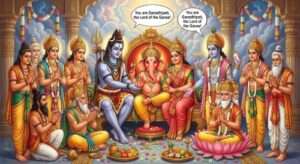
The imagery is rich with meaning. The elephant is not presented simply as an object of destruction. Its strength, intelligence, memory and dignity are transformed into attributes of divine wisdom. In this sense, the ancient story conveys a principle remarkably compatible with a scientific temperament: destructive energy is not necessarily annihilated; it can be transformed and placed under the direction of higher intelligence. Human civilisation itself advances through the transformation of natural forces into constructive purposes.
Nandi then enabled Shiva to emerge from his confinement. In the traditional narrative, the episode concludes with a cautionary teaching: powerful boons should not be granted without discrimination to those whose intentions remain governed by destructive impulses. Power without ethical responsibility can become a danger to the individual and to society. The gods then departed, and Shiva returned toward Kailasa with Nandi.
When Parvati heard that Shiva had been released, she prepared herself to receive him. Before taking her ceremonial bath, she applied a cleansing paste made from natural substances and flour. From the same material she fashioned a figure of a young boy and, through her divine power, infused life into him. She instructed him to guard the entrance and not permit anyone to enter without her permission.
The boy stood faithfully at the entrance. When Shiva approached, the young guardian, obeying his mother’s command, prevented him from entering. Shiva, unaware of the circumstances and angered by the obstruction, severed the boy’s head. He then entered the palace.
Parvati received Shiva and performed the customary rituals, but during their conversation the death of the young guardian became known. Shiva recognised that the boy had acted not out of hostility but out of obedience and duty. He regretted his action and sought to restore him to life. The elephant head associated with the earlier sacred episode was placed upon the boy, and Shiva infused him with renewed life. Thus emerged Ganesha, the elephant-headed Lord whose form unites human intelligence with the profound symbolic qualities of the elephant.
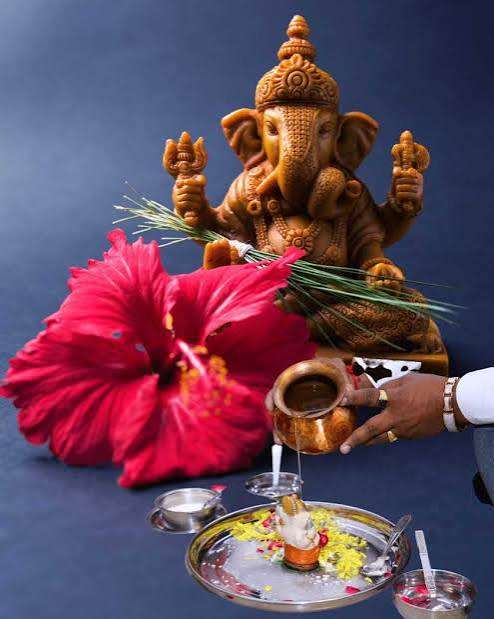
This transformation is central to the spiritual philosophy of Ganesha. The human body represents purposeful action, while the elephant head represents expansive intelligence, memory, strength and the capacity to perceive beyond immediate appearances. The large ears suggest attentive listening; the small eyes indicate concentration; the trunk represents adaptability and discrimination, capable of both tremendous strength and delicate action. His form itself becomes a visual philosophy of intelligent living.
Ganesha’s elevation did not arise merely from physical power. Young Kumaraswamy, or Kartikeya, was already celebrated for his strength, courage and martial ability and was appointed commander of the divine hosts. To determine who should preside over the primordial forces, Shiva proposed a contest: whoever could travel around the sacred places of the three worlds and return first would receive the honour.
Kumaraswamy immediately mounted his peacock and travelled with great speed. Ganesha, however, did not attempt to compete through physical speed. He invoked the sacred name of Narayana and reflected upon the deeper meaning of pilgrimage, duty and the origin of existence. He then circumambulated his parents three times.
When Kartikeya reached the various sacred places, he was astonished to find that Ganesha appeared to have already visited them. He gradually understood the principle behind his brother’s action. For Ganesha, the parents represented the immediate embodiment of the entire cosmic order. The journey around them was therefore not an evasion of the contest but a philosophical interpretation of what the contest truly meant.
Kartikeya recognised the wisdom of Ganesha and accepted his superiority in this particular test. He recommended that Ganesha be installed as the Lord of the primordial hosts and the first among those to be invoked before important undertakings. The episode establishes an enduring contrast between two forms of excellence: speed and wisdom, physical force and intellectual discrimination, external achievement and inner understanding. Society requires both, but without wisdom, power and speed can easily become directionless.
The Vedic tradition does not reduce divinity to a single human-like personality. Its deeper language frequently speaks through symbols, natural forces, cosmic principles and psychological archetypes. Ganesha can therefore be understood as a personification of ordered intelligence—the faculty that recognises obstacles, understands their causes and discovers appropriate ways to overcome them.
The elephant itself provides an extraordinary natural symbol for such intelligence. It possesses remarkable memory, sophisticated social behaviour, communication abilities, emotional sensitivity and an impressive capacity for learning. Ancient Indian civilisation observed nature closely and incorporated its characteristics into spiritual symbolism. The elephant-headed form of Ganesha consequently communicates strength without aggression, intelligence without arrogance and power under disciplined control.
The association of Ganesha with beginnings also has a profound psychological foundation. Every human undertaking begins with uncertainty. Before starting a journey, building a house, beginning education, entering a marriage, undertaking a business or commencing a ritual, the mind encounters questions: Will I succeed? What obstacles may arise? Can I control what I cannot foresee? Ganesha worship gives this psychological uncertainty a sacred form. By invoking Ganesha first, the individual symbolically places awareness before action.
In this sense, “removing obstacles” need not mean that every difficulty will magically disappear. Rather, Ganesha represents the intelligence necessary to identify an obstacle, understand its origin and respond appropriately. Sometimes an obstacle must be removed; sometimes it must be overcome; sometimes it must be accepted; and sometimes it must be transformed into an opportunity. This is a profoundly rational principle concealed within devotional language.
The worship of Ganesha also has a social dimension. Human beings cannot undertake significant activities entirely as isolated individuals. Every project requires cooperation, communication, trust, discipline and a shared objective. Ganesha, as the first-invoked deity, symbolically establishes collective harmony before action begins. His worship reminds a community that successful beginnings require clarity of intention and respect for the forces that sustain life.
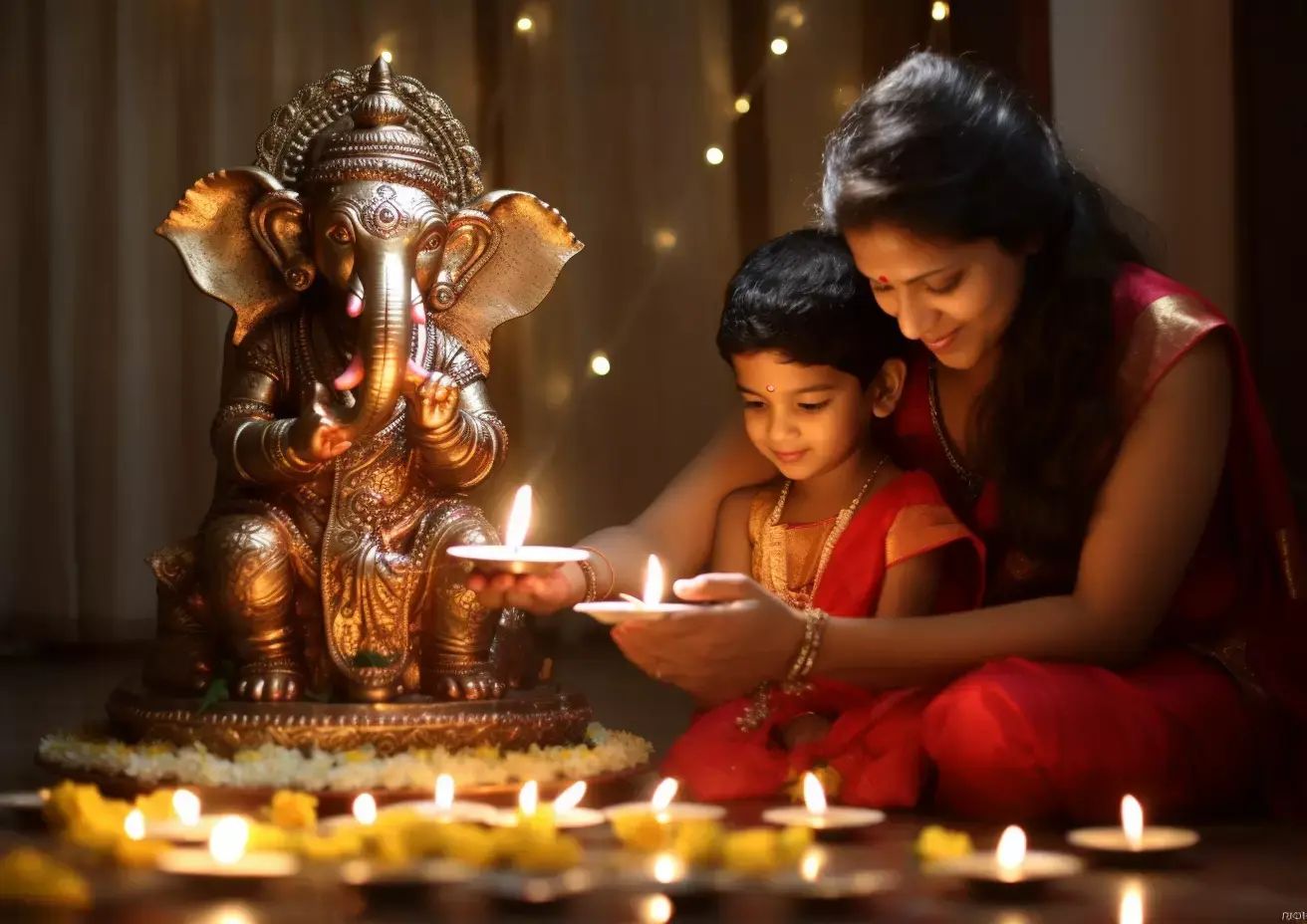
The sacred tradition further connects Ganesha with nature. His worship can be performed through simple offerings of leaves, flowers, fruits, grains and naturally available materials. Such simplicity reflects an important civilisational principle: spirituality does not necessarily depend upon extravagance. The sacred can be encountered through the ordinary elements of the natural world.
This becomes especially meaningful in the observance of Ganesha Chaturthi. At its deepest level, the festival can be understood as an invitation to recognise the relationship between human beings and nature. The traditional use of clay for the image symbolises the emergence of form from the earth and its eventual return to the same elemental source. Creation, existence and dissolution are represented within one cycle.
From a scientific perspective, this symbolism resembles the fundamental principle that matter continually participates in cycles of transformation. What human beings call birth, growth, decay and dissolution are manifestations of continuous natural processes. The clay image is shaped into a form, worshipped as a representation of the divine principle, and eventually returned to the elements. The ritual therefore carries an ecological message when practised responsibly: what comes from nature ultimately returns to nature.
The psychological significance of the festival is equally profound. Collective worship provides a structured occasion for people to pause, reflect, meet one another, express gratitude and renew social bonds. Festivals reduce psychological isolation by creating shared experiences. Music, art, ritual, food and collective participation create emotional connection and strengthen community identity.
The sages, kings and ordinary people of ancient India therefore came to regard Ganesha as worthy of invocation before important ceremonies and undertakings. The principle gradually extended across generations and through different ages of Hindu civilisation. Before learning, travelling, building, writing, conducting a ceremony or beginning a new enterprise, Ganesha is remembered because wisdom should precede action.
The deeper message is not that human beings should expect a supernatural force to perform every task on their behalf. Rather, Ganesha teaches that human beings should begin with clarity, humility, preparation and discrimination. Prayer prepares the mind; knowledge guides it; discipline sustains it; and ethical conduct gives direction to its power.
Thus, the ancient origin of Ganesha worship can be understood simultaneously at several levels. In the devotional dimension, he is the beloved son of Shiva and Parvati, the Lord of beginnings and remover of obstacles. In the philosophical dimension, he represents awakened intelligence. In the psychological dimension, he symbolises the disciplined mind capable of overcoming fear, confusion and impulsiveness. In the social dimension, he represents cooperation, order and collective responsibility. In the ecological dimension, his festival reminds humanity of its intimate relationship with the elements of nature.
Across the changing ages, the outer forms of civilisation have transformed, but the human need for wisdom before action has remained constant. Technology may change, scientific knowledge may expand and social institutions may evolve, yet human beings continue to encounter fear, uncertainty, conflict, ambition, failure and moral choices. The enduring relevance of Ganesha lies precisely here.
He is therefore not merely the deity placed at the beginning of a ritual. He represents the principle that every beginning should be accompanied by awareness. Strength must be guided by wisdom, knowledge by humility, ambition by morality and achievement by responsibility. The removal of obstacles begins not outside us but within the mind that perceives them.
The ancient sages expressed these truths through story, symbol, ritual and devotion. A modern scientific temperament can approach the same tradition through observation, psychology, ecology and philosophy without diminishing its spiritual beauty. The language may differ, but the central insight remains powerful: when intelligence governs strength and consciousness governs instinct, obstacles become opportunities for growth.
Ganesha therefore continues to stand at the threshold of every new beginning—not merely as one who removes difficulties, but as the symbol of the wisdom that teaches humanity how to meet them.


