



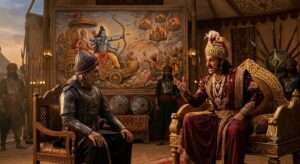
King Duryodhana approached the mighty King Salya with profound courtesy and deliberate wisdom. Bowing to his greatness, he declared, “Among all warriors, there is none who surpasses your mastery of warfare, not even Karna. You are the sharp arrow lodged in the hearts of enemies; therefore you are rightly called Salya. The responsibility I now place before you is not a mark of disrespect but the fruit of deep reflection and a carefully conceived strategy for victory. I have long pondered before coming to you, for the task is formidable. Against every strength of the Pandavas, we have devised a remedy, yet all our efforts are rendered fruitless by the extraordinary intelligence and masterful strategy of Krishna. Arjuna, though a peerless archer, depends greatly upon Krishna, whose unmatched wisdom transforms every battlefield into a theatre of divine strategy. His brilliance remains concealed beneath the humble office of a charioteer, yet it is his counsel that obstructs all our designs. You alone possess the foresight, composure, and swiftness of judgment necessary to counter Krishna’s subtle methods. It is for this reason alone that I have sought your aid. This request arises from the highest regard for your greatness, never from any desire to diminish your honour. Such an exalted undertaking can be accomplished only by one of your stature, for none besides you can dare to shoulder so magnificent and demanding a responsibility.”
The noble King of Madra listened attentively. The sincerity of Duryodhana’s words gradually dissolved the anger that had arisen in his heart. Filled with satisfaction, Salya replied, “O King, before this noble assembly of monarchs you have honoured me with praises surpassing all expectation. You have esteemed me even above Krishna himself. Your humility, trust, and reverence have deeply pleased me. Karna is renowned throughout the earth for his unrivalled generosity, courage, and glory. I shall indeed become the guide of his chariot.”
Thus, by the elegance of his speech and the subtlety of his persuasion, Duryodhana overcame Salya’s earlier objections. Yet Salya remained inwardly thoughtful, wondering whether any mortal could truly equal Krishna’s commanding wisdom. Having spoken publicly before assembled kings and warriors, he could no longer withdraw his promise. Nevertheless, he imposed a single condition. “Karna,” he declared, “must patiently hear whatever words arise within my mind. Whether pleasing or unpleasant, I shall utter them without restraint. If this condition is accepted, our bond of friendship shall remain firm and unbroken.”
Sanjaya continued, “O Dhritarashtra, your son looked upon Karna with respect and gentle affection. He considered Salya’s condition entirely reasonable and advised Karna to accept it wholeheartedly. Duryodhana’s gracious words satisfied both heroes, restoring complete harmony between them.”
After a brief silence, Duryodhana perceived that a trace of uncertainty still lingered within Salya’s heart. Desiring to remove every remaining doubt, he began to recount an ancient narrative once spoken by the immortal sage Markandeya to King Dhritarashtra.
“In ancient times,” Duryodhana said, “the mighty demon Tarakasura was slain in battle by the hosts of the gods. He left behind three illustrious sons—Tarakaksha, Kamalaksha, and Vidyunmali. Determined to surpass even their father’s greatness, they undertook severe austerities to propitiate the Creator, Brahma. Their penance was adorned with unwavering determination, perfect restraint of the senses, purity of conduct, contentment, disciplined self-study, complete surrender to the Divine, and the faithful practice of the eightfold path of yoga. Their asceticism was sincere, noble, and unsurpassed, and at length Brahma himself manifested before them, pleased by their steadfast devotion.”
The Creator spoke kindly, “Ask for the boon you desire.”
With one united voice the three brothers replied, “May we never be overcome by death at the hands of any being at any time.”
Brahma answered with gentle wisdom, “Such absolute immortality exists nowhere in creation. Neither can it be granted nor received. Consider another request, and I shall fulfil it with affection.”
The demons then said, “Grant us three magnificent cities furnished with every splendour. Let them travel wherever we desire merely by our thought. May no gods, Yakshas, Nagas, or celestial beings possess the power to destroy them. Let us roam fearlessly according to our own will.”
Brahma granted their request but attached a single condition. “Only when these three cities come together at one place shall a hero of incomparable prowess be able to destroy you with a single stroke. Apart from that moment, none shall overcome you.”
Satisfied with this condition, the brothers accepted the boon and resolved never to allow their cities to unite. Brahma then instructed them to construct their cities according to their own desire before returning to his celestial abode.
Thereafter the demons approached the celebrated architect Maya, the venerable master of mystical arts whose austerities had earned immeasurable power. Guided by their wishes, Maya constructed three incomparable cities fortified with mighty ramparts, lofty gateways, magnificent palaces, and immeasurable wealth. Vast expanses of gold, silver, and iron adorned these splendid fortresses, each extending for countless miles in every direction. The celestial city of Suvarnapura, fashioned from gold, moved through the heavens and was ruled by Tarakaksha. Rajatapura, the silver city suspended in the skies, became the kingdom of Kamalaksha. Lohapura, built of iron upon the earth, was governed by Vidyunmali.
Arrayed in divine garments, adorned with fragrant garlands, precious jewels, and celestial ornaments, the three brothers flourished amidst limitless prosperity. Empowered by Brahma’s boon, they conquered the three worlds and ruled without opposition. Maya faithfully served them, producing by his mystical powers every object they desired. Thus countless ages, extending through crores of years, passed in uninterrupted splendour.
In due course Tarakaksha’s son, Hari, was born. Possessing immense determination, he too performed severe penance until Brahma once again appeared before him.
The Creator said, “Ask for your desired boon.”
Hari replied, “Grant that within these three cities, whenever any inhabitant falls in battle, if his body is immersed in a sacred reservoir, he shall arise transformed into ten mighty warriors, each possessing strength and valour twice that of the one who died. Let each city possess an inexhaustible, self-purifying, and eternally holy stepwell for this purpose.”
Brahma granted the extraordinary boon and departed. Thereafter each city possessed an immense sacred reservoir whose waters never diminished. By virtue of this blessing, the inhabitants cast aside every fear of battle, for death itself became the source of multiplied strength.
The arrogance of the Tripura demons steadily increased. Intoxicated by power, greed, and delusion, they wandered freely throughout the universe, disturbing sacred hermitages, desecrating holy places, and obstructing the sacrifices and spiritual disciplines of sages and ancestors. Unable to endure these oppressions, the gods sought refuge with Indra, who marched against the three cities with his celestial army. Yet despite all his might, he could neither breach their impregnable fortresses nor restrain their growing tyranny. Filled with sorrow, Indra acknowledged his helplessness.
The gods and great sages then approached Lord Brahma. With Indra standing before them, they described the relentless atrocities committed by the Tripura demons and implored the Creator to reveal a means for their destruction.
Brahma replied, “These cities derive their invincibility from the immense merit of their penance. They can be destroyed only by a single divine arrow discharged at the precise moment when all three become united. No being except the great Lord Rudra possesses the power to accomplish this impossible feat. Therefore, go and seek refuge in him.”
Obeying Brahma’s command, the gods and sages performed severe austerities for a thousand divine years. Their penance surpassed imagination, purifying their hearts through unwavering devotion. Finally, accompanied by Brahma himself, they approached the supreme Lord Shiva, the compassionate refuge of all beings, the bestower of boons, whose crescent moon adorned his matted locks, whose eternal nature radiated auspiciousness, and whose boundless wisdom transcended all worlds. He is the conqueror of desire, the embodiment of truth, and the protector of righteousness.
With folded hands they prostrated before him and offered hymns filled with purity, reverence, and spiritual splendour. They praised his eternal glory, his radiant joy, his unfailing readiness to protect the Vedas and uphold dharma, and his immeasurable compassion toward those who seek refuge through wisdom and devotion. Their sacred praises delighted the great Lord, who graciously extended his divine hand in assurance, preparing to accomplish the destruction of Tripura for the welfare of all creation.
Sanjaya concluded, “O Dhritarashtra, your son employed every possible means to remove the apprehensions lingering within Salya and the assembled kings. By recalling the sacred narrative once spoken by the venerable sage Markandeya, he sought to strengthen their confidence and restore unwavering resolve before the decisive hour of battle.”

