



It is time the habitual naysayers stopped inventing bizarre and illogical questions every time Bharat’s economy produces a positive number. For far too long, the country’s economic progress has been viewed through a political lens. If GDP projections are encouraging, they are questioned. If growth outpaces expectations, the numbers are suspected. If international institutions endorse Bharat’s economic trajectory, the credibility of those very institutions is suddenly called into question. What is particularly disappointing is that sections of the Opposition and some self-styled economic experts appear unwilling to accept even assessments made by respected institutions such as the World Bank, the International Monetary Fund (IMF) and other global agencies. The irony becomes even more striking when some of those raising doubts have themselves occupied high constitutional and economic offices, including the Finance Ministry. Criticism, of course, is welcome. Indeed, it is essential in a democracy. But criticism must be based on economics, evidence and logic—not on the compulsive urge to find a cloud behind every silver lining. The latest debate over Foreign Direct Investment (FDI) is a classic example. Bharat’s Gross FDI touched a 15-year high, with inflows of $30.66 billion during April-June 2026. Ordinarily, such a figure should prompt a serious examination of why foreign investors continue to bring substantial capital into the country. Instead, some critics have chosen to dismiss Gross FDI as a possible “vanity metric” and shifted the entire debate to Net FDI. Many have asked: Which is the real number? The answer is simple: both are real—but they tell us different things. Gross FDI tells us how much foreign direct investment is flowing into Bharat. It is an important measure of the country’s ability to attract overseas capital, technology, business partnerships and long-term investments. Net FDI, on the other hand, tells us what remains after accounting for repatriation by foreign investors and outward FDI by Indian companies. During the first quarter of FY27, Gross FDI stood at $30.66 billion. Repatriation was $13.42 billion, while outward FDI was $9.41 billion, leaving Net FDI at around $7.84 billion. Does this automatically mean Bharat is doing badly or that foreign investors are losing confidence? A big no.
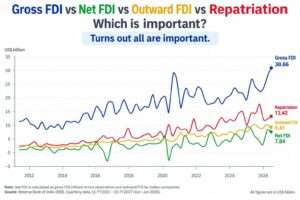
This is precisely where political rhetoric and economic reality begin to diverge. Repatriation does not necessarily mean that an investor is running away from Bharat. A private equity investor may invest in an Bharatiyan company, help it expand, build new capacity, improve operations and create jobs, and eventually sell its stake after several years at a profit. The investor may then take back its capital and profits. That is the normal investment cycle. Take, for instance, Temasek’s exit from Schneider Electric India in 2025. Temasek reportedly repatriated around $6.4 billion after selling its stake. But did Schneider Electric shut shop in Bharat? Far from it. The company subsequently took full ownership and announced plans to expand its Bharatiyan capaacity by 2.5 to three times, followed by fresh manufacturing investments in Hosur and Bengaluru. The exit of one investor, therefore, did not mean the exit of investment or economic activity. Capital changed hands, while business, capacity, employment and future investment continued in Bharat. Similarly, outward FDI should not automatically be viewed as a negative. When Indian companies invest overseas, acquire global businesses or expand into foreign markets, it reflects the growing confidence and financial strength of Bharatiyan enterprise. Sun Pharma’s $11.75-billion acquisition of Organon’s global women’s-health business in 2026, for example, represents an Bharatiyan company seeking a larger global footprint. Should Bharat really complain when its companies become global players? The sensible way to understand the FDI story is not to selectively pick one number and build a political narrative around it. We must examine the complete picture—Gross FDI, Net FDI, repatriation, outward investment and, importantly, the composition of investment. How much is going into greenfield projects? How much into manufacturing? How much represents acquisitions, reinvested earnings, private equity or venture capital? Which sectors are attracting capital? Are new factories, capacities, technologies and jobs being created? Those are the questions that matter. Gross FDI is not a vanity metric. Nor is Net FDI the only metric that matters. Both are valuable indicators when properly understood. The real question, therefore, should not be: “Which number is the real number?” It should be: “What is each number actually telling us about Bharat’s economic story?” That requires clarity—not cynicism.

