



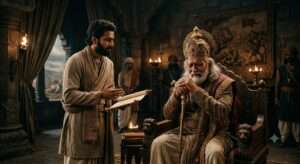
Dhritarashtra, overwhelmed by grief yet unable to surrender to it, addressed Sanjaya with a voice laden with anguish. He declared that Karna had never regarded Krishna and Arjuna with the slightest fear. So immense was Karna’s confidence in his own strength that he considered himself capable of challenging even the lord of the heavens and emerging victorious. Such was the magnitude of his faith in his valor, prowess, and invincible spirit. Yet that mighty warrior, whose pride stood as high as a mountain peak, had fallen upon the battlefield. Reflecting upon this bitter reality, the aged king lamented that Karna was no ordinary man. Duryodhana had chosen the path of enmity with the Pandavas largely because he relied upon Karna’s unwavering loyalty, knowing that Karna would go to any extent to secure his friend’s happiness and triumph.
The king recalled how Karna’s incomparable courage and martial excellence had subdued the kingdoms of Videha and Pundra, bringing them under Duryodhana’s sovereignty. Through bold campaigns and fearless conquests, many rulers became tributaries almost overnight. The strength that Karna lent to the Kaurava cause emboldened their armies and encouraged their confidence in every undertaking. His mastery over celestial weapons was unparalleled. Possessing divine astras of many forms and powers, he wielded forces whose effects could astonish even the inhabitants of heaven. Now that Karna had fallen, Dhritarashtra saw no future for the Kauravas. Victory appeared impossible, and the kingdom itself seemed destined for ruin.
The blind monarch then turned inward, marveling at his own endurance. “After hearing such dreadful tidings,” he said, “my mind has not shattered, nor has my heart broken. Surely my heart is not fashioned from flesh and blood but from unbreakable diamonds. Day after day I hear of the deaths of sons, allies, kinsmen, and well-wishers. Who else could continue living after witnessing such devastation? Who could bear burdens as grievous as these?” In the extremity of sorrow, he expressed a desire to cast away his life. He spoke of plunging into deep waters, entering blazing fire, drinking poison, or abandoning food altogether until death claimed him.
Hearing these despairing words, Sanjaya responded with wisdom and restraint. He reminded the king that he stood equal to the great monarchs of antiquity in lineage, wealth, radiance, and renown. Such a person, adorned with learning and glory, should not allow grief to consume his judgment. His education, dignity, and noble reputation demanded steadfastness rather than despair. Therefore, Sanjaya urged him not to surrender his courage before the storms of fate.
Yet Dhritarashtra’s anguish remained undiminished. He replied that Karna’s death had destroyed everything. The very thought of impending defeat pierced his heart like a sharp arrow and pressed relentlessly upon his spirit. The sorrow arising from this calamity resembled a vast and boundless ocean, and he could see no shore upon which to find relief. In his reflection upon human destiny, he declared that individual effort often proves futile before the decrees of fate. Men may plan, strive, and hope according to their understanding, yet the fruits of every action ultimately rest in the hands of destiny. Karna had always shone through the power of his own arms, yet even such a hero had fallen. What explanation remained except the supremacy of fate, the ultimate dispenser of the results of all actions?
The king further reflected upon the strange burden of his own longevity. “My heart ought to have broken upon hearing of Karna’s death,” he said, “yet it remains intact. This alone proves the vast measure of life allotted to me. Once I was honored and respected by multitudes. Now many of my relatives and companions are dead, and those who look upon me offer only sympathy. Is such a desolate existence worth preserving? Can anyone willingly endure a condition so bereft of joy and hope?” His mind, already oppressed by one sorrow, found itself overwhelmed by many more. The fall of Bhishma, the death of Drona, and now the departure of Karna had struck him in relentless succession. Among these disasters, Karna’s absence weighed most heavily upon him because it extinguished Duryodhana’s hope of victory.
Dhritarashtra confessed that he had also lost hope for the survival of his son. Karna had been Duryodhana’s shield, protector, and strongest refuge. Without him, who remained capable of safeguarding the Kaurava prince? Just as mighty Jambhasura was slain by Indra, so had Karna fallen beneath Arjuna’s arrows. The Kaurava army had lost its courage, confidence, and spirit. Duryodhana’s reliance upon Karna had been absolute. To expect victory without him seemed as absurd as expecting a lame man to win a race or a pauper to enjoy the luxuries of kings.
The king then remembered the many opportunities for peace that had been rejected. Yudhishthira had spoken with affection, reminding them that the Pandavas and Kauravas were children of the same family and ought not to quarrel among themselves. Yet Duryodhana rejected those noble words just as a sick man rejects the medicine that could restore his health. Bhishma too had warned them. While lying upon his bed of arrows, he demonstrated the extraordinary power of Arjuna by requesting water, which Arjuna drew forth from the sacred subterranean current of the Ganga. Thereafter Bhishma advised Duryodhana to reconcile with the Pandavas, divide the kingdom fairly, and enjoy peace upon his rightful share. He urged an end to the war before greater destruction followed. Yet Duryodhana ignored the counsel of the grandsire. Now an ocean of sorrow had descended upon them all, threatening to drown the house of Kuru.
Seeking to describe his helplessness, Dhritarashtra compared himself to a bird whose feathers had been plucked away by playful maidens. Such a creature, deprived of its ability to fly, must submit helplessly to the will of others. In the same manner, the consequences of his own actions had separated him from those he loved, stripped him of strength, and reduced him to helpless dependence. He wondered where he might go to escape such suffering and who could grant relief from the crushing burden pressing upon his heart.
Thus the mind of Dhritarashtra became a fertile ground for countless sorrowful thoughts. Speaking at length upon his grief, he finally turned his attention to a question that tormented him above all others. Eager to know the details of Karna’s final moments, he asked Sanjaya how the great warrior had fallen. Did Karna display the full might of his arms while battling Arjuna? Did he reveal the strength of his sinews and the pride of his heroic spirit? Did he fight with perseverance and virility worthy of praise from warriors on both sides? Did he ever retreat from the challenge, or did he remain steadfast until the end?
The king’s questions grew increasingly anxious. Had the Kaurava soldiers abandoned Karna and fled, leaving him alone amid the conflict? Did multitudes of warriors sacrifice their lives in his defense? Remembering Bhishma’s fall before Shikhandi and Drona’s death following the deception concerning Ashwatthama, Dhritarashtra wondered whether similar stratagems had been employed against Karna. Had the Pandavas resorted once more to cunning devices? Had Karna been overcome through trickery rather than through open combat? The king’s apprehensions arose from grief rather than reason, yet they demanded an answer. Sanjaya listened patiently, allowing Dhritarashtra to voice every doubt and fear. When the king’s questions had finally run their course, the faithful narrator prepared to reveal the truth of Karna’s fall exactly as it had occurred upon the field of Kurukshetra, inviting the sorrow-stricken monarch to hear the account with careful and attentive mind.

