


(…..Continued) Part I raised a straightforward but deeply uncomfortable question: how can HCA’s constitutional disqualification provisions remain effectively dormant for years when criminal cases involving serving and former office-bearers have continued through prolonged litigation?
The answer may lie entirely in the normal pace of the judicial process.
But there is another episode that makes it impossible to dismiss the broader accountability concerns as mere paranoia.
It concerns the HCA’s own Ombudsman.
The Ombudsman fight shows this isn’t simply about slow courts
In 2019, the HCA Apex Council approved former Supreme Court judge Justice (Retd.) Deepak Verma as Ombudsman-cum-Ethics Officer.
The purpose of such an institution could hardly be clearer.
An Ombudsman is meant to strengthen accountability, investigate complaints and provide an independent mechanism for addressing concerns about governance and conduct.
In an institution already facing serious questions about administration and financial management, such an office should have been welcomed and protected.
Instead, what followed, as reconstructed in the Supervisory Committee’s report from findings recorded by the Telangana High Court in subsequent proceedings, raises serious questions about the conduct of the association itself.
The proceedings concerned the manner in which the Ombudsman mechanism was challenged.
The High Court findings, as cited in the Committee’s account, included a resolution being passed “behind the back of the President and 3 other members”, a case filed in the name of a club using an incorrect postal address for HCA, and subsequent proceedings in which the role of office-bearers was alleged to have been concealed.
The High Court described the proceedings as collusive and as an abuse of the process of the court, and personal costs were imposed on the HCA Secretary.
These are extraordinary findings for any sporting association.
The significance goes beyond the particular dispute.
If an association appoints an Ombudsman to strengthen accountability, the natural response of its administration should be cooperation.
Not obstruction.
Not procedural manoeuvring.
Not an attempt to neutralise the very mechanism created to examine complaints.
This is why the Ombudsman episode matters to the present debate.
It provides context for the larger question:
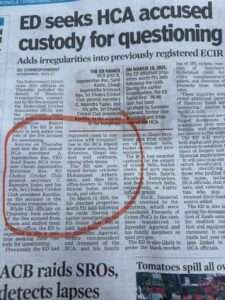 Does HCA genuinely believe in accountability, or does it believe in accountability only when somebody else is being held accountable?
The bigger scandal is the absence of consequences
This is where the HCA story repeatedly seems to go wrong.
Allegation after allegation.
Inquiry after inquiry.
Committee after committee.
Court proceeding after court proceeding.
And yet the central question remains stubbornly unchanged:
Where are the consequences?
An institution cannot survive indefinitely on investigations.
It cannot govern on the strength of press statements.
It cannot restore credibility merely by appointing another committee.
It cannot claim transparency while important questions about its administration remain buried beneath layers of litigation.
And it certainly cannot expect players, clubs, parents, coaches and cricket lovers to believe that everything is normal when the association’s own governance documents contain safeguards that appear to have little practical effect.
The Hyderabad Cricket Association is not a private club belonging to a handful of office-bearers.
It is the institutional gateway through which Hyderabad’s cricketers seek to progress from local cricket to the highest levels of the game.
Every player who dreams of representing Hyderabad, playing Ranji Trophy cricket or going further depends on the integrity of this system.
Every club participating in HCA competitions depends on fair administration.
Every parent who sends a child into the cricket system expects selection, opportunity and administration to be governed by rules rather than influence.
And every cricket lover has a right to expect that an association controlling the game will be governed with greater integrity than the controversies surrounding it suggest.
Who watches the watchdog?
The most uncomfortable question is perhaps the simplest.
Who is actually enforcing the HCA constitution?
If the rules are binding, somebody must enforce them.
If they are not being enforced, somebody must explain why.
If the disqualification provisions have never been triggered because no competent court has framed charges in these cases, that should be stated clearly.
If there are proceedings preventing such orders, the complete position should be placed transparently before the members.
If discharge orders have been passed and are under challenge, the exact legal status should be disclosed.
And if any office-bearer is ineligible under the constitution, HCA must explain how that person was permitted to contest, vote, hold office or continue in office.
There should be no selective interpretation.
There should be no “our man versus your man” approach.
There should be no distinction between one faction and another.
Rules are rules.
If the rule applies to an opponent, it must apply to a friend.
If it applies to a junior office-bearer, it must apply to a senior one.
If it applies to a challenger, it must apply equally to an incumbent.
Otherwise it is not governance.
It is factionalism wearing the clothes of governance.
HCA cannot have it both ways
HCA cannot invoke its constitution when convenient and ignore it when inconvenient.
It cannot demand respect for elections while questions remain about who was constitutionally entitled to participate in those elections.
It cannot demand institutional autonomy while failing to demonstrate institutional accountability.
It cannot ask the cricket fraternity to trust its administration while refusing to answer legitimate questions about criminal cases involving its office-bearers.
And it cannot hide behind the presumption of innocence when the question being asked is not whether somebody is guilty, but whether the association has correctly applied its own eligibility rules.
Presumption of innocence protects an accused person from being treated as convicted.
It does not automatically answer questions about eligibility under an association’s constitution.
That distinction is fundamental.
The Supreme Court-approved constitution is not decorative
The words “Supreme Court-approved” should not become ceremonial language.
If the constitution approved in the wake of the Lodha reforms was intended to bring transparency, professionalism and accountability into cricket administration, then its provisions must mean something in practice.
Otherwise, what was the point?
A constitution that exists only on paper is not governance.
It is theatre.
A disqualification clause that can theoretically remove an office-bearer after a court frames charges, but which remains practically irrelevant because proceedings never reach that stage, is a safeguard without teeth.
And safeguards without teeth are invitations to abuse.
That is why HCA’s members deserve answers.
Not excuses.
Not factional counter-attacks.
Not accusations that those raising questions are “anti-cricket”.
Not another committee.
Not another promise.
Answers.
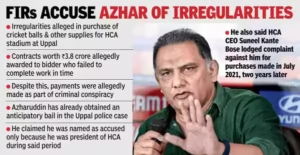
Enough of committees. Time for accountability.
Hyderabad cricket has spent too many years trapped between allegations and investigations, committees and court cases, promises and postponements.
The association needs something far more basic:
A functioning system in which rules have consequences.
If an office-bearer is eligible, establish it transparently.
If he is not eligible, act.
If a criminal case has been discharged, disclose the order and its present legal status.
If that discharge is stayed or under challenge, disclose that too.
If charges are framed, apply the constitution.
If charges are not framed, explain why the matter remains pending after all these years.
And if there is a legal impediment preventing the HCA constitution from operating as written, identify it publicly.
There is nothing complicated about that.
What is complicated is the continuing refusal — or inability — to provide a clear answer.
HCA has had committees.
It has had court interventions.
It has had an Ombudsman.
It has had supervisory oversight.
It has had criminal investigations.
It has had chargesheets.
It has had years of litigation.
What it appears still not to have is the one thing that matters most:
consequences.
And that is why the real question is no longer merely who has been chargesheeted?
The real question is:
Who is really running the Hyderabad Cricket Association?
Is it the constitution?
The courts?
The committees?
The elected office-bearers?
Or the endless machinery of delay?
Because if a rule specifically designed to prevent accused persons from occupying positions of authority can remain powerless for years, while the institution continues functioning under the control of people whose names figure in criminal proceedings, then Hyderabad cricket has a governance problem far bigger than any individual criminal case.
The HCA does not need another slogan about reform.
It needs to demonstrate that its rules apply to everyone.
It needs to demonstrate that office is not a shield.
It needs to demonstrate that elections are not a route around accountability.
And above all, it needs to demonstrate that the constitution is more powerful than the people occupying the chairs.
Until it does that, the question will continue hanging over Hyderabad cricket:
Three chargesheets. Zero consequences.
So, who is really running HCA? (Concluded)


GOD ONLY CAN SAVE HCA ..