
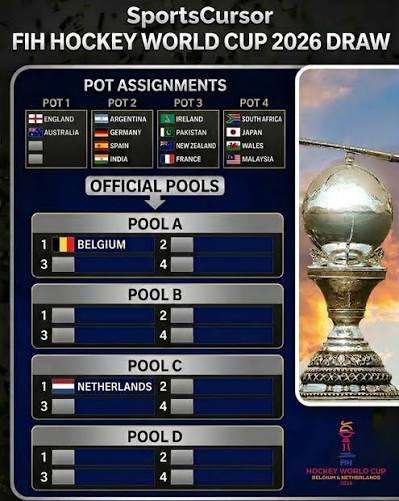
Amstelveen: The complicated format of the FIH Hockey World Cup has left teams, fans and media grappling with permutations and combinations, with the focus increasingly shifting from performances on the field to calculations about who can reach the semifinals.
Instead of the traditional knockout format, where teams progress to the quarterfinals before the semifinals, the current system has brought the second round or crossover pool into play, with first-round results against the other teams in the second-round pool carrying forward and making the qualification race difficult to follow.
In fact, Teams and media are struggling with complex qualification math because head-to-head results and goal differences from Phase I carry directly into the second-stage crossover pools.
- Phase 1 (Pool Stage): 16 teams split into four pools of four (A, B, C, D) playing three matches each. Top two advance; bottom two head to classification.
- Phase 2 (Crossover Pools): Top teams merge into new groups (Pools E and F). Head-to-head points and goal records from matching Phase 1 opponents carry over.
- Phase 3 (No Quarterfinals): The top two finishers from Pools E and F go directly to the semi-finals, leaving zero margin for error or traditional knockout-stage “resets”