Shrikant Rao
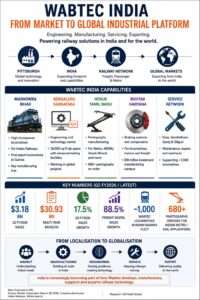
Wabtec has just given investors another reason to look closely at the company, with second-quarter 2026 sales rising 17.5 percent to $3.18 billion, adjusted earnings per share increasing 21.6 percent to $2.76 and the multi-year backlog reaching $30.93 billion. Management has also raised its full-year 2026 revenue guidance to $12.30–12.60 billion and adjusted EPS guidance to $10.60–10.90, while Freight equipment sales rose 35 per cent and Transit sales increased 18.9 percent.
For a company headquartered at 30 Isabella Street in Pittsburgh, Pennsylvania, the message from the quarter is fairly clear: the business is growing, the order book provides visibility and management is confident enough about the year ahead to raise its expectations.
There is another number in those results that deserves rather more attention than it might receive in a conventional financial reading. Freight digital sales rose 88.5 percent, helped by the acquisitions of Inspection Technologies and Frauscher Sensor Technologies, reinforcing the company’s movement beyond the traditional business of selling locomotives and railway equipment towards a broader proposition involving braking, couplers, inspection, diagnostics, software, maintenance and lifecycle services. The locomotive remains the most visible piece of the business, but increasingly it sits within a much larger technological and operational chain.
And that chain leads rather naturally to India, where Wabtec has spent several decades building something that is now considerably more substantial than the conventional multinational subsidiary. India is a large railway market, but it is also a manufacturing base, an engineering centre, a supplier-development platform, a source of technical talent and, increasingly, an export location, giving Wabtec an unusual combination of scale, operating complexity and industrial capability in one country. The interesting question is therefore not whether India matters to Wabtec — it plainly does — but whether the company can turn the capabilities it is developing here into a competitive advantage across its global business faster than its rivals can build equivalent capabilities in India.
The Turn
Wabtec’s Indian presence dates back to the early 1990s, with the company taking full ownership of its Indian joint venture in 1996, and what followed was less a single dramatic expansion than a steady accumulation of capability across freight components, locomotives, transit systems, engineering, digital technologies and services. The distinction matters because the Indian operation no longer resembles a foreign manufacturer that has simply established an assembly plant close to a large customer; over the years Wabtec has developed relationships with Indian Railways, suppliers, engineers and technology institutions while adapting products to local operating conditions and gradually moving higher up the value chain.
The decisive change in manufacturing scale came with Marhowra. The Bihar plant, established through the partnership between Indian Railways and Wabtec, began operations in 2018 around the high-horsepower Evolution Series diesel-electric locomotives required for Indian freight operations. The facility has since ramped up to a stated capacity of 170 locomotives a year, including 100 for Indian Railways.
What makes Marhowra more interesting now is that the production story has started moving in the opposite direction. In June 2025, the first export locomotives from the plant were flagged off for Guinea, supporting the TransGuinéen Railway and the Simandou iron-ore project. The customer in Guinea does not buy a locomotive because it happens to have been manufactured in Bihar; it needs reliability, performance, delivery discipline, engineering support and lifecycle economics, making the export a much more meaningful test of manufacturing maturity than another localisation announcement.
That is where the old Make in India argument becomes more interesting. The issue is no longer simply whether a global railway company can manufacture competitively in India, but whether its Indian operation can become good enough at engineering, supplier development, quality, production and service that the parent company is prepared to use it for customers somewhere else. Marhowra has begun to answer that question, although repeating the achievement across products and geographies will be the harder test.
Beyond Locomotives
The locomotive can easily dominate the Wabtec conversation because it is large, expensive and photogenic, but much of the Indian opportunity sits in the equipment surrounding it. Wabtec’s Transit business has capabilities in braking systems, pantographs, couplers, air-conditioning systems and passenger access doors, while its Rohtak campus, opened in 2024 with an $18 million investment, manufactures axle-mounted disc brakes, distributor valves, brake calipers, actuators and friction material for freight cars, metro coaches and locomotives serving Indian Railways and metro customers.
That portfolio fits a railway system that is becoming more technologically demanding. Dedicated Freight Corridors have altered freight operations, electrification has changed locomotive requirements, Vande Bharat is creating a more sophisticated passenger-train ecosystem and the expansion of metro networks is generating demand for braking, current collection, couplers, doors and other systems that increasingly determine fleet availability and safety. In March 2026, Wabtec announced contracts for more than 680 pantographs for Chennai Metro Phase II, Mumbai Metro Lines 4, 5 and 6, Indian Railways’ MEMU programme and Vande Bharat Sleeper trains, with production at Hosur and deliveries scheduled to begin late in the year.
There is an interesting competitive dimension here because Wabtec is not operating in an empty field. Alstom has established a substantial Indian manufacturing and engineering footprint, Siemens is deeply involved in the country’s locomotive programme, Knorr-Bremse remains formidable in braking and rail systems, while BEML, Titagarh Rail Systems and Jupiter Wagons are building increasingly capable Indian businesses around rolling stock and railway equipment. The market has therefore moved beyond the stage when simply having a factory in India constituted an advantage; cost, engineering, quality, delivery, digital capability and lifecycle support now have to work together.
That may be the more important test for Wabtec over the next decade: whether it can make its different Indian operations reinforce one another quickly enough for the combined capability to become harder to copy than any individual factory.

Bengaluru Advantage
Some of Wabtec’s most valuable Indian assets consequently have little to do with factory size. The India Engineering and Technology Center in Bengaluru was established in 2019 with a $5 million investment, while Wabtec subsequently opened its largest Indian engineering laboratory there, with 30,000 square feet of test-lab space and another 12,000 square feet for operations and offices. The significance of Bengaluru lies less in the number of people working there than in the kind of problems they are being asked to solve and whether those solutions can travel beyond India.
India is a useful railway laboratory because the operating environment is rarely forgiving. Heat, dust, monsoon conditions, long distances, heavy axle loads, high utilisation and a rapidly electrifying network expose weaknesses that may not appear under more controlled conditions, forcing suppliers to adapt technology to actual operating requirements. The high-reach pantograph developed for India’s double-stack freight operations is one example, because the height required for overhead electrification on the Dedicated Freight Corridors created a problem that could not simply be solved by importing an existing catalogue product.
That makes the low-cost-engineering description of India increasingly inadequate. The more valuable proposition is the ability to encounter a difficult railway problem at commercial scale, develop a solution alongside a demanding customer, test it in service and then determine whether the knowledge has value somewhere else. For Pittsburgh, that is potentially more useful than engineering cost arbitrage.
Shopfloor Logic
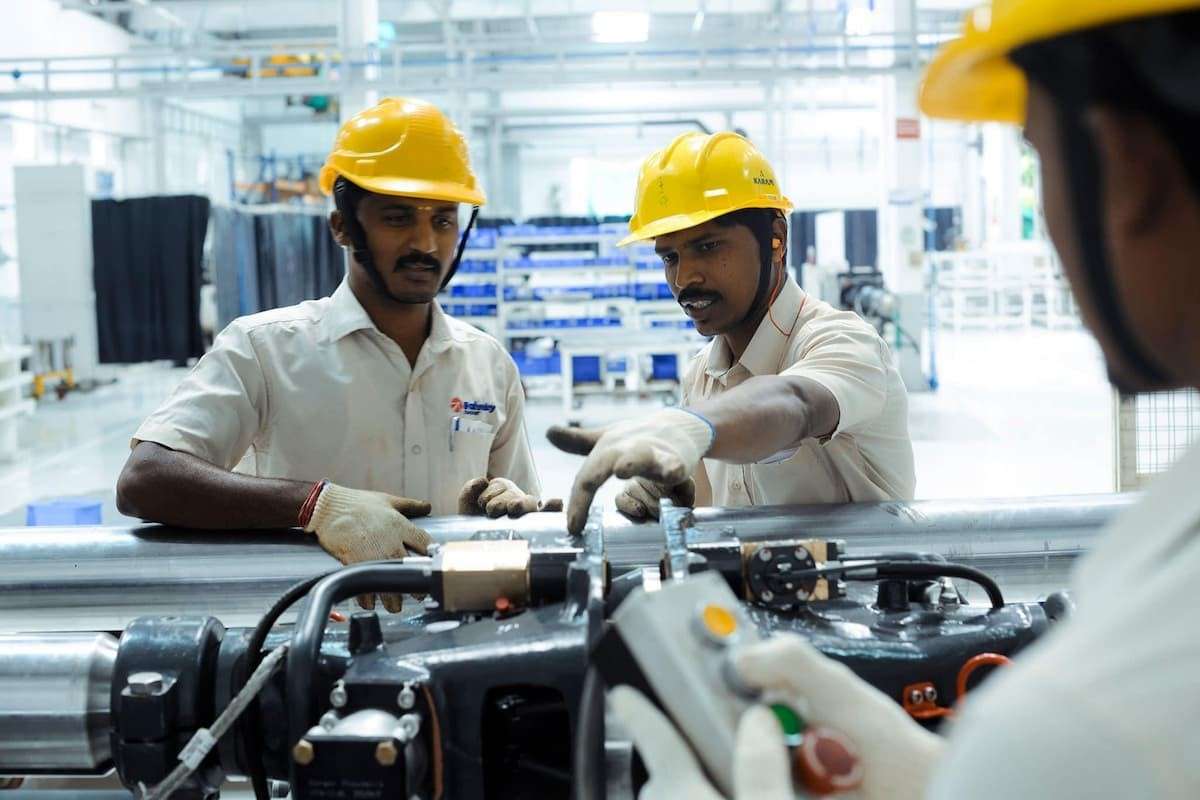
The same principle applies inside the factories, where railway reliability is often determined by decisions made long after an engineering drawing has been approved. Wabtec has used lean manufacturing practices at Marhowra and invested in structured skill development, with its programme involving written tests, practical assessments and interviews and giving employees greater responsibility across safety, quality, delivery, maintenance and engagement; the company reported a 31% improvement in employee skill levels following the programme. Its wider work around the plant has included smart-welding training for engineers from local polytechnics, while community programmes have supported more than 600 female entrepreneurs.
These initiatives matter because training in a railway factory is not simply an HR exercise. A supplier problem can eventually become a locomotive reliability problem, an assembly error can become a maintenance issue thousands of kilometres away and a design improvement that never reaches the shopfloor remains a drawing. The stronger manufacturing cultures allow information to travel in both directions, with production teams identifying recurring problems, engineers responding to them and service experience feeding back into design and manufacturing.
The same logic applies to gender diversity. Wabtec has promoted women through its Women of Wabtec programme and diversity initiatives, but the more meaningful measure is whether women increasingly occupy engineering, quality, supply-chain, supervisory and plant-management positions where manufacturing decisions are made. An industry does not become more diverse merely because recruitment statistics improve; the change becomes industrially meaningful when the people making technical and operational decisions begin to reflect a broader talent pool.
Service Network
The locomotive is also only the beginning of Wabtec’s relationship with Indian Railways because its economic value depends on what happens after delivery. Wabtec has expanded locomotive service capabilities through facilities including Gooty in Andhra Pradesh and Siliguri in West Bengal, where a new facility began operations in January 2026 to support 250 Indian Railways locomotives. Wabtec says its operations at Roza, Gandhidham, Gooty and Siliguri together will service the 1,000 Wabtec locomotives in the Indian Railways fleet.
That service model has an important strategic consequence because every locomotive in operation provides information about how equipment behaves under Indian conditions, while maintenance teams see problems that may never appear in a laboratory. If that information travels back into Bengaluru, manufacturing and product engineering, the service network becomes part of a larger industrial loop rather than simply an after-sales organisation. In a railway market where availability matters almost as much as the original purchase price, that relationship can become difficult for a new entrant to reproduce.
Digital Railway
The digital side of Wabtec’s business makes that loop more valuable. The 88.5% increase in Freight digital sales in the latest quarter reflects a company trying to expand its relationship with railway operators from physical equipment towards inspection, sensing, diagnostics and data-driven services.
India offers an unusually large test bed for that transition because a railway network of its scale generates enormous amounts of operational information, but the commercial value lies not in collecting data for its own sake; it lies in converting that information into better maintenance planning, higher asset availability, improved safety, lower energy consumption and more predictable operations. Once railway customers begin buying that capability, the competitive field also changes because the contest is no longer confined to traditional rolling-stock manufacturers and component suppliers.
Export Test
The Guinea locomotives from Marhowra provide the clearest evidence that India’s role is beginning to extend beyond its own railway network. The ES43ACi locomotives built for the TransGuinéen Railway and Simandou project give the Bihar operation an opportunity to demonstrate that standards developed around Indian Railways can satisfy an international mining and infrastructure customer, while the export gives the plant credibility that domestic production alone cannot establish.
There is a larger opportunity if India can combine manufacturing economics, supplier localisation, engineering depth and dependable quality, because Wabtec could then use Indian facilities as export platforms rather than simply as production centres for the domestic market. India would matter not only because Indian Railways is one of the world’s largest railway systems, but because capabilities developed here could help Wabtec compete in Africa, Asia and other markets where freight, mining and passenger-rail investment are growing.
One successful programme, however, does not make a global export hub. Wabtec will have to demonstrate that Indian plants can repeatedly meet different regulatory requirements, customer specifications, delivery schedules and lifecycle-support expectations. Guinea is therefore less a conclusion than a beginning.
Investment Base
Putting one neat number against Wabtec’s total investment in India would be misleading because the commitment has accumulated across businesses and over decades rather than arriving as one giant capital cheque. There are identifiable investments such as the $5 million Bengaluru engineering centre and the $18 million Rohtak campus, alongside Marhowra, Hosur and the service infrastructure developed around the locomotive fleet.
But the less visible industrial investment may ultimately be more important: suppliers developed over years, engineers trained on global programmes, technicians familiar with Indian operating conditions, quality systems for safety-critical equipment and relationships with Indian Railways, RDSO, metro organisations and train manufacturers. None appears as a single line in Wabtec’s financial statements, yet this is precisely the industrial capital a competitor cannot reproduce simply by announcing a new factory.
Leadership Legacy
Leadership has mattered in building that base, and the timing of Sujatha Narayan’s retirement gives the Indian story an interesting point of transition. Narayan retired from her full-time corporate career on June 30, 2026, stepping away from her role as Wabtec’s India Region Leader after almost three decades in corporate life; in announcing her departure, she said she had been privileged to work with the Ministry of Railways, Railway Board, RDSO, metro organisations and train manufacturers and described the journey as helping build a $1 billion enterprise in India. She also thanked Wabtec India’s 3,000 employees.
Her contribution is significant not because the Indian business became large simply by virtue of the market, but because it required sustained engagement between a global company and Indian institutions, customers, suppliers and employees, along with the confidence to move India from being principally a market for technology towards becoming a place where technology could be engineered, manufactured, serviced and exported.
The next leadership phase consequently starts from a very different base. The task is no longer simply to establish Wabtec in India but to make freight, transit, engineering, manufacturing, digital technology and lifecycle services reinforce one another, because the value of the Indian operation will ultimately be determined by what the different parts can contribute together rather than by how impressive each looks separately.
Pittsburgh Question
The latest financial results give that question some urgency. Wabtec now has a $30.93 billion multi-year backlog, stronger Freight and Transit businesses and enough confidence to raise its 2026 revenue and earnings guidance. India will not determine those numbers by itself, but it can influence what sits underneath them if the company succeeds in turning Indian manufacturing, engineering, service and digital capabilities into assets that contribute to programmes outside the country.
Pittsburgh remains the global headquarters and the centre from which Wabtec’s corporate direction is set, but the architecture of the business is becoming more distributed, with Bengaluru carrying engineering responsibilities that extend beyond India, Marhowra developing into an export manufacturing base, Hosur supplying systems for the next generation of passenger rail, Rohtak adding specialised production and the service network supporting locomotives long after delivery. Taken together, those facilities suggest that India’s importance can no longer be measured simply by the size of its domestic order book.
The competitive question is now unavoidable. Alstom, Siemens and Knorr-Bremse already possess substantial Indian operations, while domestic manufacturers are becoming more capable and Indian Railways is demanding greater localisation, better technology and stronger lifecycle economics. Wabtec’s advantage will therefore depend on whether it can convert the depth of its Indian footprint into something competitors cannot easily match, rather than assuming that three decades of presence will protect its position.
The Next Test
That is why the latest results matter beyond the numbers themselves. Wabtec is growing, its order book provides substantial visibility and management is confident enough to raise its guidance, but the next phase of growth will depend increasingly on how effectively the company combines the physical and digital sides of its business and how much of that combination can be built in markets such as India.
Three decades after Wabtec came to India because the country’s railway market was too important to ignore, the relationship is beginning to work in both directions. Marhowra’s locomotives moving towards Guinea provide the most visible symbol of that change, but the deeper shift is taking place across Bengaluru, Hosur, Rohtak, the supplier network and the service organisation, where India is gradually becoming part of how Wabtec develops, manufactures, supports and exports railway technology.
Pittsburgh remains the headquarters and the place from which Wabtec’s financial performance and global direction are reported, but some of the industrial capability behind its next chapter is being developed several thousand kilometres away, across an Indian railway ecosystem that is itself becoming more ambitious, more technologically demanding and considerably harder to treat as merely a market for someone else’s technology.
That, perhaps, is the more interesting measure of Wabtec’s Indian journey now: not simply how much the company can sell into India, but how much of what it builds, learns and perfects here can ultimately help shape the next global chapter of Wabtec.