



In the sacred atmosphere of the Vedic age, where the rhythm of existence was understood as a divine harmony between cosmic law and human consciousness, the sage Gr̥tsamada raised his profound invocation to Indra through the exalted metres of Jagatī and Triṣṭubh preserved within the Rigveda. These hymns were not merely poetic praises composed for ritual recitation; they were luminous revelations born from deep states of contemplative insight. The Vedic sages perceived the universe as a living sacrifice sustained through reciprocal exchange between the visible and invisible worlds. Thus, as the sacred fire of Agni rose upward carrying the oblations, the hymns simultaneously ascended as vibrations of consciousness seeking communion with the cosmic powers governing creation.
For the welfare of humanity and the preservation of universal order, the sages invoked the primal and heroic Indra, the lord of luminous strength and victorious intelligence. Through the burning flames of Agni, offerings were poured with reverence, while melodious Vedic chants resonated through the sacrificial enclosure. In Vedic understanding, sound itself possessed creative potency. The precise intonation of mantra was regarded as a scientific discipline of consciousness capable of harmonising the individual mind with cosmic energies. Therefore, the chanting of hymns was not symbolic devotion alone, but a subtle process through which the inner faculties of human beings were refined and elevated.
The sage lovingly invited Indra, the eternally youthful power who moves beyond the decay of time while all worlds gradually grow old beneath the cycles of existence. In this imagery, the Vedic seers expressed a profound metaphysical truth. The universe undergoes perpetual transformation, aging, and dissolution, yet the divine principle underlying creation remains ever fresh, radiant, and inexhaustible. Indra thus represents the undiminished vitality of cosmic consciousness that renews life endlessly. Though ancient beyond comprehension, he remains forever youthful because divine energy is never exhausted by manifestation.
The hymns declare that there exists no realm in which Indra is absent. This insight reflects the Vedic perception of an interconnected cosmos permeated by unseen intelligence. All powers, whether manifest in nature, mind, or spirit, are latent within the universal principle symbolised by Indra. The Soma elixir residing within him signifies not merely a ritual drink, but the essence of heightened awareness and spiritual exhilaration experienced by sages in elevated states of consciousness. His bodily strength symbolises the sustaining power of natural law, while the brilliance radiating from him reflects the illumination of awakened intelligence. The vajra held in his hand represents concentrated force, decisive will, and the thunderous energy capable of shattering ignorance and obstruction. The wisdom enthroned in his head signifies the supremacy of enlightened consciousness over chaos and confusion.
When Indra journeys across the vast stretches of heaven and earth upon his celestial horses, neither the terrestrial world nor the heavenly realms can restrain him. Mountains cannot obstruct his path, and oceans cannot halt his chariot. In Vedic symbolism, this portrays the unstoppable movement of cosmic energy and awakened intellect. Just as natural forces transcend barriers through their inherent momentum, the power of divine consciousness penetrates all limitations. The imagery also reflects a scientific temperament deeply embedded within Vedic thought, wherein natural phenomena such as storms, lightning, rainfall, and celestial motion were perceived as expressions of ordered energy governed by universal principles rather than arbitrary events.
No strength can exceed the greatness of Indra, for he is the conqueror of hostile forces and the protector of cosmic harmony. Yet the enemies described in Vedic hymns are not merely external adversaries. They also symbolise fear, ignorance, greed, inertia, and destructive tendencies within human consciousness. Thus, Indra becomes the divine force that liberates the mind from bondage and restores inner clarity. Ornamented with celestial splendour, he is worshipped through yajñas conducted by humanity seeking prosperity, wisdom, and protection. The yajña itself was understood as a sacred science of reciprocity, teaching that harmony in society and nature arises through disciplined offering, restraint, cooperation, and reverence toward the forces sustaining existence.
Indra is praised both as the enjoyer and the giver of Soma. He is celebrated as a scholar, revealing that Vedic civilisation never separated wisdom from strength. True power was considered incomplete without knowledge, and true knowledge required disciplined energy. Agni, radiant and wish-fulfilling, accompanies Indra to partake of Soma, symbolising the union of aspiration and illumination. Fire transforms matter into subtle essence, just as spiritual discipline transforms ordinary consciousness into divine insight.
The Soma essence itself is described as mindful, invigorating, and strength-bestowing. Beyond its ritual dimension, Soma symbolises the blissful state attained when the human mind becomes harmonised with higher awareness. The stimulation of Soma is not mere intoxication but the awakening of latent faculties within consciousness. Modern scientific reflection may perceive in these descriptions an intuitive understanding of altered states of perception, heightened cognition, and the transformative effects of disciplined ritual, sound, breath, and meditative absorption upon the human nervous system.
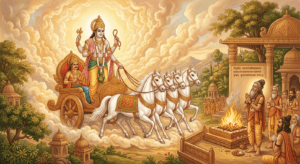
The Adhvaryu priests prepare the Soma with meticulous care, reflecting the extraordinary precision characteristic of Vedic ritual culture. Every gesture, chant, and offering followed measured principles resembling a sacred science. The sages understood that order in action generates order within consciousness. Therefore, the preparation of Soma symbolised the disciplined refinement of human energies before they could be offered to the divine.
Indra’s chariot, his vajra weapon, and his swift Hari horses are all described as granters of boons. These symbols collectively portray the dynamic faculties required for spiritual and worldly accomplishment. The chariot represents directed movement toward truth, the vajra signifies unwavering determination, and the horses symbolise the disciplined senses and vital energies that carry consciousness toward higher attainment. Indra, delighted by Soma, becomes the embodiment of awakened strength guided by luminous intelligence.
The sage further glorifies Indra as the destroyer of enemies and the protector who carries humanity across the dangerous ocean of conflict like a steadfast ship. War in the Vedic vision was not solely external combat but also the perpetual struggle between light and darkness within the human condition. Therefore, prayer becomes a means of aligning oneself with divine order amid the uncertainties of life. The sage approaches Indra with humility, asking the deity to absorb and accept the hymn born from sincere devotion and contemplative insight.
The flowing generosity of Indra is compared to the nourishing nature of the cow, which consumes simple grass yet produces sustaining milk for its calf. This metaphor beautifully expresses the Vedic understanding of transformation within nature. From simple elements emerge nourishment, vitality, and life itself. In the same manner, divine grace transforms human effort into spiritual abundance. The prayer reaches Indra with the intimacy and certainty of a devoted wife approaching her beloved husband, symbolising the inseparable bond between the soul and the divine source.
Finally, the sage prays that the rich gifts offered in sacrifice may satisfy the priests and bring prosperity to the worshippers, together with their children and grandchildren. The Vedic vision never confined spirituality to individual salvation alone. It embraced continuity across generations, recognising that the preservation of wisdom, virtue, and sacred knowledge was essential for the flourishing of civilisation. Through the chanting of Ṛgvedic hymns during yajña, humanity sought not only material prosperity but also inner illumination, ethical harmony, intellectual refinement, and alignment with the eternal rhythm of cosmic truth.

