Lakshmanrao Upadhyayula
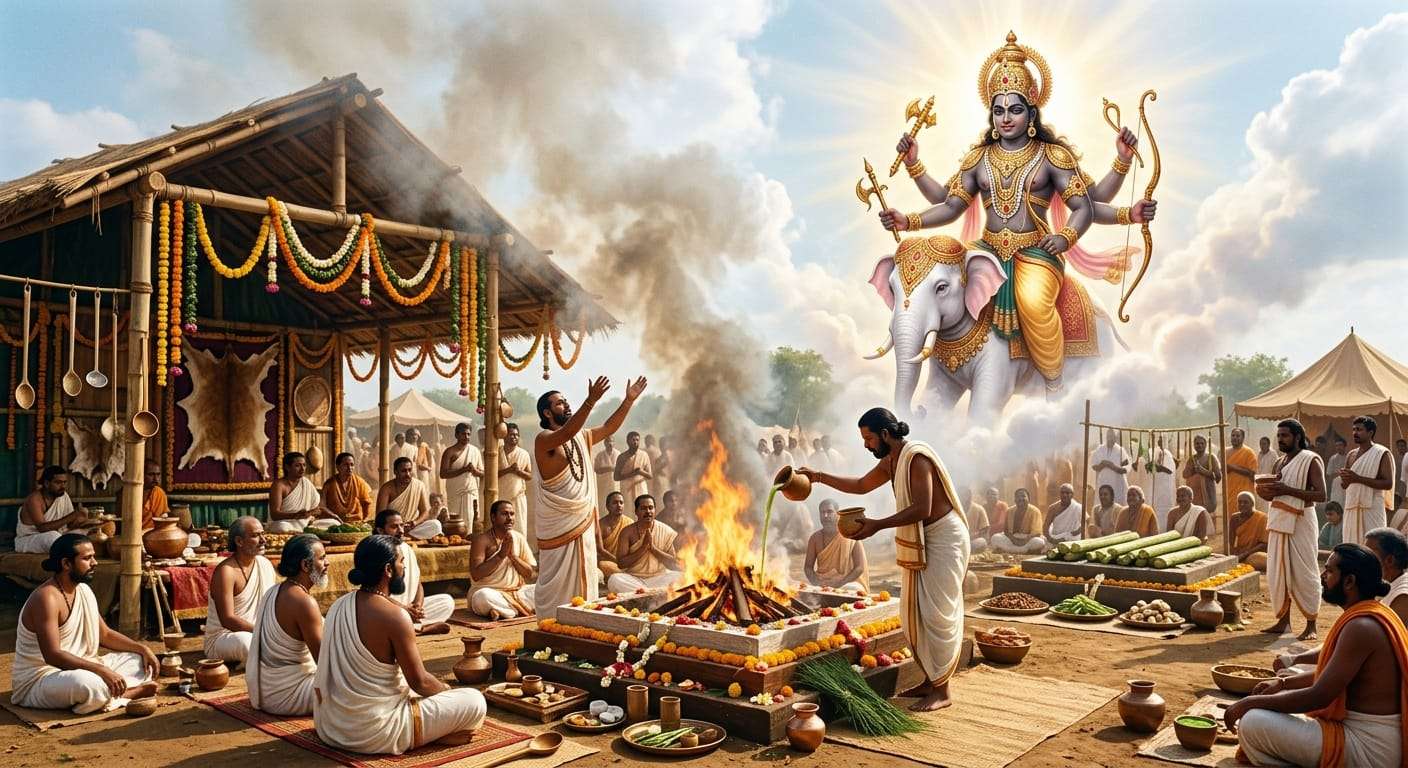
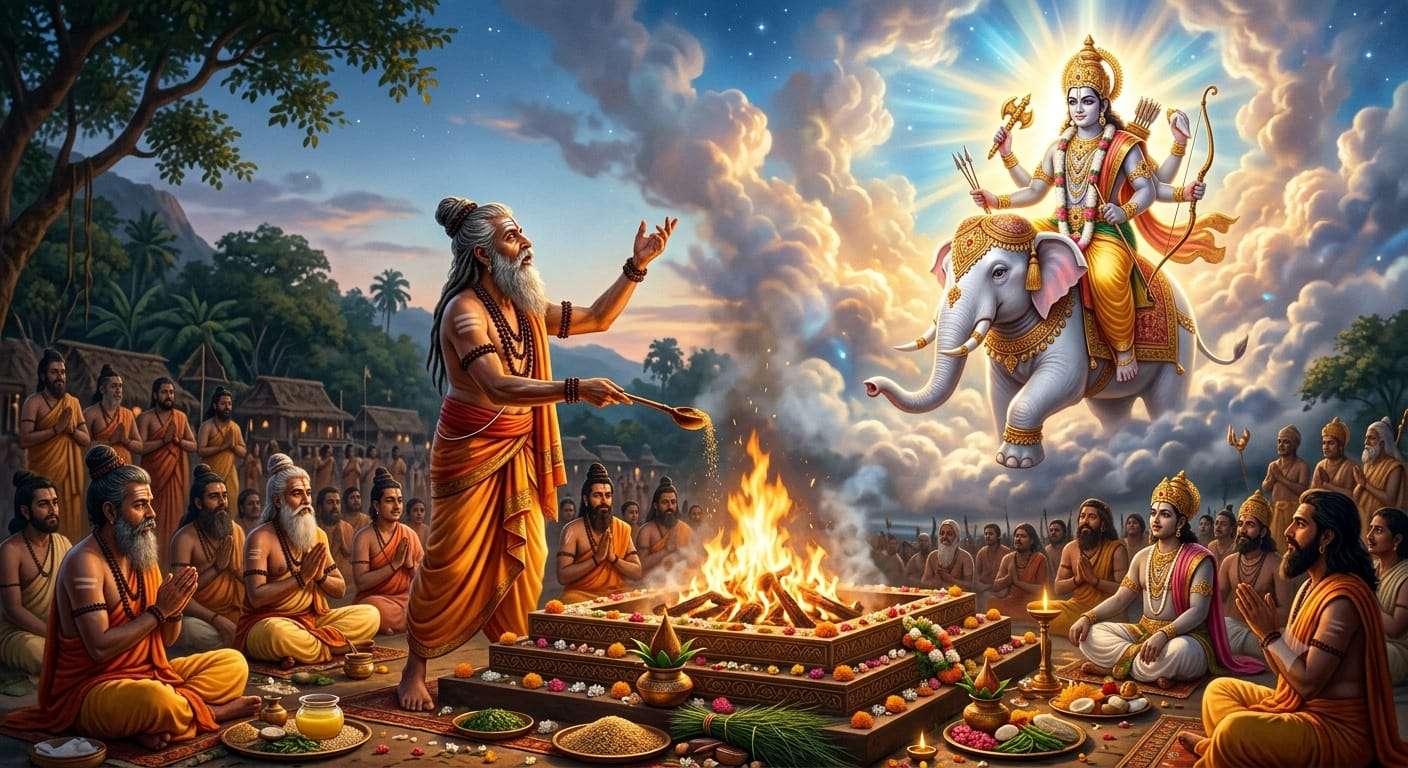
The sage Bhargava Somahuti, immersed in the disciplined cadence of Tristubh metre, raises his invocation to Agni, the divine mediator, inviting him as the sacred guest who transcends all impurity and bears the oblations from the mortal realm to the divine. Agni is not merely fire in its physical manifestation, but the knower of all transformations, the silent witness who converts human intention into divine reception. In this invocation, the patrons call upon him with reverence, recognising his ability to assume manifold forms, bridging the fragile boundary between man and god, between the visible ritual and the invisible cosmic response.
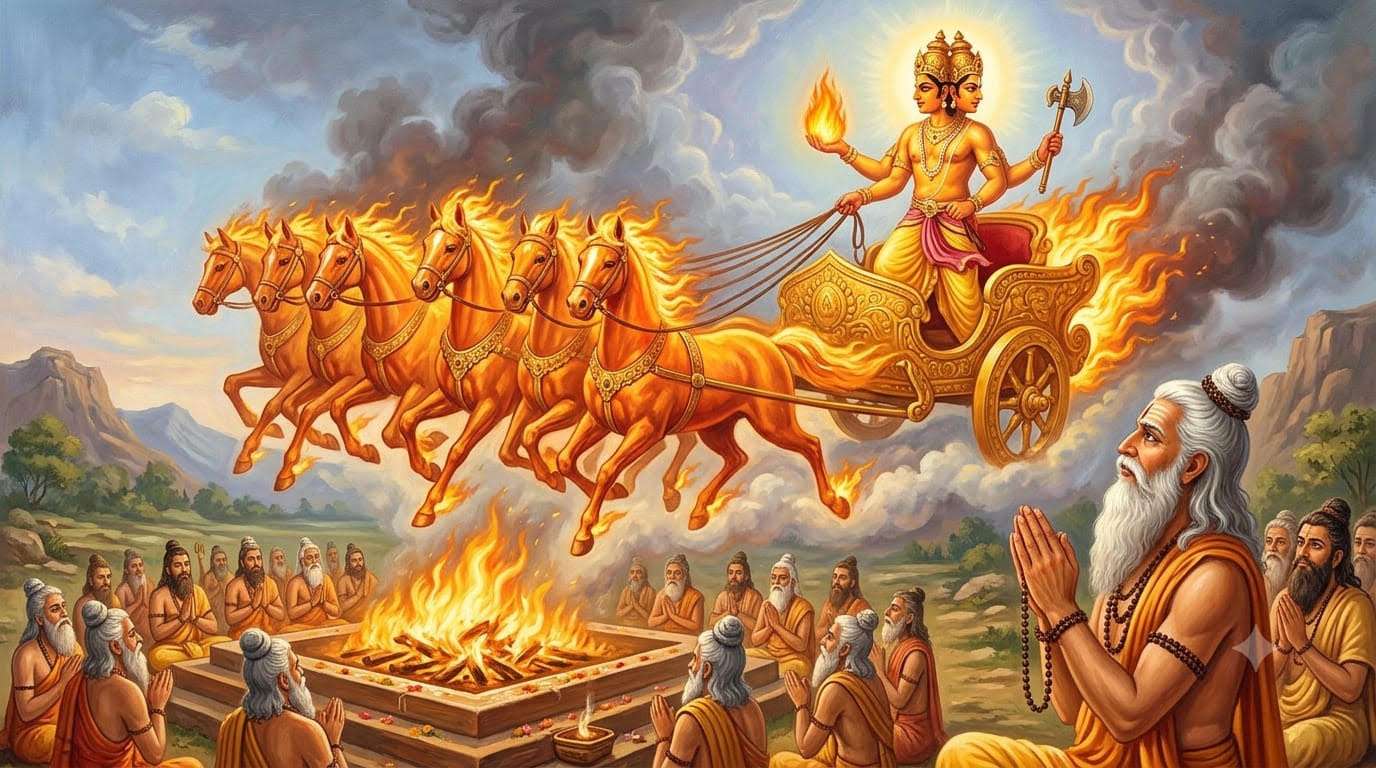
The ancient seers, the Bhrigus, are remembered as those who first discovered and established Agni in the subtle layers of existence—within the celestial waters, within the mid-region of the atmosphere, and within the heart of humanity. This triadic स्थापना reflects an early intuitive grasp of universal energy permeating all planes of existence. Agni is described as swift-moving, symbolically yoked with horses, representing dynamic energy and momentum. As the lord among the gods, he embodies both command and service, ensuring that the forces aligned with truth prevail, while adversarial energies are subdued through the harmonising power of sacrifice.
In the Vedic imagination, Agni is not distant; he is installed among men like a trusted friend. He stands at the sacred threshold of the sacrificial arena, the corridor where intention becomes offering and offering becomes transcendence. As night descends, Agni alone illumines the path, symbolising consciousness amidst the darkness of ignorance. The patron strengthens Agni through offerings, not merely to sustain the ritual flame, but to awaken the inner fire that grants vitality, courage, and physical prowess. When Agni consumes the sacrificial wood, spreading in all directions, his flames resemble the restless motion of a horse’s tail, a vivid metaphor capturing both beauty and kinetic energy.
The hymns themselves are personified as companions of the ritual, resonating with the vibratory essence of sound that the Vedic seers understood as fundamental to creation. Agni manifests within the priests who chant, indicating that divine presence is invoked through disciplined speech and intention. Appearing in multicoloured radiance, Agni symbolises the spectrum of energy transformations, much like the dispersion of light into its constituent hues. Though ancient, he is ever youthful, renewing himself with each offering, reflecting the cyclical regeneration inherent in natural processes.
Agni’s power is likened to that of a thirsty being consuming forests, spreading rapidly and unpredictably like flowing waters. His sound echoes like a chariot in motion, suggesting both resonance and गति. The path he leaves behind is marked by soot and darkness, a subtle recognition of combustion’s by-products, yet he himself shines with the brilliance of the vast heavens. This duality captures an early scientific awareness: that transformation involves both प्रकाश and अवशेष, energy and residue, creation and dissolution.
As the expander of the universe, Agni is envisioned as a force that stretches the boundaries of earth and existence itself. His movement is free, like an untethered animal, governed not by external control but by intrinsic law. He burns dry wood and thorns alike, reducing obstacles to ash and extracting their essence, symbolising purification and the conversion of the gross into the subtle. The sages recall with gratitude how Agni protected them in their earliest sacrifice, embedding that act of grace deeply in their collective memory.
By the third offering, the ritual matures into a refined expression, where melodious hymns arise not merely as recitation but as अनुभूति. Agni transforms the worshippers into warriors—not merely in the physical sense, but as seekers capable of confronting ignorance and adversity. He is invoked to grant noble progeny and enduring wealth, which in the Vedic sense extends beyond material abundance to include wisdom, strength, and continuity of dharma.
The sages of the Grutsamada lineage uphold Agni as their protector, honouring him through the finest articulation of chandas. Their pursuit is both spiritual and practical: they draw wealth from hidden realms, attain worthy descendants, and overcome opposition. In this synthesis of devotion and action, the hymn reveals a profound worldview where spirituality does not reject the material but refines and elevates it.
Finally, the creators and chanters of these hymns are acknowledged as intellectuals, custodians of knowledge and vibration. Their appeal to Agni is not for fleeting gain but for expansive prosperity that sustains both individual and collective well-being. In this, the hymn stands as a testimony to the Vedic vision—a harmonious blending of spiritual insight and empirical observation, where fire is at once a physical phenomenon, a psychological force, and a cosmic principle guiding transformation across all dimensions of existence.