



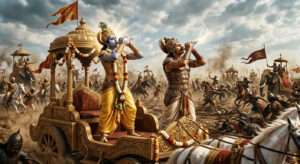
At the encampment of the Pandavas, the air itself seemed to quicken with life, stirred by the solemn pledge of Arjuna and the divine endorsement of Sri Krishna. The resonance of Arjuna’s Devadatta conch, joined with the taut, vibrant twang of the Gandiva, and magnified by the sacred Panchajanya of Krishna, rose like a celestial proclamation. It was not merely sound but spirit—an awakening call that invigorated the righteous and struck terror into the pride of the Kauravas. Then spoke Bhima, his voice deep with admiration and fire, declaring that such a vow, though stern and formidable, would uplift the hearts of the just while shattering the arrogance of their foes. He proclaimed that the reverberation of Panchajanya was itself an omen of victory, for its divine origin bore testimony to triumph over darkness.
He recounted how that very conch had once echoed even in the realm of death, when Krishna, in his devotion to his guru Sandeepani, descended to reclaim his son. At the sacred shore of Prabhasa, the Lord had encountered the demon Panchajana, who had devoured the boy. Slaying the demon with unerring force, Krishna drew forth the conch from its body; and sanctified by his touch, it became Panchajanya, endowed with divine potency. Its majestic sound now rolled across the battlefield, destined to erode the confidence of Duryodhana, just as Bhima had declared. Amidst this charged atmosphere, Arjuna’s mind, once clouded by grief and wrath, regained its clarity, steadied by the unity and encouragement surrounding him.
Sanjaya, narrating these events to Dhritarashtra, observed that the combined resonance of Panchajanya and Devadatta unsettled the Kuru forces, revealing how united resolve could shape destiny itself. Meanwhile, spies carried news of Arjuna’s terrible vow to Jayadratha, who was seized by dread. Restless and consumed by fear, his mind burned with anxiety as he hastened to Duryodhana’s court. There, before the assembly of mighty kings, he cast aside pride and composure, trembling openly as he questioned the justice of being singled out for destruction. He lamented that he had not alone offended Arjuna, and yet bore the burden of the warrior’s wrath. Overcome with despair, he even resolved to flee, caring not for dishonor if only his life might be preserved.
Jayadratha’s anguish deepened as he reflected upon the uncertainty of loyalty among warriors bound more by purpose than by affection. The power of his boon had waned, and with it his sense of worth; he feared that in the calculus of war, he might now be deemed expendable. His voice faltered, his limbs trembled like branches in a storm, and his thoughts surged like restless tides. Yet Duryodhana, ever skilled in persuasion, responded with calculated assurance. He praised the valor of his assembled champions—Ashwatthama for his fierce resolve, Krithavarma for his strength, Shakuni for his cunning, Somadatta for his nobility, and Shalya for his formidable prowess. Without issuing direct command, he subtly entrusted them with Jayadratha’s protection, weaving praise into responsibility. He assured the trembling king that he and his brothers would stand as an unyielding fortress, and that even the lord of the heavens could not breach their defense.
Reassured, though not entirely freed from fear, Jayadratha sought the counsel of Dronacharya. With humility, he inquired about his own skill in comparison to Arjuna’s. Drona, with measured honesty, replied that though both had been trained under him, Arjuna had surpassed all through relentless trials and discipline. Yet he also offered protection, declaring that as long as he lived, no harm would befall Jayadratha under the shelter of his arrows. He spoke further, not merely as a warrior but as a teacher of life, reminding him that death is inevitable for all beings, whether kings or commoners. Fear of death, he said, was unworthy of one who had studied the Vedas, performed sacrifices, and upheld royal duty. True fulfillment lay not in clinging to life, but in performing one’s duty without attachment to outcome.
Thus, in one breath, Drona imparted both assurance and truth—comforting the mind while strengthening the spirit. He urged Jayadratha to cast aside hesitation and embrace the path of a warrior, for those who meet death with courage attain realms reserved for the noble and the wise. These words, though stark, ignited within him a renewed resolve. The fear that had once paralyzed him now transformed into a determined readiness.
Soon, the air trembled once more with the clash of drums, the blare of conches, and the thunder of war instruments. Jayadratha, steadied by counsel and emboldened by the support of his allies, prepared himself for battle. Around him, the Kaurava forces shed their earlier despondency, rising with renewed vigor. Their cries of defiance answered the echoing calls of Devadatta and Panchajanya. Thus, both armies stood poised upon the brink of destiny—one inspired by divine assurance, the other hardened by resolve—each awaiting the inevitable storm of battle.

