


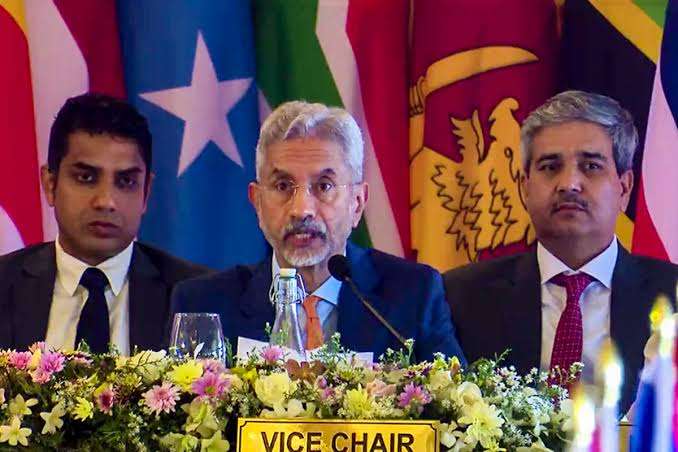
United Nations: India will ensure that issues such as free, open and rule-based maritime order, including safety of seafarers, and countering terror financing get the “attention they deserve” at the UN Security Council, External Affairs Minister S Jaishankar has said.
India launched its official campaign for a non-permanent seat on the UN Security Council (UNSC) for 2028-29 on Monday at an event at the world body’s headquarters, attended by UN ambassadors, diplomats and officials.
Jaishankar said that India’s approach to the UN is rooted in ‘SHANTI: Securing Holistic Advancement through Norms, Trust and Integrity’, as he outlined in detail New Delhi’s priorities for the UNSC term.
He said the safety of seafarers was “another major concern thrown up by developments in the Gulf”. Jaishankar said India had long been active in search and rescue missions, humanitarian assistance and disaster relief, and capacity building through the sharing of best practices. “We will endeavour to ensure that these issues get the attention they deserve in the Security Council,” he said.
Jaishankar said India makes regular and wide-ranging contributions in maritime security, including anti-piracy, counter-narcotics and anti-trafficking operations. “Our forces are protecting sea lanes across the Indo-Pacific, specifically in the northern and southern Arabian Sea, Gulf of Aden, Malacca Straits and even in the Gulf of Guinea,” he said. India’s emphasis on maritime security comes amid challenges from the US-Israel conflict against Iran, with closures and blockades in the Strait of Hormuz affecting fuel prices, supply chains and the safety of seafarers. Amid the West Asia conflict, 11 Indian nationals have lost their lives, and several seafarers have been rescued after ships and tankers came under attack.
On terrorism, Jaishankar said countering terror financing would be another major priority in India’s campaign. “Even as the world strives to sustain growth and promote prosperity, some long-standing challenges continue to confront us. Significant among them is terrorism,” he said. “For far too long, our efforts have concentrated on countering its symptoms, but that would only give us limited results unless we are focused on constricting its resource base. Our commitment is to concentrate on countering terror financing and encourage objective and evidence-based proposals for listing of terrorist groups,” he said.
Elections for the 2028-29 term will be held in June next year, with India and Tajikistan in the contest for the sole Asia-Pacific Group seat. India last served on the 15-nation Security Council in 2021-22. It has previously been a non-permanent member seven times before, in 1950-1951, 1967-1968, 1972-1973, 1977-1978, 1984-1985, 1991-1992 and 2011-2012.
A special video screened at the event highlighted India’s expanding role on the global stage and its priorities for the campaign. “For a world in disorder, one civilisation has always answered with a single word — Shanti (peace),” the video said, alongside footage of conflict and natural disasters and of India’s relief efforts. Jaishankar also said that with 4,300 personnel deployed across 10 of the 11 active UN peacekeeping missions, “few countries would have our experience in preparing peacekeeping to be future-ready”. On artificial intelligence, he said India has put forward a human-centric vision and remains committed to bridging the global digital divide. He added that in a world marked by conflict and tension, India has consistently backed dialogue and diplomacy, sought to bridge differences and find common ground, while focusing on reducing the impact of such developments on the Global South.
With its campaign now formally under way, India has set out a broad UNSC agenda centred on maritime security, terror financing, peacekeeping, artificial intelligence, multilateral reform and the concerns of the Global South.


