Upadhyayula Lakshman Rao
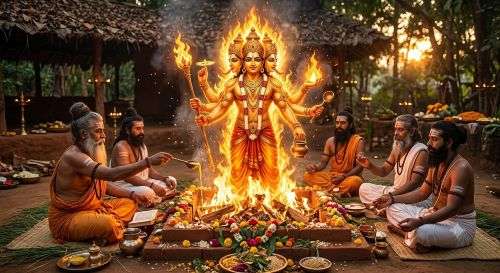
In the solemn cadence of Trishtup Chandas, as preserved within the sacred corpus of the Rigveda, the seer Agastya raises a profound invocation to the Visvedevas, the collective divinities who govern the manifold forces of existence. His prayer is not merely ritualistic utterance but a conscious alignment of human intention with cosmic order. He begins by invoking Agni and Savitr, beseeching them to enter the sanctified precincts of the yajña, accompanied by terrestrial and celestial powers. This act symbolizes the harmonization of elemental energies, where fire and solar radiance represent transformation and illumination, essential both in spiritual ascent and in the scientific understanding of energy as the basis of all processes.
The sage envisions the arrival of divine forces as an irresistible movement of youthful vitality, reflecting the perpetual dynamism inherent in nature. Just as all worlds are sustained by an unseen equilibrium, so too does he seek fulfillment and nourishment through divine grace. The invocation of Mitra, Varuna, and Aryaman embodies the principles of universal law, moral order, and social cohesion. These deities are not distant abstractions but representations of regulating forces, akin to the laws of physics that maintain balance within the cosmos. Their affection is sought not merely for protection but for the flourishing of life under the guidance of ṛta, the cosmic order.
Agni, revered as the foremost guest among the gods, is approached with reverence and intimacy. The sage identifies himself with the swiftness and brilliance of fire, symbolizing the human aspiration to mirror divine qualities. Through hymns, he seeks to satisfy Agni, who acts as the mediator between the visible and invisible realms. In scientific reflection, Agni represents the transformative principle of energy exchange, the very mechanism by which matter evolves and sustains life. The invocation thus bridges metaphysical devotion with an intuitive grasp of natural processes.
The grandeur of Varuna is extolled as both compassionate and formidable. He is portrayed as the guardian who restrains disorder and directs the forces of nature with precision. His roar against adversaries signifies the inevitable correction of imbalance, much like the self-regulating systems observed in ecological and physical sciences. Through Varuna’s grace, sustenance and completeness are assured, reflecting an ancient awareness that harmony with natural law yields abundance and continuity.
In a gesture of humility and cyclical awareness, the sage declares that offerings are made day and night, aligned with the rhythms of seasons. Just as a cow yields milk when approached with care, so too do the gods respond to sincere invocation. The mention of Ahirbudhnya, the “space-walker,” evokes the mysterious depths of cosmic and subaquatic realms, suggesting an early contemplation of hidden forces that sustain existence beyond immediate perception.
The hymn proceeds to invoke Tvastr, the divine artisan, whose presence signifies the principle of formation and structure. In the sacred space of yajña, he is invited to manifest harmony alongside the priests, symbolizing the union of creative intelligence and disciplined action. The call to Indra, the wielder of cosmic शक्ति and the vanquisher of chaos, reflects the aspiration for strength and victory over inner and outer adversities. The analogy of a cow nurturing its calf illustrates the intimate reciprocity between devotion and divine response, where sincere thought returns as a tangible blessing.
The Maruts are invoked as powerful, vibrant forces of nature, embodying both motion and stability. Their association with winds and rains highlights an acute observation of meteorological phenomena, where atmospheric dynamics bring fertility to the earth. The transformation of barren lands into fertile abundance through their action mirrors the scientific understanding of climatic cycles and ecological renewal.
The sage further calls upon Ashvins and Pushan for protection and sustenance, recognizing the interconnectedness of health, nourishment, and guidance. Vishnu, Vayu, and Indra are invoked collectively as embodiments of expansive, dynamic, and forceful energies that sustain life. These invocations reveal a holistic worldview where every aspect of existence is animated by a conscious principle, yet operates with an order that can be observed, studied, and understood.
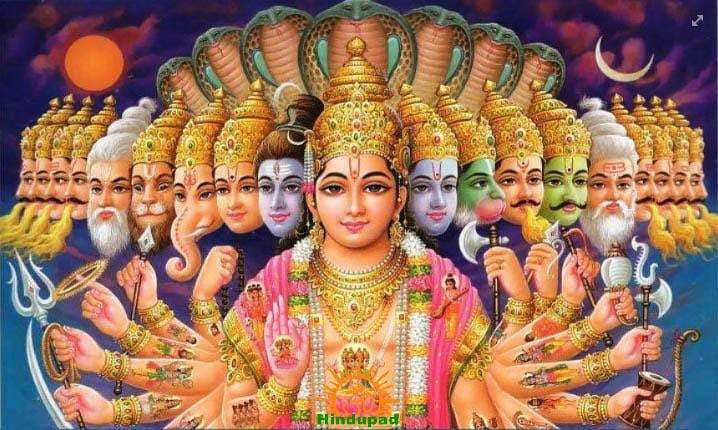
In the culmination of the hymn, the sage affirms that the collective spirit of the gods constitutes the very life force of humanity. The yajña becomes a symbolic convergence of matter, energy, and consciousness, where offerings transform into radiant forces that sustain both the divine and the human realms. The aspiration for food, strength, longevity, and dwelling is not merely material but reflects a deeper quest for harmony with the universal order. Thus, the hymn stands as a synthesis of spiritual insight and proto-scientific awareness, where devotion and observation unite to reveal the profound unity of existence.