


Vinay Rao
The IPL was never just a tournament. For a generation of players from second-tier cities and rural India, it opened a door that hadn’t existed before — a contest for eleven roster slots that grew into an economy of thousands, through state leagues and city leagues that became genuine pathways to the top. That was cricket’s real democratization.
Hyderabad, oddly, was left off that ladder for years. Its players waited. A city with one of the deepest cricketing pedigrees in the country had no league of its own to call a pathway. The wait lasted the better part of a decade — and when the change finally came, it didn’t come by choice. It came because it had to.
A reform forced by the court
The Telangana High Court stepped in to address the long-running dysfunction at the Hyderabad Cricket Association and, in May 2025, appointed Justice P. Naveen Rao (Retd.) as a Single Member Committee to oversee its functioning. It was not the mandate anyone expected to produce a T20 tournament — but that is what destiny had in store.
Justice Naveen Rao’s record made him an unusual fit for the job and an ideal one. His judicial career included modernising court infrastructure across Telangana and helping set up new courts after the state’s bifurcation — work serious enough that the Chief Justice of India publicly credited Telangana with becoming a lead state in judicial infrastructure, citing Justice Naveen Rao’s efforts by name, including the design of child-friendly courts in Warangal.
It followed, then, that his approach to HCA would be systemic rather than cosmetic. From the moment he took charge, a modern T20 tournament for the districts was the plan — not an afterthought, but the centrepiece. Alongside it came a deliberate effort to shed cricket’s old identity as a Hyderabad game and rebuild it as a Telangana one.

Resistance, and the team that stayed
The early moves met resistance. The appointments of Mr. Agam Rao as chairman and Mr. Sanjeev Reddy as convenor were contested. Justice Naveen Rao held his position, and the three worked through the friction to get the league off the ground. Momentum shifted decisively with the election of Mr. M. Jeevan Reddy as HCA Secretary — from there, the dream had a delivery mechanism, not just a vision.
The next test was commercial: could the tournament attract serious franchise money? It did. The credibility that Justice Naveen Rao’s presence lent to the process helped draw bids reported to be the second-highest among all state association leagues in the country — franchise bids alone crossed ₹46 crore, before sponsorship and other revenue lines are even counted — a signal that the market had taken TG20 seriously from day one. Behind that outcome was sustained groundwork: Mr. Bharani, as GM of Operations, put in relentless, largely unseen effort throughout to keep the tournament on track, while Mr. Ramakrishna Udupa worked the franchise side directly, making the case to prospective owners for why TG20 mattered. The arrival of Mr. Prasanna as CEO brought his BCCI and IPL-level expertise into the tournament, giving it systems and scale that put it in a class of its own among state leagues.
Grand by Design
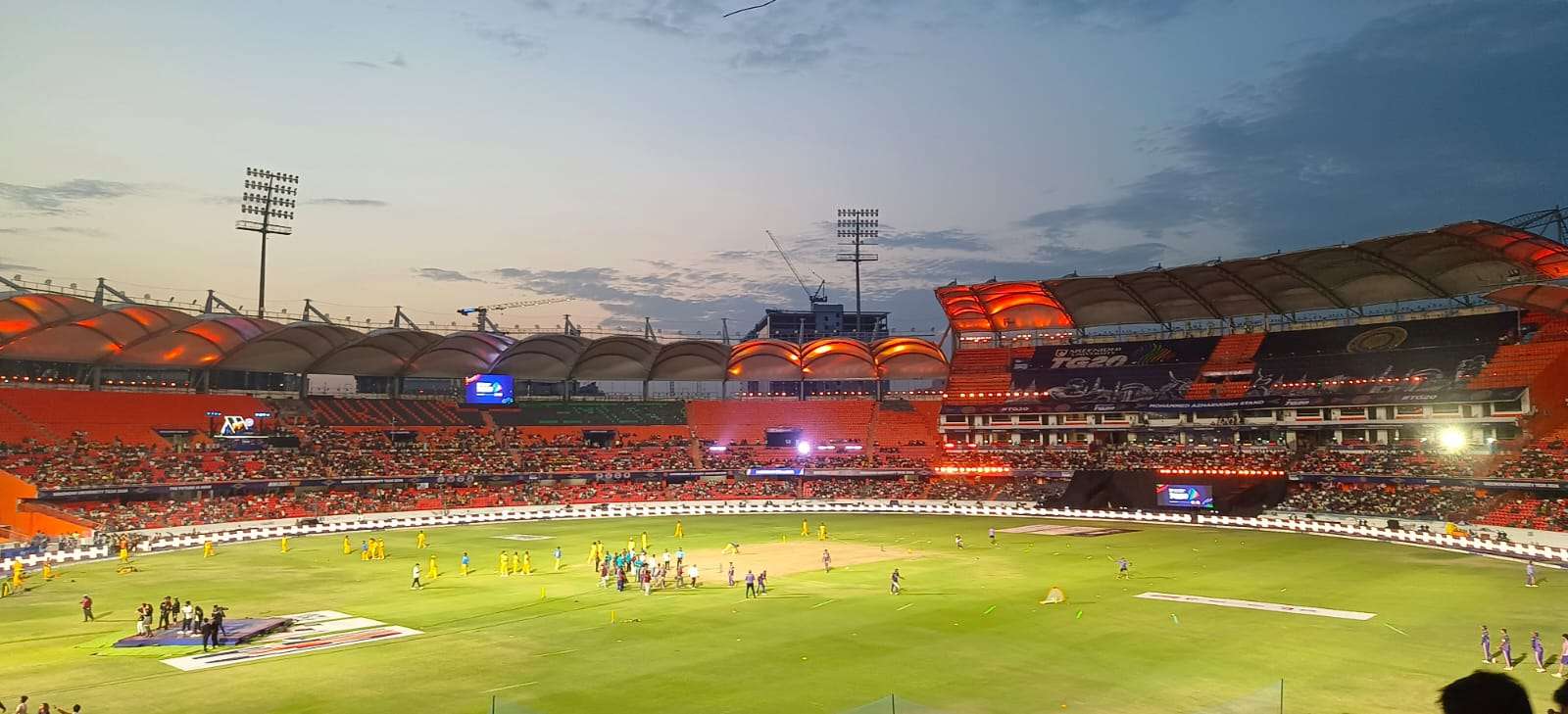
The tournament was launched in May 2026, with play getting underway in June and the final set for July 12. Every touchpoint along that timeline — the logo launch, the franchise bid process, the auction, the inauguration — was built to be an event in its own right, escalating day by day until the cricket itself had to match the occasion it had been given.

The most consequential decision, though, may be structural rather than ceremonial: districts have been woven into the tournament’s identity, with franchise names displayed prominently alongside them, and a rule mandating a minimum of four district players per squad and two in every playing XI. A related move — introducing two combined-district teams into HCA’s A Division league — is unprecedented for the association.
The criticism this has drawn is specific: that districts are being used as ornaments in a Hyderabad-centred story, wheeled out for optics while the substance of the reform serves HCA’s own image makeover rather than district cricket itself. It’s a fair question to ask of any reform that puts districts in the marketing before it puts them in the structure. But the mandated playing-XI quotas and the entry of combined-district sides into the A Division aren’t optics — they are hard structural commitments that outlast any single tournament’s branding, and they exist nowhere in HCA’s rulebook before this reform. Optics fade after the trophy is handed out; a playing-XI requirement doesn’t. Perceptions of a “perfect” cricket structure have never existed anywhere, but the distinction between a gesture and a rule is the one that matters here, and this was written as a rule.
The people behind the scenes
Tournaments this size run on people who rarely make the honour board. A few worth naming here: Manoj Malhotra, who coordinated budget approvals and the paperwork underpinning the SMC’s operations; Mahender Goud, who handled coordination with the secretaries, the awards presentation, and much else besides, and who is also credited with the idea of showcasing club-sector representation through the awards; Ubaid Khan and his team, who ran a broader backend support operation spanning creatives, ticket printing, and much else that kept the tournament’s day-to-day machinery running; Bhargava, ably assisted by Ayush, who absorbed relentless pressure on passes and ticketing; Raviteja and Brahmanandam, who kept franchise practice sessions running smoothly; Stephen and Sundar, who handled venue management, ground preparation, and match-day coordination; Garima, on hospitality; Ravi Reddy, who made sure schoolchildren got time out of class to watch matches live at the stadium; and the groundstaff, led by the man known across HCA simply as Chandu Sir — whose pitches held up match after match and turned the tournament into a genuine run-fest, the kind that gets the ball flying to the boundary. If names have been missed here, the omission is the author’s, not theirs — HCA would do well to issue a formal note recognising everyone who made this possible.
When HCA eventually puts up its honour board, the names of Justice Naveen Rao, Secretary Jeevan Reddy, Agam Rao, and Sanjeev Reddy belong at the top of it.
But the real test of this reform isn’t this season — it’s what survives beyond it. Committees change, office-bearers change, and HCA will one day be led by people who had no hand in building TG20. The appeal here is simple: whoever comes next should be judged by one standard — did they make it grander, more modern, and more reflective of the times than they found it. That standard should outlast any individual name on the honour board, including the ones on it today.
None of this happens, either, without institutional backing beyond the association itself — the sustained support of Commissioner of Police C.V. Anand and the Government of Telangana was foundational to getting this tournament to the ground.
(This is not an official HCA release. It reflects the author’s ringside view, assembled from information gathered across multiple sources.)



hoping to see the below boys in IPL
Tanmay Agarwal
Ved
Ganesh
Abhirat
C V Milind
Hima Teja