Pochiraju Raja Rao
Bharateeyan politics has never lacked strange alliances. Yesterday’s bitter rivals have often become today’s indispensable partners, only to part ways again when political convenience changes course. Yet, not every political realignment strengthens democracy or enhances a party’s credibility. Some alliances come at a price too high to justify the arithmetic.
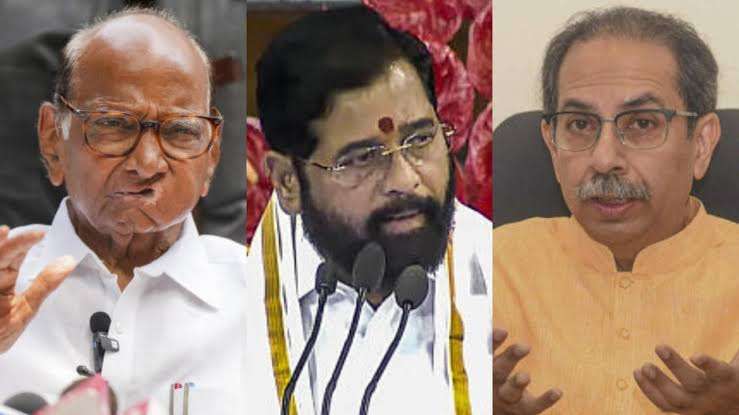
The latest political speculation emerging from Maharashtra—that rival factions of the Shiv Sena and the Nationalist Congress Party (NCP) could eventually reunite before finding a place within the BJP-led National Democratic Alliance (NDA)—belongs to precisely that category. Whether these reports have substance or are merely products of political gossip is beside the point. Even the possibility deserves serious reflection, particularly for the Bharatiya Janata Party, which has painstakingly cultivated the image of being a party guided by ideology rather than expediency.
The BJP would do well to resist any temptation to embrace such a move.
Defections are hardly new to Indian politics. Since Independence, political loyalty has increasingly become subordinate to personal ambition. Ideology, once the cornerstone of public life, has steadily given way to political opportunism. Public service has, in too many cases, been replaced by the pursuit of office, influence and personal enrichment. Maharashtra itself has witnessed some of the most dramatic examples of this trend.
Eknath Shinde’s rebellion against Uddhav Thackeray was justified by its supporters as a revolt against the latter’s departure from the ideological legacy of Balasaheb Thackeray. Balasaheb consistently projected the Shiv Sena as a staunch advocate of Hindutva and repeatedly ruled out any alliance with the Congress, which he regarded as fundamentally opposed to his ideological convictions.
Yet, after the 2019 Assembly elections, Uddhav Thackeray chose precisely that path. By joining hands with the Congress and the undivided NCP to form the Maha Vikas Aghadi government, he became Chief Minister but at the cost of abandoning the political legacy on which the Shiv Sena had built its identity. Many observers viewed the decision less as ideological evolution and more as a triumph of political ambition over principle.
Similarly, Ajit Pawar’s repeated political somersaults have come to symbolise the fluidity of contemporary Indian politics. His split from Sharad Pawar and subsequent alliance with the BJP-led government was widely interpreted as a move driven more by power calculations than ideological conviction.
Against this backdrop, any attempt to reunite these factions only to facilitate their eventual accommodation within the NDA would inevitably raise uncomfortable questions. More importantly, it could inflict lasting damage on the BJP itself.
For years, the BJP has distinguished itself as a “party with a difference,” claiming higher standards of political conduct, internal discipline and ideological commitment. While political compulsions have occasionally required strategic alliances, the party’s greatest strength has remained its credibility among supporters who believe it represents a principled alternative to conventional power politics.
That credibility has already come under increasing public scrutiny.
The Opposition has persistently attacked the BJP as a “washing machine” party, alleging that politicians facing corruption charges or criminal investigations suddenly find political rehabilitation after joining its ranks. Whether fair or unfair, that perception has gained traction in sections of public discourse. Every new induction of a controversial political figure reinforces that narrative and weakens the BJP’s moral authority to campaign against corruption and political dishonesty.
If leaders who spent years attacking the BJP, opposing its ideological positions and aligning with parties they once denounced are now welcomed back without accountability, ordinary party workers may legitimately wonder what value ideology truly holds. More importantly, voters who have repeatedly rewarded the BJP for standing firm on principles may begin questioning whether political convenience has overtaken conviction.
The BJP today enjoys a dominant national position not merely because of electoral arithmetic but because millions of supporters perceive it as a party anchored in a larger ideological mission. That perception is an invaluable political asset. It should not be sacrificed for short-term coalition management or marginal electoral gains in one state.
Political expansion is undoubtedly important, but expansion without discernment often weakens an organisation from within. Winning allies is desirable; importing credibility-deficit politicians is not. The BJP must remember that public trust, once compromised, is extraordinarily difficult to rebuild.
Maharashtra’s evolving political landscape will continue to throw up surprises. However, prudence demands that the BJP draw a clear red line. Not every political merger deserves encouragement, and not every former adversary deserves rehabilitation.
For a party that aspires to shape India’s political future on the foundations of nationalism, good governance and integrity, preserving credibility must always outweigh the temptation of political convenience. That is a lesson the BJP can ill afford to ignore.